
Aspirin Paste: What the Chemistry and Case Reports Actually Show
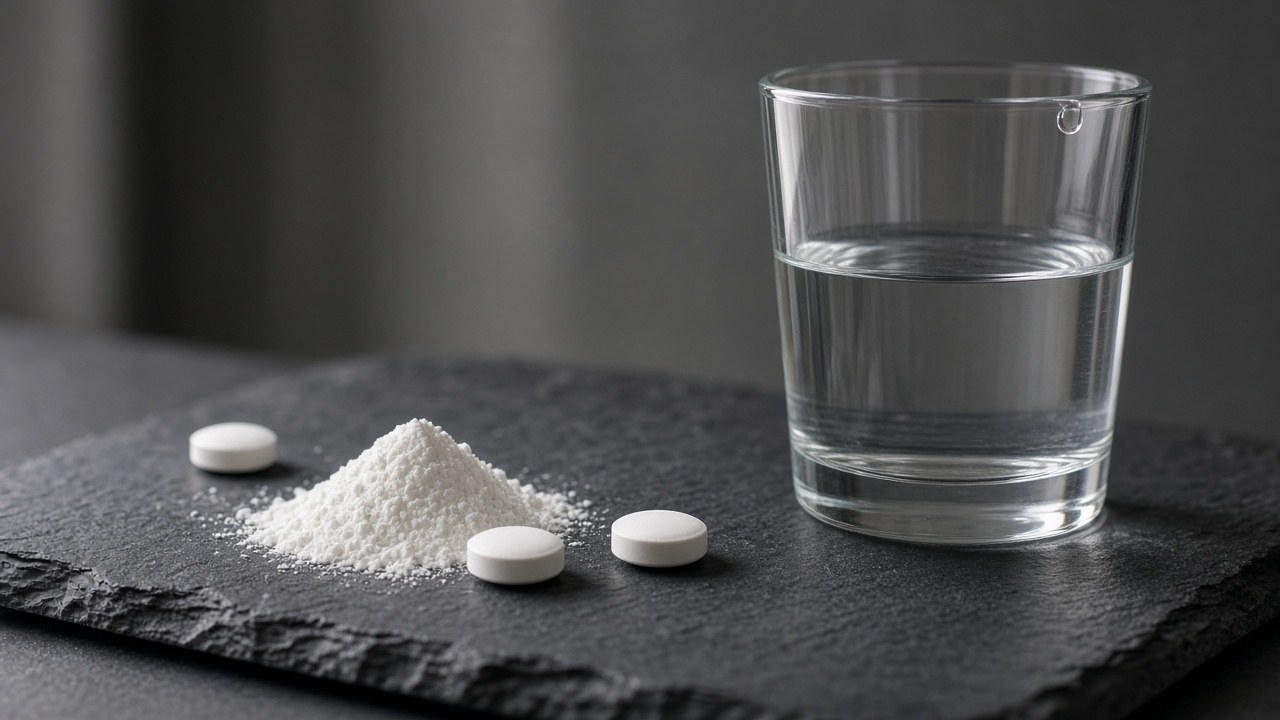
The folk remedy behind searches for aspirin paste is a crushed aspirin tablet, moistened and held against a sore tooth or a bee sting. It sounds reasonable, since aspirin is a painkiller, so why not put it right where it hurts? The chemistry of aspirin and the published case reports tell a different story. This article is about that evidence. It is not a how-to and not medical advice.
What aspirin is, chemically
Aspirin is acetylsalicylic acid. PubChem gives its IUPAC name as 2-acetyloxybenzoic acid and its molar mass as 180.16 g/mol. It’s an ester made by acetylating salicylic acid. We cover that reaction step by step in the salicylic acid and acetic anhydride reaction, so it isn’t repeated here.
Two properties matter for a paste.
It’s an acid. The Hazardous Substances Data Bank, via PubChem, lists a pKa of 3.49 at 25 °C. That makes it a noticeably stronger acid than acetic acid. It isn’t very soluble: PubChem’s HSDB entry gives 4,600 mg/L in water at 25 °C. As a rough illustration (my own calculation, ignoring activity effects), a saturated solution at that strength would have a pH of about 2.6. A paste, being mostly undissolved solid, would be expected to keep that acidic film topped up for as long as it stays in place (an inference from the solubility figure, not a measured value).
It falls apart in water. HSDB describes aspirin as “stable in dry air; in moist air it is gradually hydrolyzed into salicylic and acetic acids.” In solution, it is most stable at pH 2–3, less stable at pH 4–8, and least stable below 2 or above 8. In a saturated aqueous solution at pH 5–7, “aspirin is almost completely hydrolyzed within 1 week at 25 °C.” That’s why a lab checks a product for leftover or regenerated salicylic acid using the colour reaction in the salicylic acid iron(III) chloride test. A similar ester hydrolysis, run deliberately on methyl salicylate, is the first step in Odinity’s Bengay into aspirin lab.
How aspirin works, and why that matters for the myth
The pain relief people expect comes from biochemistry, not acidity. PubChem’s mechanism notes (from HSDB) say aspirin “acetylates prostaglandin endoperoxide synthase … and irreversibly inhibits its cyclooxygenase (COX) activity.” That enzyme makes prostaglandins, which help sensitize pain receptors. HSDB adds that salicylates produce analgesia partly through a peripheral action and partly a central one, “possibly in the hypothalamus,” and that “the peripheral action may predominate.”
Here is where the myth slips in. “Peripheral” refers to where in the body the drug acts. It does not mean the drug works best when packed onto a surface. None of the sources read for this article tested whether aspirin held against a tooth relieves dental pain. What they do document is what the acid does to the tissue it touches.
Illustration evoking aspirin breaking down in moisture (artist’s impression).
Aspirin paste on teeth and gums: what case reports show
Dentists have a name for the result: an “aspirin burn.” Three published reports illustrate it.
A 2020 case in the Saudi Endodontic Journal. Hussam Alfawaz described a 55-year-old woman who had placed aspirin “near a painful tooth and around the buccal vestibule for 2 consecutive days.” At her visit she had “a grayish-white fibrin-coated ulcer” on the inside of her cheek, extending into the folds of the gum. The report’s explanation is chemical: aspirin, “which is acidic and a proton donor, causes epithelial necrosis, erosion, and chemical burn through its protein coagulation effects.” The cause of the toothache was deep decay, and it needed dental treatment. After she stopped putting aspirin in her mouth, the lesion “healed entirely without scarring” within two weeks.
A 2018 case in the Journal of Dental Specialities. Amita Poswal and colleagues reported a 35-year-old woman who placed aspirin powder under her tongue for a toothache. She developed sloughing of the tissue on the underside of the tongue, about 3 × 4 cm, with whitish slough on the cheek lining. The authors note that the damage depends on the caustic nature of the agent, the quantity, and the duration of exposure. They add that most chemical burns of this kind heal within 7 to 14 days without scarring.
A 1989 case in the Journal of the American Dental Association. F. S. Maron described a mucosal burn in a 4-year-old who had been given chewable aspirin at bedtime and “fell asleep before swallowing them.” That injury was accidental rather than a deliberate home remedy. It shows that the same chemistry applies whenever tablets sit against the lining of the mouth.
The pattern across the reports is consistent. The white patch is dead surface tissue, not a cure working. The toothache usually has its own cause, such as decay, that the paste can’t touch.
Aspirin paste on skin: the bee sting trial
The skin version has been tested more directly. For about two decades, the New South Wales Poisons Information Centre in Australia had advised callers to put aspirin paste on bee and wasp stings. In 2003, Corrine Balit, Geoffrey Isbister and Nicholas Buckley reported a randomized controlled trial of that advice in the Journal of Toxicology: Clinical Toxicology. Their abstract notes that the centre had recommended it “since the early 1980s.” Anecdotes suggested it worked, “but a literature search found no evidence to support this.”
Callers who had been stung were randomly assigned, 2:1, to advice to use an ice pack plus aspirin paste, or an ice pack alone. The results:
- Swelling: no swelling at 12 hours in 57% of the aspirin group vs 74% with ice alone (p = 0.26).
- Pain: no pain at 12 hours in 81% vs 95% (p = 0.34).
- Redness: median duration 6 hours with aspirin vs 2 hours with ice alone (p = 0.04).
The authors concluded that topical aspirin paste “was not effective in reducing the duration of swelling or pain” and “significantly increased the duration of redness,” while symptoms “rapidly subsided with ice alone.”
Limits of the evidence
This is thin evidence, and it should be read that way.
- Case reports can’t give a rate. They show that aspirin burns happen and what they look like, but not how often. The Saudi Endodontic Journal report itself says oral chemical burns are “described only as case reports” and that there is “a lack of information on the epidemiology.”
- Case reports select dramatic outcomes. People who used a paste with no visible harm don’t end up in journals. That cuts both ways: it also means there’s no published record of the paste helping.
- The sting trial was small. It had 56 people (37 and 19). Its confidence intervals were wide: the swelling difference ran from −47% to +12%. That can’t rule out a small benefit, although the trend went the wrong way.
- The trial tested advice, not supervised application. Initial follow-up was within 24–48 hours, so what people actually applied wasn’t observed. I read the trial’s full abstract, not the full paper, so details of blinding and how outcomes were scored aren’t covered here.
- Stings aren’t teeth. The trial doesn’t test oral use, and the oral case reports don’t test pain relief. The two strands answer different questions.
What’s settled and what’s a rule of thumb
Settled chemistry:
- Aspirin is acetylsalicylic acid, a weak acid with a pKa near 3.5.
- Moisture hydrolyzes it to salicylic and acetic acids.
- Its pain-relieving action runs through inhibition of COX enzymes.
Well documented, but only as case reports: placing aspirin against the lining of the mouth can cause a chemical burn that shows up as a white, sloughing ulcer.
Tested once, in a small trial: aspirin paste on bee and wasp stings didn’t beat ice and lengthened redness.
Folk belief without support in these sources: that putting aspirin where it hurts works better than the way the drug is meant to be used.
Hazard data: in company reports to the European Chemicals Agency that PubChem aggregates (315 reports), acetylsalicylic acid is classified as H302, harmful if swallowed (95.6%); H319, causes serious eye irritation (22.2%); H315, causes skin irritation (20.6%); and H335, may cause respiratory irritation (20%).