
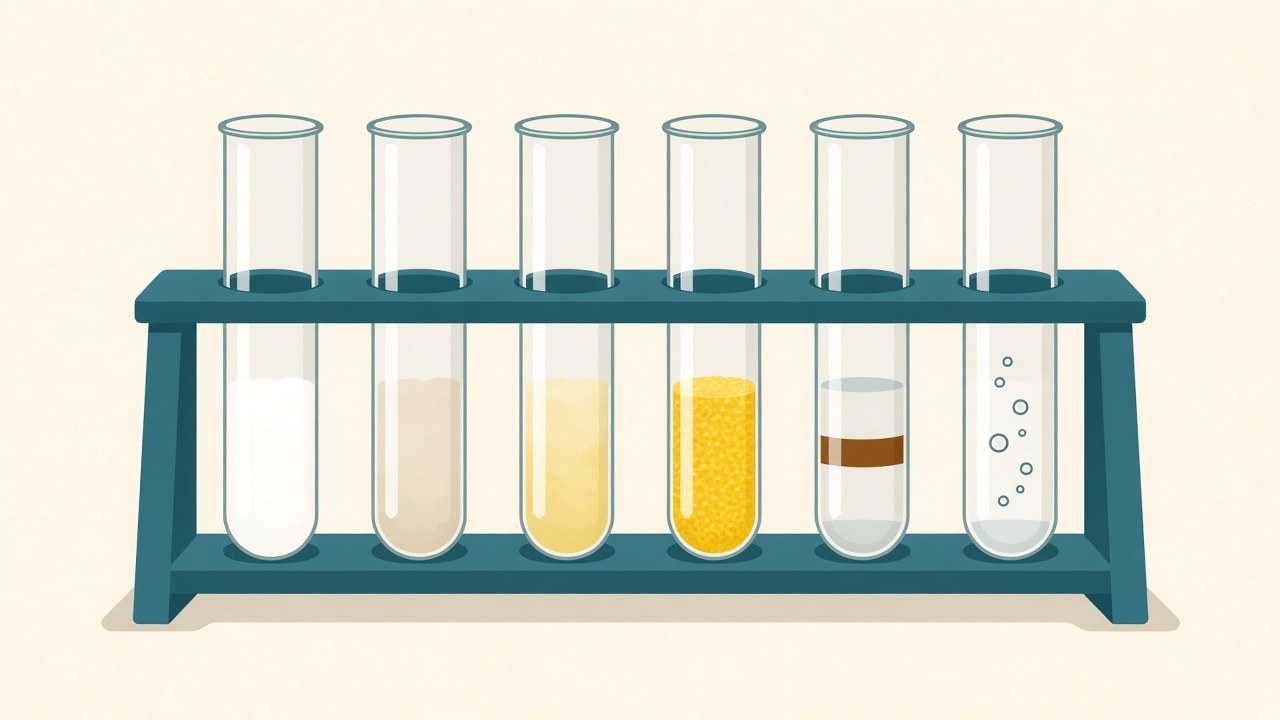
Anion Analysis: How Classic Lab Tests Identify Common Anions
Hand a chemistry student a white powder and ask what’s in it, and half the job is finding the anion: the negatively charged part of the salt. Is it a carbonate, a chloride, a sulfate? Classic anion analysis answers that with a handful of reagents and a careful eye for fizzing, cloudiness and colour. The order of the tests matters almost as much as the tests.
The three signals: gas, precipitate, colour
Most anion tests rely on one of three observations. A gas comes off when acid is added. A solid (a precipitate) forms when a metal ion is added. Or a colour appears when the anion is oxidised, reduced or complexed.
Precipitate tests lean on solubility rules. A De Anza College lab manual summarises the ones that matter here:
- Nitrates are always soluble.
- Chlorides, bromides and iodides are soluble unless the cation is silver, lead(II), copper(I) or mercury(I).
- Sulfates are soluble except with calcium, barium, strontium, silver and lead(II).
- Carbonates and phosphates are insoluble except with Group 1 cations and ammonium.
Gas tests lean on acid strength. The Wired Chemist lab tutorial notes that compounds containing anions that are conjugate bases of weak acids generally react with nitric acid. Carbonate gives off carbon dioxide; a metal sulfide gives off hydrogen sulfide, though the same tutorial notes that oxidising acids such as nitric acid can also oxidise sulfide to elemental sulfur, which is why its sulfide test uses hydrochloric acid.
Carbonate and sulfide: the gas tests
Carbonate (CO32−). Add acid and carbonate fizzes as carbon dioxide escapes: CO32− + 2H+ → CO2 + H2O. To confirm the gas is CO2, the Wired Chemist procedure bubbles it through barium hydroxide solution, where it forms a white precipitate of barium carbonate. Odinity’s carbonate alkalinity lab shows the quantitative side of the same acid–base chemistry, titrating natural waters with sulfuric acid.
Sulfide (S2−). With non-oxidising acids such as hydrochloric acid, sulfides release hydrogen sulfide, the gas known for its rotten-egg smell. The more reliable signal is a strip of filter paper moistened with lead acetate. The Wired Chemist tutorial describes a gas that turns lead acetate paper black as a positive test, because black lead sulfide forms on the paper. Very insoluble sulfides may need concentrated acid.
Silver nitrate and the three halides
Chloride, bromide and iodide all form insoluble silver salts. A LibreTexts page by Jim Clark lists the colours: silver chloride is white, silver bromide very pale cream, and silver iodide very pale yellow. It admits the last two “can only be differentiated in a side-by-side comparison.”
Ammonia sorts them out. Silver chloride dissolves in dilute ammonia. Silver bromide barely changes in dilute ammonia but dissolves in concentrated ammonia. Silver iodide doesn’t dissolve in ammonia of any concentration.
The reason is the solubility product (Ksp). Ammonia ties up silver ions as the diamminesilver(I) complex, [Ag(NH3)2]+, which lowers the free silver concentration. That’s enough to dissolve silver chloride (Ksp 1.8 × 10⁻¹⁰), but not silver iodide (8.3 × 10⁻¹⁷). The De Anza manual turns this into a confirmation for chloride. Dissolve the white precipitate in ammonia, then acidify with nitric acid. If the white solid comes back, chloride is confirmed.
Bromide and iodide can also be told apart by oxidising them to the free halogens. Wired Chemist uses chlorine water and an organic solvent layer, which turns orange-brown for bromine and purple for iodine.
Quantitative versions of the silver reaction are standard lab work. See Odinity’s chloride determination by Fajans titration and gravimetry, with a dichlorofluorescein endpoint, and a wastewater chloride and nitrate lab that titrates with silver nitrate to a chromate endpoint.
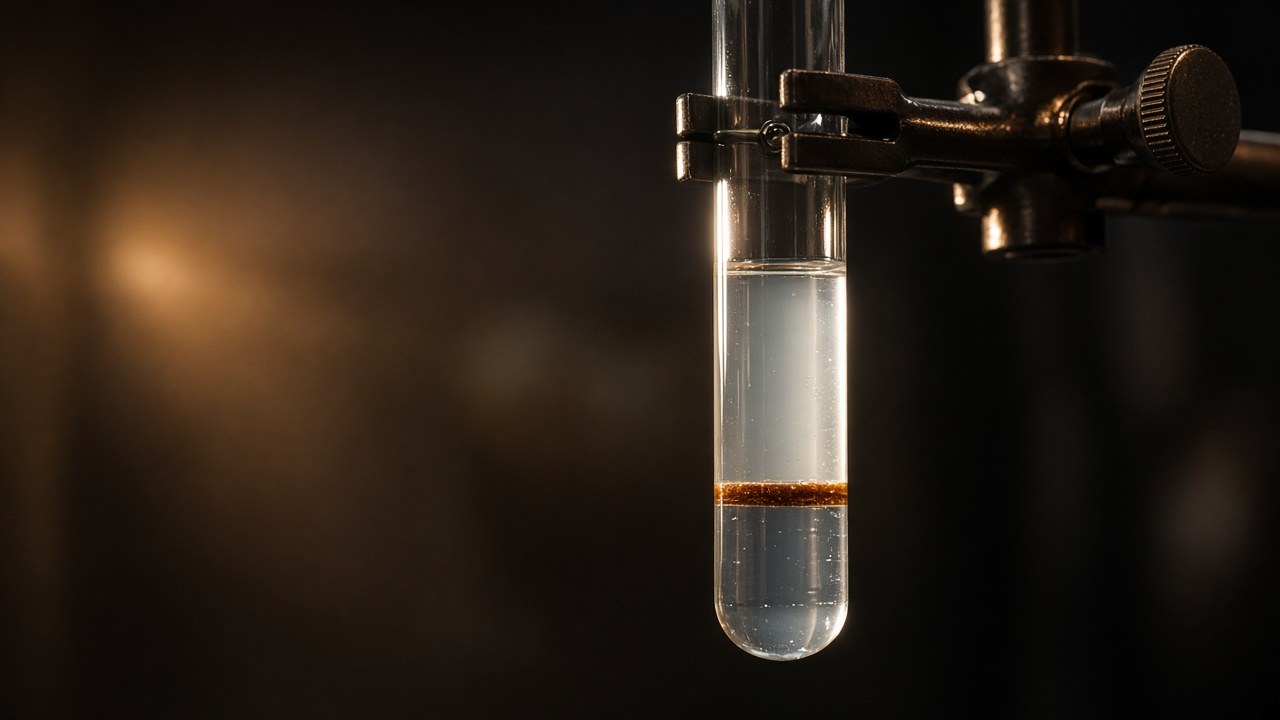
Illustration of a brown ring forming between two layers in a test tube (artist’s impression).
Sulfate and the barium chloride test
Barium sulfate is the classic white precipitate. The trick is to acidify first. Wired Chemist explains that barium also forms insoluble salts with the anions of weak acids, such as carbonate, sulfite and phosphate, and that acidifying the solution prevents those from precipitating.
De Anza puts it in terms of acid strength: sulfate is the conjugate base of a strong acid, so barium sulfate stays solid in strong acid while barium phosphate dissolves. De Anza still warns that phosphate may also precipitate under these conditions, so its own test has to be run as a check.
Phosphate’s yellow precipitate
Phosphate is identified with ammonium molybdate in nitric acid, usually warmed. The product is a yellow crystalline precipitate, ammonium phosphomolybdate, (NH4)3[P(Mo12O40)]. According to De Anza, other anions may also precipitate with the reagent, but those solids are white. So the colour, not just the presence of a solid, is the result.
Molybdate chemistry also underlies quantitative phosphate work. In Odinity’s phosphates in water lab, a combined molybdate, antimony tartrate and ascorbic acid reagent is added, and absorbance at 880 nm is read against a calibration curve.
Nitrate: the brown ring
Nitrate is the awkward one. Since nitrates are always soluble, there’s no precipitate to look for. The Odinity student writing up a qualitative analysis of anions lab picked nitrate as the hardest to detect for exactly that reason: it showed little reaction in the screening tests.
The classic answer is the brown ring test. Iron(II) sulfate is added to the acidified sample. Then concentrated sulfuric acid is run gently down the side of a tilted tube so it forms a separate layer underneath. Nitrate oxidises Fe2+ and is itself reduced to nitric oxide (NO). The NO binds excess Fe2+ as the brown complex [Fe(NO)]2+, which shows as a ring at the boundary between the layers.
A Santa Monica College experiment on LibreTexts uses a different route. Aluminium in sodium hydroxide reduces nitrate to ammonia, which turns moist red litmus blue above the tube.
Why anion analysis runs in sequence
Few of these tests are unique to one anion, so the order is what makes them trustworthy. The De Anza flowchart runs like this:
- Add nitric acid. Effervescence flags carbonate.
- Add silver nitrate to the acidified solution. A precipitate means a halide, sorted out with ammonia and oxidation.
- If silver gave no precipitate, test the remaining candidates. Barium chloride in acid confirms sulfate, ammonium molybdate confirms phosphate, and the brown ring confirms nitrate.
Two kinds of interference drive that design.
- Removing interfering ions. The LibreTexts halide page says the nitric acid added before silver nitrate “reacts with, and removes, other ions that might also form precipitates with silver nitrate.” Wired Chemist names carbonate, sulfide and phosphate among the silver salts that acid destroys.
- Clearing a sample before testing. The Santa Monica College spot tests skip a fixed sequence and test each anion on a fresh portion. Where one ion interferes, they remove it first. Thiocyanate, which also gives a white silver precipitate, is destroyed by boiling with nitric acid before the chloride test.
The Odinity anion lab followed the same logic: screening tests with sulfuric acid, silver nitrate, barium and calcium chloride, and permanganate, then a confirmation test for each anion.
How ion chromatography compares
Environmental and drinking-water labs now commonly measure anions instrumentally. The US EPA’s Method 300.0 covers fluoride, chloride, nitrite, bromide, nitrate, orthophosphate and sulfate by ion chromatography in its Part A, with bromate, chlorite and chlorate in a separate Part B. A small sample is injected, and the anions are separated on a guard column and an analytical column. They then pass through a suppressor and are measured by a conductivity detector. Each anion is identified by its retention time against standards.
The method’s detection limits in reagent water run from 0.002 mg/L for nitrate-nitrogen to 0.02 mg/L for chloride and sulfate. That’s far beyond what a cloudy test tube can show, and one run handles all seven anions at once.
It has interferences of its own. EPA notes that anions with similar retention times can overlap, and that a large amount of one anion can interfere with the resolution of a neighbouring peak. Carbonate and small organic anions can co-elute near fluoride. Carbonate and sulfide aren’t on the method’s list at all, and the standard eluent is itself a sodium carbonate–bicarbonate solution. So instruments don’t remove the need for chemical judgement; they move it.
A note on reagent safety
PubChem’s aggregated GHS data list silver nitrate as an oxidizer that causes severe skin burns and eye damage (H272, H314) and is very toxic to aquatic life. The same database lists sulfuric acid and nitric acid, used in the brown ring and acidification steps, as causing severe skin burns and eye damage (H314), with nitric acid also an oxidizer (H272). Hydrogen sulfide, released in the sulfide test, is listed as an extremely flammable gas that is fatal if inhaled (H220, H330), so gas-releasing steps belong in a fume hood.
What’s settled, and what’s a rule of thumb
The chemistry behind each test is well settled. Silver halides follow their solubility products, barium sulfate survives strong acid, phosphomolybdate is yellow, and iron(II) and nitric oxide form the brown complex.
What’s softer is the reading. Pale cream versus pale yellow is a judgement call, and silver halides darken in light. A faint brown ring or a weak fizz in a dilute sample can be missed. That’s why lab manuals run known controls beside the unknown. The rule of thumb is to treat one positive test as a lead and a confirmed sequence as an answer. When concentration matters, use a quantitative method, such as a titration or an instrument.