
How the Copper in Brass Shapes Its Colour, Strength and Machining
A brass doorknob, a trumpet and a plumbing valve can look like the same golden metal, but they aren’t the same recipe. Brass is copper with zinc mixed in, and the amount of copper in brass decides a surprising amount: whether it glows reddish or pale yellow, whether it bends cold or cracks, and how cleanly it cuts on a lathe. Chemists have reliable ways to measure that copper share, and the methods are a tidy tour of analytical chemistry.
What brass is
Brass is an alloy made mainly of copper and zinc. Odinity’s determination of copper and lead in brass lab describes it that way and notes why it’s so widely used. It has a gold-like colour, suits musical instruments and is a common plumbing material. An engineering-materials lecture from the New Jersey Institute of Technology (NJIT) puts it simply: zinc is the most common addition to copper, and that alloy is known as brass.
The recipe can vary a lot. An analytical chemistry procedure from California State University, Dominguez Hills, published on LibreTexts, notes that brass formulations may contain up to 39% zinc, 2.5% tin and 8.5% lead. Copper makes up most of the rest. In the Odinity lab, atomic absorption spectroscopy put the copper in one unknown sample at about 77.9%.
How the copper share changes colour
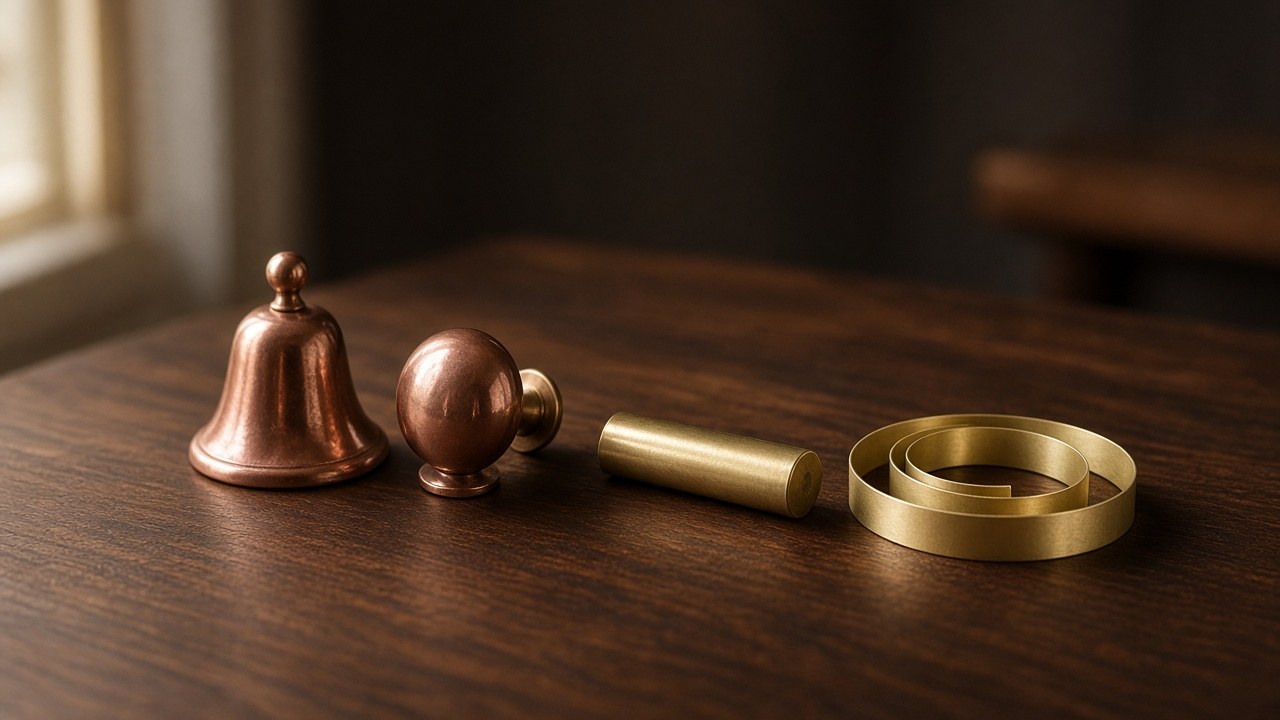
Pure copper is reddish. Researchers at the University of Newcastle and the University of Technology Sydney describe brass colours running “from the red of copper through to bright yellow to grey-silver” as the zinc content rises. Their study links the shift to the alloy’s electronic structure: adding zinc pushes the onset of light absorption to higher energy. At lower zinc contents, brass keeps copper’s crystal structure, the face-centred cubic arrangement known as the alpha phase. The study puts that range at below about 30 atomic percent zinc, while a standard phase-diagram reference from ASM International gives the alpha limit as about 32.5% to 39% zinc, depending on temperature. Across that range the hue moves from copper red towards bright yellow.
So a high-copper brass looks warmer and redder, and a lower-copper one looks yellower. This is a useful rule of thumb, but colour alone is a poor way to read composition. Surface tarnish, other alloying elements and the way the metal was finished all change what the eye sees.
How it changes strength and workability
The bigger story is crystal structure. A 2022 review of machinable brasses in the journal Metals, by researchers at the University of Sheffield, the University of Ioannina and Greece’s ELKEME metals research centre, lays out the two main phases.
- Alpha (α): a copper-based solid solution with a face-centred cubic structure. It’s softer and more ductile.
- Beta (β): an ordered copper-zinc intermetallic with a body-centred cubic structure. It’s harder but less ductile.
Once zinc goes past the alpha limit, lower-copper brasses contain more beta, although heat treatment and processing also shift the balance. The review compares two leaded brasses. One with about 35% beta was stronger and harder but stretched less before breaking than a nearly all-alpha alloy. The NJIT lecture adds that alpha brasses are ductile and formable, and that within this group strength and ductility both increase with zinc content.
In Odinity’s annealing lab, brass samples heated to 800 °C and cooled slowly in the oven lost about 40% of their measured hardness. The literature value the student compared it with was 32%. The same alloy can be hard or soft depending on how it was processed.
Zinc content also affects how brass ages. The NJIT lecture warns that brasses with 20 to 36% zinc may suffer dezincification in acidic or salty solutions. That’s corrosion that leaches out the zinc. The Metals review describes it as most prominent between 15 and 30% zinc, leaving a porous, copper-rich layer that shows up as red patches. The two sources draw the range slightly differently.
Why some brasses contain lead
Machinists want brass that breaks into short chips instead of long, tangled ribbons. That’s the main reason small amounts of lead are added. According to the Metals review, lead sits in brass as tiny separate globules, collecting mainly at the boundaries between the alpha and beta grains. Because lead solidifies at a low temperature, it also fills micropores that form during casting, which helps make castings pressure-tight.
When a cutting tool passes through, the lead particles act as stress concentrators and lubricant. They help the metal break into small, discontinuous chips and reduce tool wear. Finer lead particles, below about 5 micrometres, work better than coarse ones.
Copper share matters here too. The review notes that a two-phase alpha-beta brass breaks chips better than a pure alpha alloy, and that more beta and finer alpha grains create more boundary sites where lead can sit.
Lead in plumbing brass is also regulated. The U.S. Environmental Protection Agency explains that Section 1417 of the Safe Drinking Water Act defines “lead free” as a weighted average of 0.25% lead across the wetted surfaces of pipes, pipe fittings, plumbing fittings and fixtures, and 0.2% for solder and flux. When Congress first set the definition in 1986, pipes could contain up to 8% lead. The Reduction of Lead in Drinking Water Act of 2011 cut that to the 0.25% weighted average. The EPA adds that since September 1, 2023, manufacturers and importers of regulated plumbing products must have “lead free” certification. The Metals review concludes that most newly designed lead-free compositions still machine only moderately well compared with leaded ones, although standard lead-free brasses given a special heat treatment machined about as well as leaded brass.
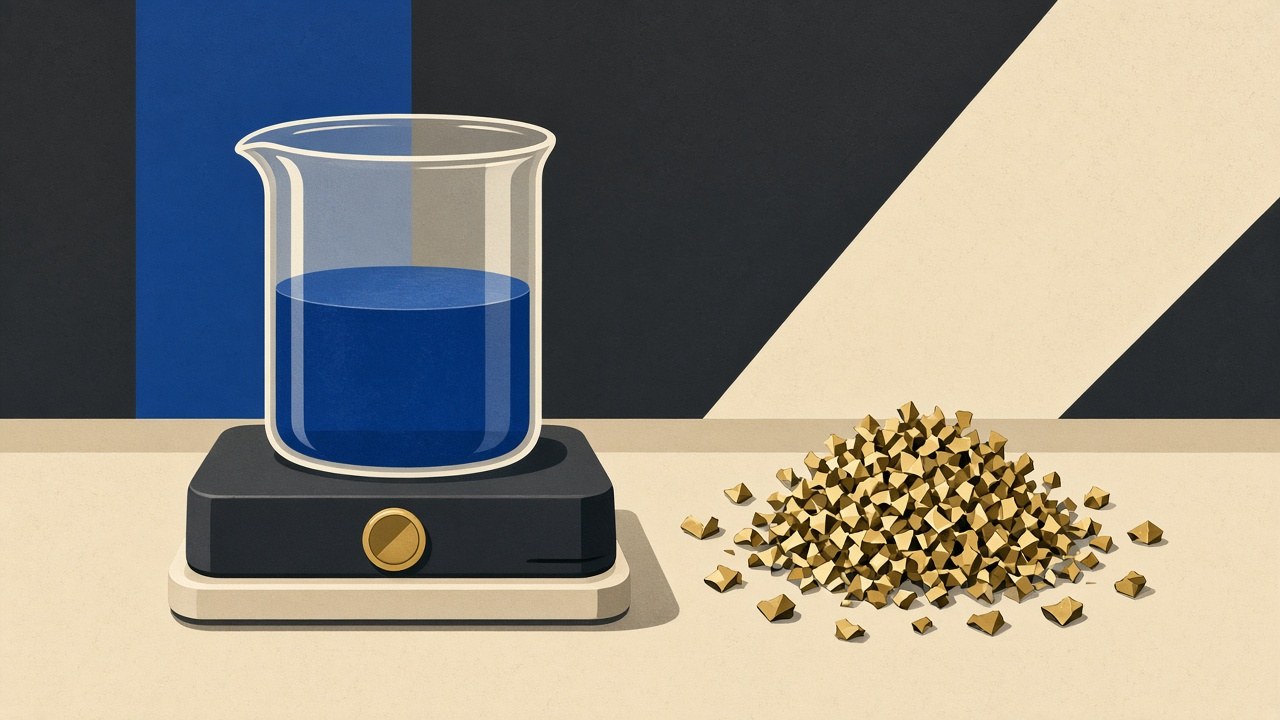
Illustration of brass pieces beside a deep-blue copper solution in a beaker (artist’s impression).
How labs measure copper in brass
Almost every method starts the same way: dissolve the metal in nitric acid. The Odinity brass lab gives the reaction for copper: 3Cu + 8HNO3 → 3Cu(NO3)2 + 2NO + 4H2O. Zinc and lead dissolve too. Once the sample is a solution, there are several ways to count the copper.
Iodometric titration
This is the classic wet-chemistry route. The CSU Dominguez Hills procedure explains the key reaction: in slightly acidic solution, copper(II) ions oxidise iodide to iodine and drop out as solid copper(I) iodide (2Cu2+ + 4I− → 2CuI + I2). The iodine released is then titrated with standard sodium thiosulfate, using starch as the indicator. Each copper ion accounts for a fixed amount of iodine, so the volume of thiosulfate gives the copper.
Several details keep it honest:
- Leftover nitrate also oxidises iodide, so the procedure fumes the sample with sulfuric acid until all the nitric acid is gone. This is done in a fume hood, and the procedure warns that the sulfur trioxide fumes are dangerous and must not be inhaled.
- Iron(III) would also release iodine. Phosphoric acid locks it into a complex that doesn’t react.
- Some iodine sticks to the CuI solid. Adding thiocyanate near the end frees it, giving a sharp change to a white or cream end point.
- The procedure notes that dissolved zinc and lead don’t interfere, because iodide can’t reduce them under these conditions.
Odinity’s determination of copper in pennies lab uses the same chemistry on coins. The student standardised the thiosulfate against pure copper dissolved in nitric acid, and used urea to remove nitrogen oxides.
Spectrophotometry
Copper(II) forms a deep-blue complex with ammonia, Cu(NH3)42+. A University of Louisiana Monroe chemistry manual, written for copper solutions in general, explains that the complex absorbs strongly from 550 to 650 nm, with a maximum near 610 nm. The CSU Dominguez Hills procedure shows the same dark-blue complex forming when dissolved brass is made alkaline with ammonia. It forms properly only in excess ammonia, so the manual adds plenty to every standard and sample. Measure a series of known copper standards, plot absorbance against concentration (Beer’s law), and read the unknown off the line.
Atomic absorption and other instruments
The Odinity brass lab tried four methods on one sample: HPLC, flame atomic absorption spectroscopy (AAS), gravimetric analysis of lead as lead sulfate, and anodic stripping voltammetry. The HPLC data were unusable because the column was contaminated with algae and couldn’t be used. Voltammetry gave a copper value with a confidence range far too wide to use. AAS gave the tightest results: 77.91% copper and 7.54% lead.
The gravimetric method gave 15.68% lead, which the student flagged as implausibly high. It’s a good reminder that two careful methods on the same sample can disagree.
What is settled and what varies
Brass is mainly copper and zinc. As zinc replaces copper, the colour moves from red towards yellow and the structure shifts from ductile alpha towards harder beta. Lead, when present, sits as separate particles that make the metal easier to machine. Dissolving brass in nitric acid and measuring the copper by titration, colour or atomic absorption are well-established methods.
Plenty of the rest is rule of thumb. Colour is a rough guide to composition, not a measurement. Phase boundaries and corrosion ranges are quoted slightly differently from source to source. Heat treatment and processing change hardness too, not just composition. And lead-free brasses are still an active research area, with most new alloy designs still machining less well than leaded brass. If you want to know the copper share in a particular piece of brass, the only real answer is to measure it.