

Benzoic Acid Melting Point and What It Says About Purity
A pinch of white crystals can’t talk. It can tell you, though, roughly how clean it is, and all you need to do is warm it up slowly and watch the exact moment it turns to liquid. The benzoic acid melting point is one of the classic examples chemistry students use to learn this trick: pure benzoic acid melts at about 122 °C, and a contaminated sample gives itself away by melting lower and over a wider span of temperatures.
That sounds like a small thing. It’s actually one of the oldest and cheapest purity checks in the chemistry lab, and it rests on some surprisingly deep physics about disorder.
Why a melting point is a fingerprint, with a caveat
A compound’s melting point is a physical constant, so it can be used to support the identity of an unknown solid. Chemists compare the temperature they measure with the “literature value” listed in reference sources. (If you want the basic difference between melting and boiling first, Odinity has a primer on melting point and boiling point.)
Here’s the caveat: a melting point supports an identification, but it doesn’t prove one. As the organic lab textbook by Lisa Nichols at Butte College points out, millions of solid organic compounds exist, most of them melt below 250 °C, and two different compounds can easily share the same melting point. So a melting point is one piece of evidence, best combined with others.
What is the benzoic acid melting point, exactly?
It depends on who you ask and how they measured it, which turns out to be a useful lesson in itself.
- The NIST Chemistry WebBook lists a fusion (melting) temperature of 395.2 ± 0.7 K, which is about 122.0 °C. That figure is an average of 18 of the 20 published values NIST collected.
- The same NIST page lists benzoic acid’s triple point, the single temperature where solid, liquid and vapor coexist, at 395.52 K (about 122.4 °C). Several independent studies agree on it to within hundredths of a kelvin, and NIST’s evaluators mark it as recommended for use as a calibration standard.
- In a teaching lab, a sample of pure benzoic acid measured on an ordinary MelTemp apparatus gave a range of 120–122 °C, according to the Nichols textbook.
These numbers don’t really conflict. They come from different methods: a careful thermodynamic average, a precisely defined triple point, and a quick student measurement with a basic heating block. If your recrystallized benzoic acid melts at about 120–122 °C, you’re in the right neighborhood. If it starts melting at 110 °C, something else is in there.
Why impurities lower and widen the melting range
Settled science says impurities do two things to a melting point: they lower it and they broaden it. The reason has to do with entropy, a measure of disorder.
Melting happens at the temperature where the solid and liquid are in balance. Breaking the attractions between molecules costs about the same energy whether the sample is pure or not. What changes is the gain in disorder. A pure solid and an impure solid are both fairly orderly, but an impure liquid is a messier mixture than a pure one. So melting an impure solid gives a bigger jump in entropy, and a bigger entropy jump means melting happens at a lower temperature. It’s the same effect chemists call freezing point depression, just viewed from the other direction.
The broadening comes from how an impure solid actually melts. Up close it’s patchy, with pockets of each component scattered through it like the grains in granite. When it’s heated, melting starts in tiny pools at the lowest possible temperature for that mixture, called the eutectic temperature. Those pools dissolve more of the impurity, and melting slowly creeps upward as the liquid gets richer in the main compound. Your eye doesn’t catch the first drop until roughly 10–20% of the sample has already melted, according to the Nichols text. The more impurity there is, the earlier in this process that first visible drop shows up, and the wider the recorded range.
What contamination looks like in real numbers
The Nichols textbook includes a neat experiment: benzoic acid deliberately spiked with known amounts of another compound, acetanilide, measured on a MelTemp.
- Pure benzoic acid: 120–122 °C
- 5 mol% acetanilide: 114–121 °C
- 10 mol% acetanilide: 109–120 °C
- 15 mol% acetanilide: 105–117 °C
- 20 mol% acetanilide: 94–116 °C
Look at what happens. At 20% contamination, the start of melting drops by 26 degrees and the range stretches from 2 degrees wide to 22. In photos of the samples heated side by side in the Nichols text, both impure samples finished melting before the pure one even began.
Odinity’s archive has student lab work on this exact effect, including measuring melting points of compounds and mixtures and a lab on eutectic mixtures.
The sharp-melting trap and the mixed melting point
A narrow range, under about 2 °C, is generally taken as a sign of purity. But there’s a catch. If an impure sample happens to sit close to its eutectic composition, nearly all of it melts at one temperature, and it can give a deceptively sharp melting point even though it’s far from pure.
The clever workaround is the mixed melting point. You grind your unknown together with a known sample of the compound you think it is, in roughly equal amounts, and melt the blend. If they’re the same substance, nothing has really been mixed, so the melting point stays sharp and close to the literature value. If they’re different, you’ve just made a 50/50 mixture, and its melting point drops and spreads out. The Nichols text says this lets you “almost certainly” identify an unknown, which is about as strong a claim as a simple test gets.
How labs actually measure it
The standard method is low-tech and works well. According to the Nichols procedure:
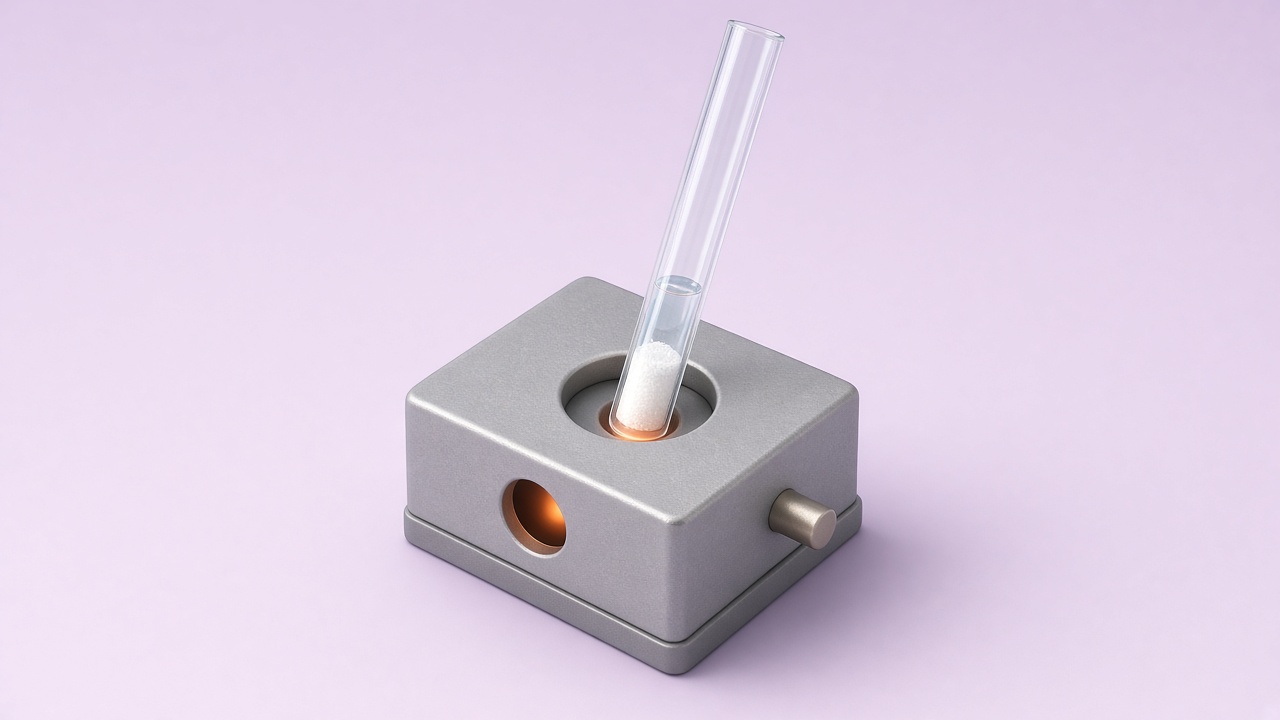
- Pack a small amount of dry, finely crushed sample into a thin glass capillary tube sealed at one end, to a height of about 2–3 mm.
- Slide the tube into a heated metal block such as a MelTemp, and heat at a medium rate until you’re about 20 °C below the expected melting point.
- Then slow down a lot, to no more than 1 °C every 30 seconds, so the sample and the thermometer stay at the same temperature.
- Record two temperatures: when the first droplet appears, and when the whole sample has turned from opaque to clear.
Lab manuals don’t all agree on the details. MIT’s lab techniques video slows to 1–2 °C per minute within 20 °C of the expected value, close to Nichols’ maximum of 1 °C every 30 seconds. But it recommends a shallower sample, about 1 mm of packed solid, and warns that going past 2 mm can cause errors from uneven heating. Nichols says 2–3 mm and no more than 3 mm, because a taller sample gives an artificially broad range. Both agree on the key point, though: you have to heat slowly near the melting point so the sample and the thermometer stay at the same temperature. Otherwise the reading stops being a true measure of the sample’s temperature. MIT’s guide also warns that large crystals leave air pockets that heat unevenly, so they should be crushed first.
These are lab procedures: wear eye protection, and remember that the heating block and the hot water used for recrystallization can cause burns.
Recrystallization: how chemists get benzoic acid clean
The usual way to purify benzoic acid is to recrystallize it from water. The idea is simple: pick a solvent that dissolves your compound poorly when cold but well when hot. Benzoic acid fits the bill. Reference values cluster around 3 g per liter near room temperature (PubChem lists 3.4–3.5 g/L at 25 °C and about 3 g/L at 20 °C). One encyclopedia entry in PubChem gives 0.29 g/L at 20 °C, which is likely a unit slip for 0.29 g per 100 mL. Hot water is a different story. Seidell’s classic solubility tables list about 0.35 g per 100 g of water at 25 °C, but roughly 5.9 g per 100 g at 100 °C, so boiling water dissolves more than ten times as much.
You dissolve the impure solid in hot water, filter it while hot if there’s any undissolved gunk, then let it cool slowly. The LibreTexts recrystallization guide explains that slow, undisturbed cooling grows larger, purer crystals, while cooling it too fast can give a fine precipitate instead. An ice bath at the end gets more crystals out, and vacuum filtration collects them. Then comes the payoff: take a melting point and compare it with the literature value. You can see the whole process in Odinity’s lab reports on extracting benzoic acid and purifying an unknown solid by recrystallization.
Some benzoic acid always stays dissolved in the leftover water, so recovery is never 100%. At room temperature (25 °C), 100 mL of water holds about a third of a gram. Chilling it in an ice bath lowers that, but doesn’t eliminate it. That’s why recipes call for the smallest amount of hot water that will dissolve the solid.
What a melting point can and can’t tell you
The settled part: impurities lower and broaden melting ranges, and pure benzoic acid melts at about 122 °C. That’s reliable textbook thermodynamics, backed by decades of measurements.
The limits are just as important:
- It’s a rough purity check, not an exact assay. The Nichols text calls it “a rough measure of purity.” A good melting point doesn’t tell you how much of an impurity is present, or what it is.
- Eutectic mixtures can fool you by melting sharply, which is why the mixed melting point exists.
- Your number depends on your method. Heating rate, how well the sample is packed, and whether the thermometer is calibrated can each shift a reading by a degree or two. That explains much of the gap between a student’s 120–122 °C and NIST’s 122.0 °C.
- Coincidences happen. Other compounds can melt near 122 °C, so a match supports an identity rather than proving it.
Still, few experiments give you so much for so little: a capillary tube, a heater, a few minutes, and a white powder tells you how pure it is.