
How Gas Chromatography Works: Carrier Gas, Column and Detector
Inject a diluted sample of gasoline into a gas chromatograph, and the trace shows at least 50 separate peaks. This guide explains how gas chromatography works as an instrument: a stream of inert carrier gas, a long, thin column inside an oven, and a detector at the far end that notices each compound as it comes out. Once you know what each part does, any GC trace becomes much easier to read.
The four parts of a gas chromatograph
David Harvey’s Analytical Chemistry 2.1 (on LibreTexts) lists the essential components:
- a supply of compressed gas for the mobile phase
- a heated injector that “rapidly volatilizes the components in a liquid sample”
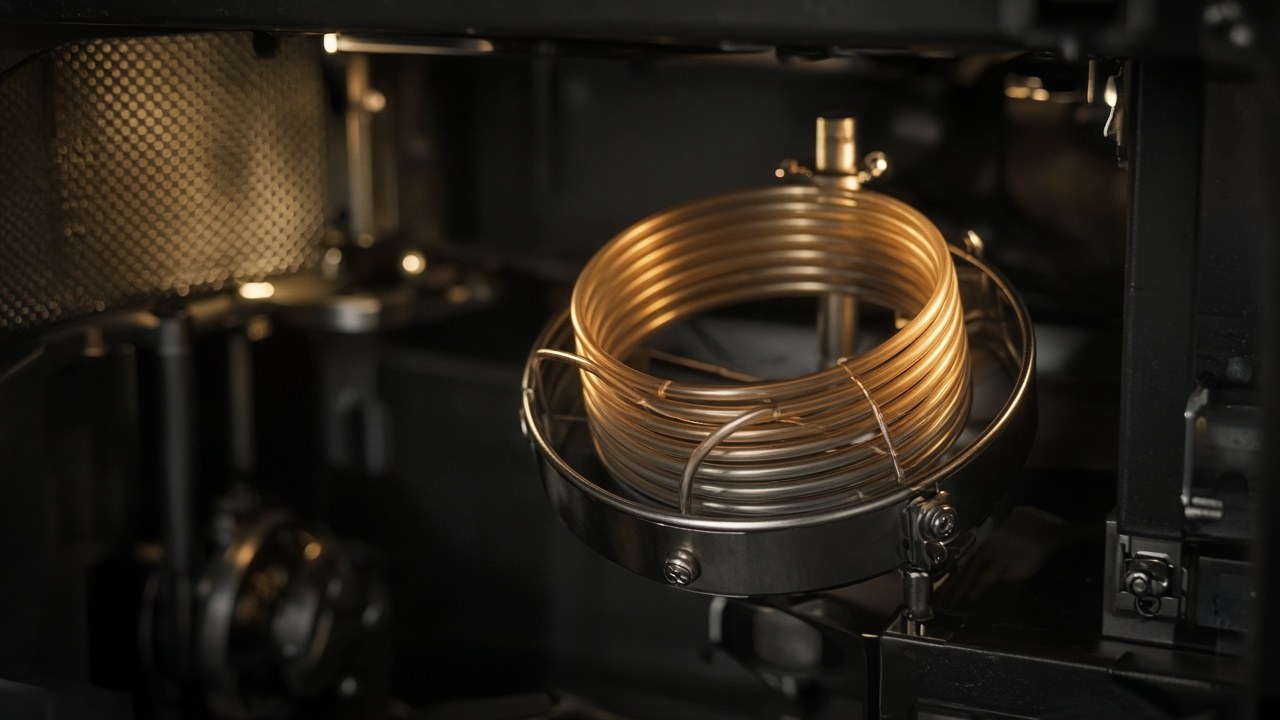
- a column inside an oven whose temperature can be controlled
- a detector
Each part has a specific job, and each one sets limits on what the instrument can do.
Carrier gas: the mobile phase
The carrier gas does the moving. Harvey names helium, argon and nitrogen as the most common choices. All three have the advantage of being chemically inert toward both the sample and the column. The choice “often is determined by the needs of [the] instrument’s detector.” Lisa Nichols’ Organic Chemistry Lab Techniques (Butte College, also on LibreTexts) notes that it is usually helium.
Flow rates are small. Harvey gives typical flows of 25–150 mL/min for a packed column and 1–25 mL/min for a capillary column.
The column: where separation happens
There are two broad kinds of column. Harvey sums up the trade-off: a packed column “can handle larger samples,” and a capillary column “can separate more complex mixtures.”
- Packed columns are tubes of glass, stainless steel, copper or aluminum, typically 2–6 m long and 2–4 mm wide inside, filled with a coated particulate support.
- Capillary columns are fused-silica tubes 15–100 m long, with an internal diameter of about 150–300 μm. Their inner wall carries a very thin film of stationary phase. Harvey’s example column is 30 m long with a 0.25 μm coating. Nichols notes that 30 m is the common length.
The difference in performance is large. Harvey’s example packed column has about 3,600 theoretical plates, a measure of separating power, while his example capillary column has about 129,000.
The stationary phase is usually a high-boiling polymer. Polydimethyl siloxane, Harvey writes, is nonpolar and “often makes a good first choice for a new separation.” Replacing some of its methyl groups with other groups makes it more polar. Polyethylene glycol, sold as Carbowax, is a polar phase.
How gas chromatography works inside the column
Every molecule in the column switches back and forth between two states. Either it clings to the stationary-phase coating, or it is in the carrier gas being swept downstream. Nichols explains that a compound moves into the gas only when heat from the oven gives it enough energy to overcome its attraction to the coating. It travels a little way, sticks again, and keeps “bouncing from one position to the next until they exit the column.”
Her key point is that every compound covers the same distance in the same gas, so all of them spend the same time in the mobile phase. Separation therefore comes entirely from how long each compound spends stuck to the stationary phase. Weakly held compounds come out early, and strongly held ones linger.
The time from injection to detection is the retention time. It plays the same role as Rf in thin-layer chromatography, but it is far more reproducible. Nichols notes that retention times typically vary by no more than 0.01 minute between identical runs. The logic is the same as in Odinity’s explainer on why nonpolar compounds travel farther in TLC, except that a gas does the moving and heat decides when a compound lets go.
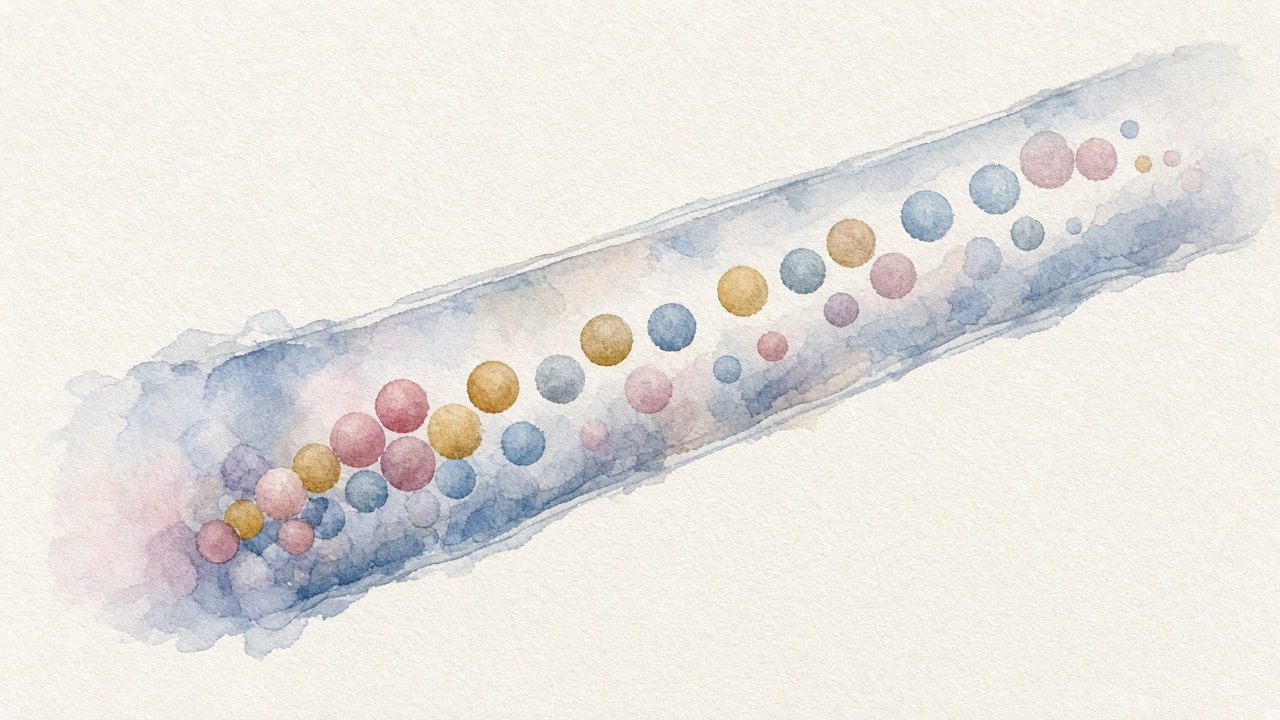
Illustration evoking compounds spreading apart as they travel through a column (artist’s impression).
What sets the order: boiling point, polarity and temperature
The forces that hold a compound to the coating tend to be the same ones that hold it in its own liquid. That, Nichols explains, is why boiling point is such a good predictor of elution order: lower-boiling compounds usually come out first. Harvey says the same for polydimethyl siloxane columns. Boiling points play a similar role in Odinity’s guide to simple vs fractional distillation.
Polarity takes over when boiling points are close. Harvey puts it directly: if two compounds have similar boiling points, “a separation is possible only if the stationary phase selectively interacts with one of the solutes.” His general rule is that nonpolar compounds separate more easily on nonpolar phases, and polar compounds on polar ones.
Temperature is the main control the operator has. A hotter oven brings everything out sooner. Harvey notes that in an isothermal run, at one constant temperature, the oven is usually set slightly below the boiling point of the lowest-boiling compound. Many methods instead use a temperature “ramp,” heating the oven steadily during the run. Nichols writes that a ramp lets compounds elute faster and sharpens their peaks, and that the best ramp “often takes experimentation to achieve.”
Detectors: FID, TCD and MS
Flame ionization detector (FID). The gas leaving the column is mixed with hydrogen and burned in air. Harvey explains that burning organic compounds produces electrons and cations. With about 300 volts across the flame, these carry a tiny current of roughly 10−9 to 10−12 amps, which is then amplified. Most carbon atoms produce a signal, except those in carbonyl and carboxylic groups, so the FID is “an almost universal detector for organic compounds.” It doesn’t detect water or CO2. Its detection limit is about two to three orders of magnitude better than a TCD’s, but it destroys the sample.
Thermal conductivity detector (TCD). The gas flows over a heated tungsten-rhenium filament, and the filament’s electrical resistance depends on its temperature. When a compound elutes, the gas conducts heat differently, so the filament’s temperature and resistance change. A reference cell fed with carrier gas that bypasses the column corrects for drift. Helium is the carrier of choice here because of its high thermal conductivity. Harvey calls the TCD universal and non-destructive, so analytes can be recovered afterward.
Mass spectrometer (MS). Molecules leaving the column are ionized and broken into fragments, which are sorted by mass-to-charge ratio. Because the spectrum is recorded continuously, it can be checked at any retention time, which adds identification to separation. Harvey gives typical detection limits of 25 fg to 100 pg. Nichols adds that GC-MS methods often use a “solvent delay,” which keeps the detector off while the large solvent peak passes.
What the trace tells you
A chromatogram plots detector signal against time, and each peak carries two pieces of information.
- Position (retention time) suggests identity. Without an MS, identity is checked by running a pure standard under identical conditions.
- Size suggests amount. Harvey states that “the area under the peak is proportional to the amount of analyte injected.” Nichols stresses that area, not height, is what counts: “A tall, narrow peak may have a smaller area than a short, wide one.”
Detectors don’t respond equally to every compound, so raw peak percentages can mislead. Calibration curves or response factors correct for this. For high accuracy and precision, Harvey recommends an internal standard, a known amount of a second compound added to every sample. A single peak isn’t proof of a single compound either: two compounds can come out together, and some may elute before data collection starts or stay on the column.
See it in real lab reports
Odinity’s student lab reports show these principles at work:
- Separating and identifying alcohols by GC tests stationary phases and temperatures to find the conditions that best separate four alcohols.
- Measuring the percent alcohol in two mouthwashes by GC sets out to measure the alcohol in Listerine against ethanol standards and to confirm that Crest Pro Health contains none.
- Identifying orange oil in a hexane unknown measures d-limonene using anisole as an internal standard.
Limits: volatility and heat
GC only works for compounds that can become gases. Harvey is blunt: a sample’s constituents “must be sufficiently volatile.” A low-volatility compound may linger and show up in later runs, and a nonvolatile one “will condense at the top of the column,” degrading its performance. Nichols adds that ionic solids should never be run.
Heat is the other limit. For samples that decompose easily, Harvey notes, an on-column injection without a heated injector may be necessary. The stationary phase has temperature limits too. All liquid phases tend to “bleed” from the column when heated, and the limits in his table keep that loss small.
What’s settled and what’s a rule of thumb
Settled:
- Separation comes from differences in time spent in the stationary phase, because every compound spends the same time in the gas.
- Peak area is proportional to the amount injected, but detector response differs from compound to compound.
- FID, TCD and MS detectors differ in what they see, how little they can detect, and whether they destroy the sample.
Rules of thumb:
- Elution follows boiling point. This works well on nonpolar columns, but polarity can override it when boiling points are close.
- Like separates like: polar phases for polar compounds, nonpolar phases for nonpolar ones.
- Method details such as column, ramp and dilution are usually found by experiment.