
Why Nonpolar Compounds Travel Farther in TLC
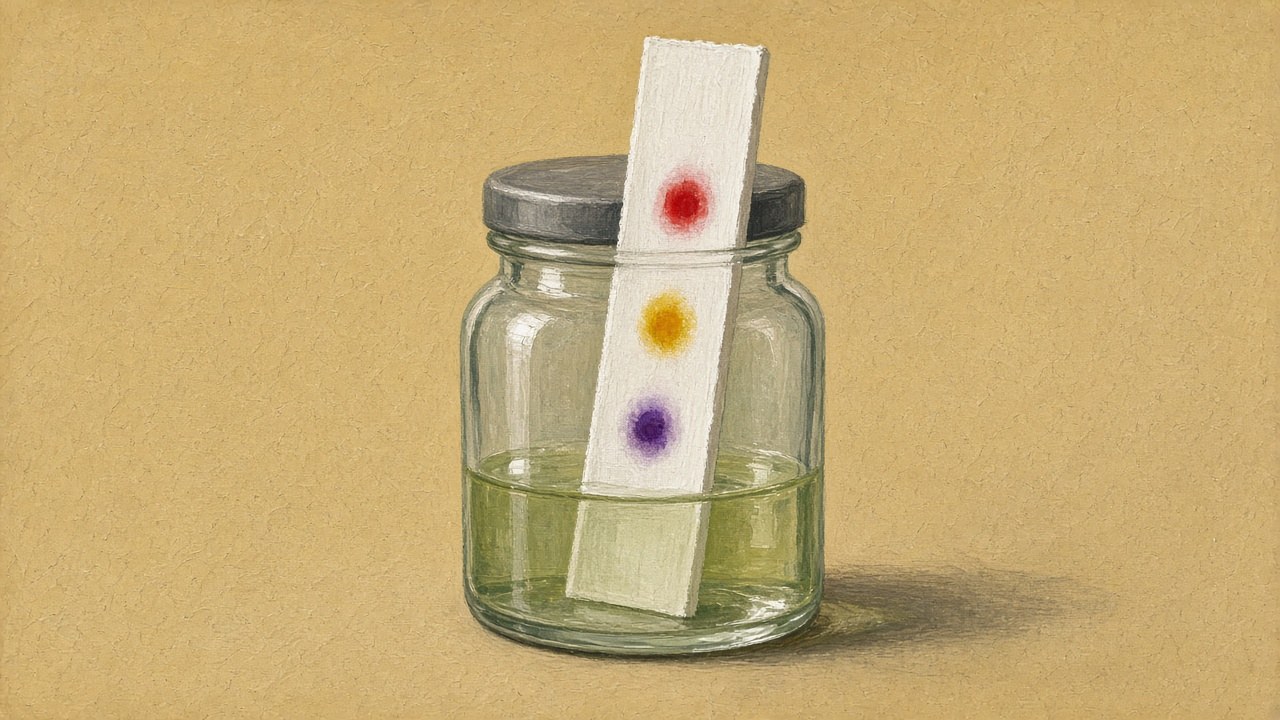
Spot a mixture on a strip of silica, stand it in a little solvent, and within minutes the components have spread out into a ladder of spots. The greasy, nonpolar ones nearly keep pace with the solvent, while the polar ones lag near the start. The reason why nonpolar compounds travel farther in TLC (thin layer chromatography) comes down to a tug-of-war between a polar surface and a much less polar liquid. Once that’s clear, most of the practical rules for running a plate follow from it.
Two phases and one equilibrium
Every TLC plate has a stationary phase and a mobile phase. In Lisa Nichols’ Organic Chemistry Lab Techniques (on LibreTexts), the stationary phase is almost always a silica or alumina adsorbent. The mobile phase is an organic solvent or solvent mixture, called the eluent, that rises up the plate by capillary action. A compound on the plate is constantly moving back and forth between being adsorbed on the solid and dissolved in the liquid. It only moves up the plate during the time it spends in the liquid.
Silica gel is a network of silicon–oxygen bonds with O–H groups on its surface and a layer of water molecules. Nichols calls it a “very polar stationary phase.” Pairing it with a relatively nonpolar eluent is what’s known as normal-phase TLC, which Nichols calls the most common form of TLC. Reverse-phase plates flip the arrangement, with a nonpolar surface and a polar solvent.
The distance a compound moves is reported as its retention factor, Rf. That’s the distance the spot travelled divided by the distance the solvent front travelled, both measured from the starting line. An Rf of 0.55 means the spot went 55% as far as the solvent.
Why nonpolar compounds travel farther in TLC
Nichols gives two reasons, and they push in the same direction.
The stationary phase holds polar compounds back. Compounds with oxygen or nitrogen atoms can hydrogen bond to the silica surface. They spend more of the run stuck to the plate than similar-sized compounds that interact only through weak London dispersion forces. Less time in the mobile phase means less distance travelled and a lower Rf.
The mobile phase favours nonpolar compounds. In normal-phase TLC the eluent is always less polar than the silica. On the “like dissolves like” principle, nonpolar compounds dissolve better in it and spend more time moving.
Nichols illustrates this with three related compounds run in 6:1 hexanes:ethyl acetate. Ethylbenzene, which “is completely nonpolar,” ran highest. Benzaldehyde came next, and benzyl alcohol ran lowest. Benzyl alcohol’s OH group can form more hydrogen bonds to silica than benzaldehyde’s carbonyl oxygen, so it sticks harder.
Size matters too. Benzophenone runs slightly higher than acetophenone even though both are ketones. Nichols offers two possible explanations: the oxygen in benzophenone is more crowded, or its extra nonpolar bulk helps it dissolve in the eluent.
Odinity’s thin layer and column chromatography lab sums up the same idea in a student’s words. The most polar compounds “are attracted most to the polar silica gel on the TLC plate, giving them the smallest Rf values, while the least polar compounds in a mixture have the largest Rf values.”
How solvent polarity shifts Rf
Because the eluent is half of the equilibrium, changing it moves every spot. Nichols ran three compounds in 6:1 hexane:ethyl acetate and again in a more polar 3:2 mix. All the spots kept their order but climbed higher. One went from Rf 0.33 to 0.54, another from 0.49 to 0.65. Nichols gives two reasons:
- A more polar eluent pulls polar compounds into the mobile phase.
- Polar solvent molecules can occupy binding sites on the silica, displacing the sample. That raises Rf for polar and nonpolar compounds alike.
Odinity’s fluorene and 9-fluorenone separation shows this on a real mixture. Pure hexanes gave Rf values of 0 and 0.33, which the student judged “too nonpolar.” Pure ethyl acetate gave a single spot at 0.7, “too polar.” A 10% ethyl acetate in hexanes mix gave two well-spaced spots at 0.20 and 0.56. In a TLC assessment of a three-component mixture, toluene proved too nonpolar: one spot moved well up the plate, but the other two barely left the starting line. Ethyl acetate carried all three toward the top, but too close together to separate well.
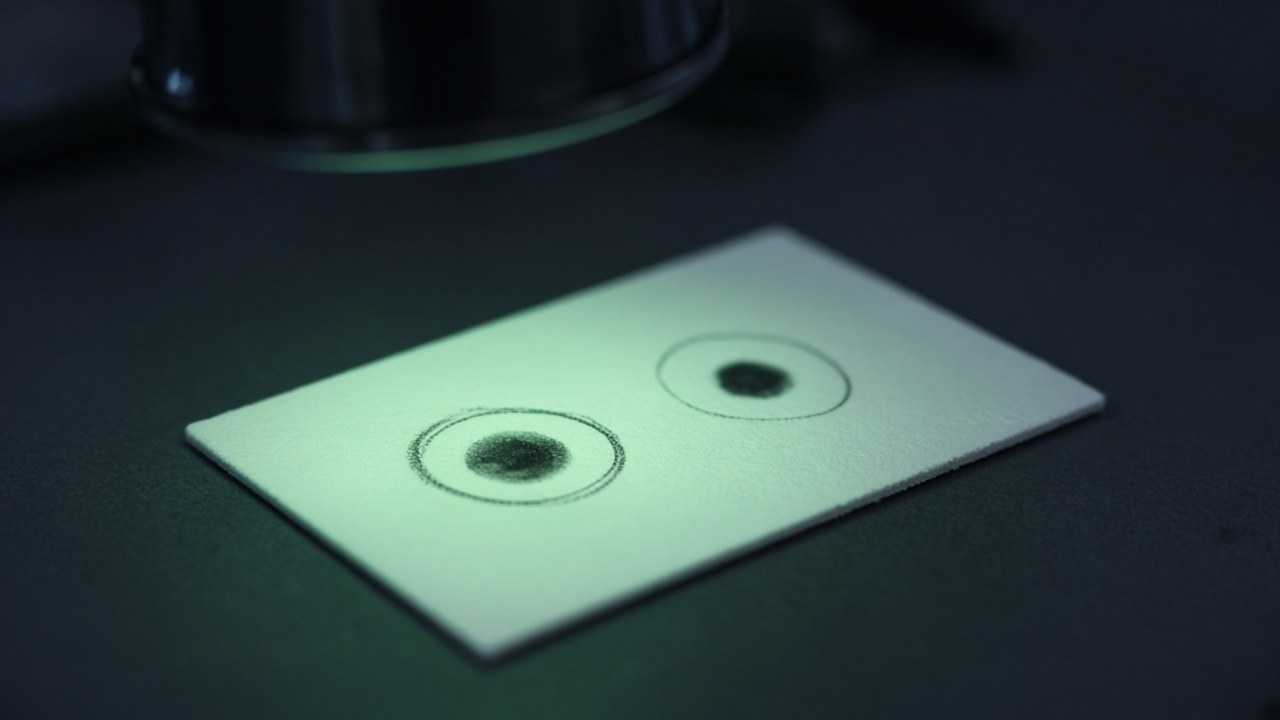
Illustration of dark spots on a TLC plate under UV light, circled in pencil (artist’s impression).
Choosing an eluent
An MIT laboratory techniques handout describes a good solvent system as one that “moves all components of your mixture off the baseline, but does not put anything on the solvent front.” It gives a target Rf range of 0.15 to 0.85, and admits that’s not always possible.
The same handout ranks common solvents by polarity:
- Nonpolar: hexane, pentane, cyclohexane and petroleum ether.
- Moderately polar: from toluene and diethyl ether up through dichloromethane and chloroform to ethyl acetate and acetonitrile.
- Very polar: alcohols such as methanol.
It calls 0–30% ethyl acetate in hexane the most popular combination. The University of York’s teaching-lab guide lists similar pairings, such as hexanes with ethyl acetate or diethyl ether, toluene with dichloromethane, and small percentages of methanol in dichloromethane.
The adjustment rule is simple. Make the eluent more polar to raise Rf, or less polar to lower it. If a compound streaks instead of forming a tight spot, the MIT handout suggests the sample is probably too concentrated and should be diluted. Odinity’s plant pigment TLC lab shows how much trial and error this can take. Only two of the solvent systems the class tried separated the pigments well.
Seeing colourless spots
Most organic compounds are colourless on a white plate, so they have to be visualized after the run. Nichols separates the methods by whether they change the compound.
- UV light (non-destructive). Commercial plates usually contain a fluorescent material, such as zinc sulfide, that glows green under 254 nm light. Compounds that absorb at that wavelength block the glow and show up as dark spots. This works best for aromatic and highly conjugated compounds. Many other compounds are invisible under UV “even though they are still there.” The spots disappear when the lamp is switched off, so they’re circled in pencil. Odinity’s thin-layer chromatography experiment did exactly this.
- Iodine vapour (semi-destructive). Iodine forms coloured complexes with many organic compounds, giving yellow-brown spots. Nichols says it works with “approximately half” of compounds. Alcohols, carboxylic acids and alkyl halides often don’t stain, and the colour fades as the iodine evaporates.
- Chemical stains (destructive). These react with particular functional groups. Permanganate picks up alkenes and oxidizable groups, p-anisaldehyde and vanillin many aldehydes, ketones and alcohols, and iron(III) chloride phenols. The stain is chosen to suit the structures you expect.
A note on solvent safety
PubChem’s GHS data for hexane include the European Union’s harmonised classification of n-hexane: highly flammable liquid and vapour (H225), may be fatal if swallowed and enters airways (H304), causes skin irritation (H315), may cause drowsiness or dizziness (H336), suspected of damaging fertility (H361f), causes damage to organs through prolonged or repeated exposure (H372), and toxic to aquatic life with long-lasting effects (H411). Of the 4,001 company reports to the European Chemicals Agency that PubChem aggregates, 98.2% classify hexane as highly flammable (H225), and more than 93% also list the aspiration, skin-irritation, drowsiness, reproductive, repeated-exposure organ and aquatic hazards.
Limits: co-spots and reproducibility
Matching Rf isn’t proof of identity. Two different compounds can run at nearly the same height. Nichols recommends a co-spot: a middle lane where the reference and the unknown are spotted on top of each other. If they’re different compounds with slightly different Rf values, the co-spot may show an elongated spot rather than a single round one. The co-spot also helps when the solvent runs at a slight diagonal across the plate. Even a promising result needs other tests to confirm a structure.
Rf values are approximate. Nichols ran acetophenone to different heights and got similar, “although not identical,” Rf values. The differences come partly from ruler error and partly from varying amounts of water adsorbed on the plates. The conclusion is blunt: “Rf values should always be regarded as approximate.”
Chamber conditions matter too. Filter paper in a closed chamber keeps the air saturated with solvent vapour. If the eluent evaporates from the plate instead, the run can stall, and the composition of a mixed eluent can shift locally.
So the settled part is the physical picture. Polar compounds bind silica and dislike a nonpolar eluent, so they run low; nonpolar compounds run high; and a more polar eluent lifts everything. What’s rule of thumb is the rest:
- target Rf ranges
- favourite solvent pairs
- which stain to reach for
- the habit of comparing Rf values only between lanes run on the same plate, in the same chamber