
How Does Hibernation Work? Torpor, Cold Hearts and Burning Fat
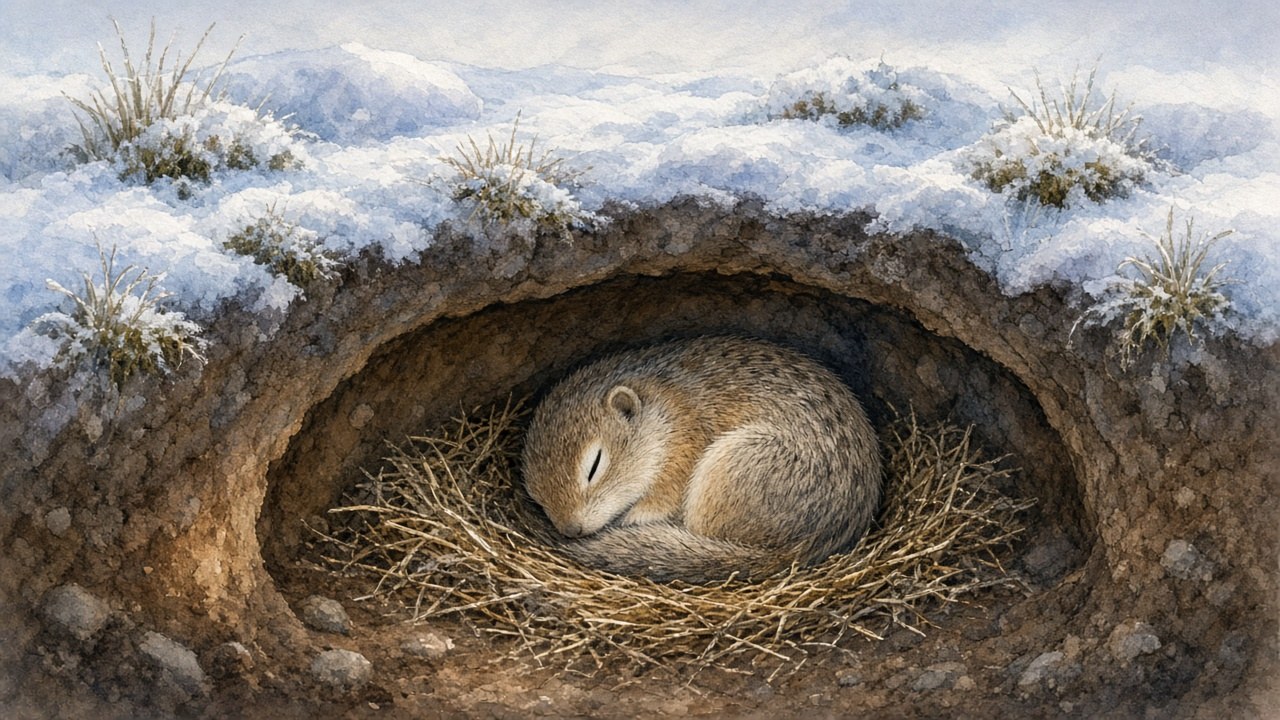
In the Arctic, an Arctic ground squirrel can spend seven to eight months of the year hibernating, with its body temperature dipping below the freezing point of water. After a few weeks of this, it warms itself back up, stays warm for a short while and then sinks back down again. It repeats this all winter. So how does hibernation work? It isn’t one long sleep. It’s a cycle of deep shutdowns and expensive restarts, and some of the biggest questions about it are still open.
Winter’s two problems
The U.S. National Park Service puts it simply: winter brings “less food and it is intensely cold.” An animal that stays warm needs fuel to do it, and the fuel is scarce exactly when the demand is highest. Many animals respond by going dormant, slowing down their bodies for a while. Hibernation is a specific kind of dormancy.
The NPS lists three requirements for a true hibernator: reduced metabolism, slower heart rate and lowered body temperature. That rules some familiar sleepers out.
- Snakes and other reptiles brumate instead. They can’t make their own body heat, so their metabolism slows because the cold forces it to, not because they control it.
- Frogs hide from cold and dryness in unfrozen water or dry burrows.
- Rodents and some bats are the classic true hibernators, and the NPS calls rodents “the champions of hibernation.”
Before any of this, the animal has to stock up. Large species like bears eat heavily in summer and fall and store the food as fat. Smaller ones, like many squirrels and mice, cache food to eat slowly through the winter.
How does hibernation work? Torpor, then arousal, again and again
Physiologists split hibernation into repeating pieces. The basic unit is a torpor bout: a stretch of days or weeks when the animal’s metabolism, heart rate and temperature are turned way down. Each bout ends with an arousal, when the animal rewarms itself to normal body temperature. It stays warm for a short spell, called interbout euthermia, then drops back into torpor.
The numbers are extreme. A 2022 paper by Thomas Ruf and colleagues in Frontiers in Physiology notes that hibernating mammals often cut their metabolic rate to 5% or less of their basal rate. In most species, body temperature falls to just above the temperature of their surroundings. The longest torpor bouts vary by species, from about 3 days to 98 days.
The thirteen-lined ground squirrel is the lab favorite. According to a review by Mallory Ballinger and Matthew Andrews in the Journal of Experimental Biology, a torpid squirrel has a heart rate less than 5% of its normal rate. It uses only 2 to 3% of its usual oxygen and holds a body temperature of 2 to 10 °C. As they put it, these are “physiological characteristics that would result in death for most mammals.” These squirrels go without eating for five to six months, living off their stored white fat.
Arctic ground squirrels go further. The NPS says their normal body temperature of 99 °F can drop as low as 27 °F, below freezing, for a few weeks at a time before they briefly wake up and warm up.
Torpor isn’t the animal simply getting cold. As the animal enters torpor, the Ballinger and Andrews review explains, its thermoregulatory set point drops. The body stops defending its normal temperature and lets itself cool toward the surroundings. If the surroundings get too cold, heat production switches back on to keep body temperature above freezing. Ruf’s paper makes the same point: each species has a minimum body temperature that it defends.
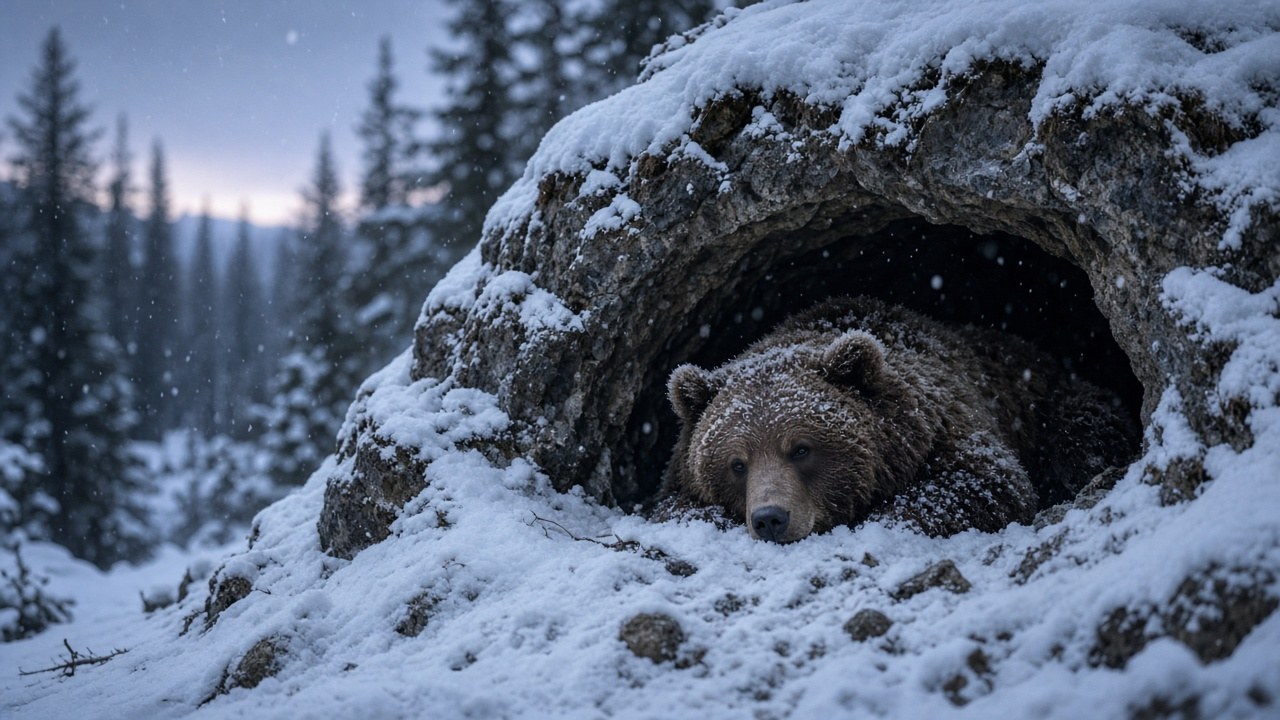
Illustration: a bear in its winter den. Bears cut their heart rate to 8 to 10 beats a minute but stay warm.
The waking up is the expensive part
The arousals are where the energy goes. Ruf and colleagues cite older measurements showing that arousals and the warm spells after them account for at least 70% of a hibernator’s total energy use over winter. That’s a striking cost for something that interrupts the savings.
The heat comes from brown adipose tissue, or brown fat. Unlike ordinary white fat, which stores energy, brown fat is built to burn it. Its cells are packed with mitochondria. Normally mitochondria use the energy from food to make ATP, the cell’s energy currency. In brown fat, a protein called UCP1 lets protons leak back across the inner mitochondrial membrane, so the energy comes out as heat instead. Ballinger and Andrews describe the result as likely “the highest capacity oxidation of fat (per mass of tissue) that occurs in mammals.”
The review describes what happens during an arousal in the thirteen-lined ground squirrel:
- The set point rises, and the nervous system signals brown fat to start burning.
- Metabolic rate jumps before body temperature does.
- Brown fat can run up to 14 °C hotter than the animal’s rectal temperature.
- Shivering, which a torpid animal can’t do, joins in only once the body has warmed enough.
- Body temperature rises about 20 °C in under an hour and is back to normal in under three hours.
Brown fat makes rewarming cheaper too. The review cites work showing it cuts the energy cost of arousal by 60% by speeding the process up. Fittingly, the tissue was once nicknamed “the hibernation gland,” and it was first described in hibernating marmots in 1551. In small hibernators, brown fat grows in autumn and shrinks again in spring.
Do bears hibernate?
Even the National Park Service gives two answers. One NPS article says bears “aren’t true hibernators because their body temperatures don’t drop during the winter.” A Katmai National Park blog calls bear dormancy hibernation and describes it as “particularly remarkable in bears.” The disagreement is mostly about definitions. Here is what the Katmai blog says a denning bear does.
- Temperature: a bear stays above 88 °F (31 °C), not far below its normal 100 °F (37.7 °C).
- Breathing and heart rate: about one breath a minute and 8 to 10 heartbeats a minute.
- Fuel: a bear may burn more than 4,000 calories a day and lose up to a third of its body weight by spring.
- Waste: a bear doesn’t eat, drink, urinate or defecate in the den. Its kidneys almost shut down, and urea is recycled into proteins that maintain muscle and organs.
The Katmai blog adds that healthy bears come out in spring without losing muscle mass or bone density. Ruf’s paper notes that a few species can hibernate continuously at body temperatures of roughly 20 to 30 °C instead of cycling through deep cold torpor.
What’s settled and what’s still a mystery
Settled:
- True hibernation is regulated, not just cold. Animals lower their set point, and they rewarm themselves even when the surroundings stay cold.
- Deep hibernators cycle between multi-day torpor bouts and short arousals.
- Brown fat supplies the heat that starts each arousal.
Still open:
- Why rewarm at all? Ruf and colleagues write that the function of these arousals “has remained unclear” since they were first described in 1832. Suggestions include sleep, fighting off pathogens and restoring enzymes the heart needs. The sleep explanation, for one, was later questioned.
- What keeps time? The same paper says the clock mechanisms that time torpor and arousal “are entirely unknown.” A long-standing idea is an “hourglass”: something builds up or runs out during torpor and can only be reset when warm. Ruf’s group built a mathematical model on that idea that reproduces many observed patterns. A model fitting the data isn’t proof of the mechanism, and the authors present it as hypothesis and theory.
- Lessons for people? The Katmai blog suggests that understanding bears might one day help treat kidney, heart and bone diseases, or help astronauts on long missions. That’s a research hope, not a result.
What is clear is that hibernation is a carefully managed state, not a long nap. A ground squirrel spends the winter shutting itself almost all the way down, then burning its fat reserves to come back, over and over, until spring.