
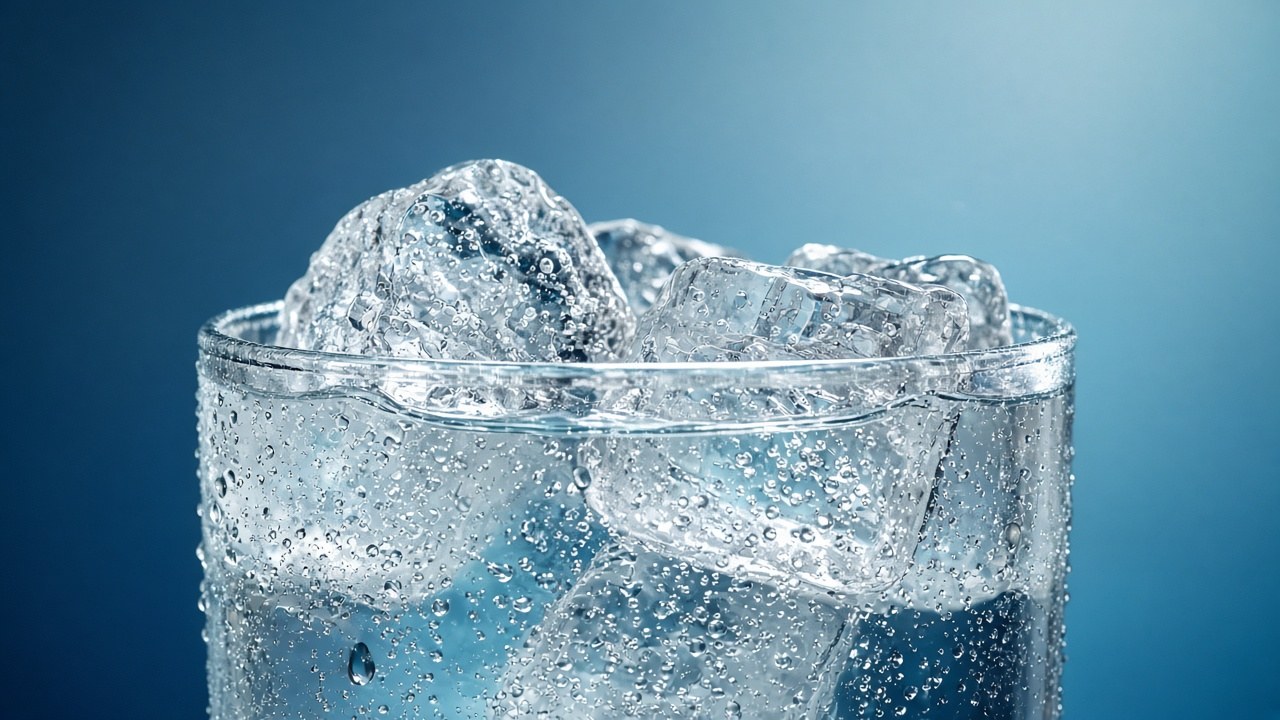
Why Does Ice Float? The Hydrogen Bonds That Save Lakes From Freezing Solid
Drop an ice cube into a glass of water and it bobs at the top. Nobody finds that surprising, but it should be. For almost every other substance, the solid sinks in its own liquid. Water is a rare exception, and life on Earth depends on it. So why does ice float? Because when water freezes, its molecules lock into an open, honeycomb-like framework that takes up more room than the liquid did.
It comes down to density
Whether something floats depends on density: its mass divided by its volume, or how much matter is packed into a given space. Anything less dense than the liquid around it floats.
The numbers for water are close, but the difference matters. LibreTexts’ chemistry text gives liquid water at 0 °C as 0.9998 grams per cubic centimeter, and ice at 0 °C as 0.9168. A NOAA classroom activity rounds those to 1.0 and 0.92 g/mL. The U.S. Geological Survey says ice’s density drops by about 9% when water freezes, so ice is about 90% as dense as liquid water.
That’s what you see in a glass. USGS notes that roughly 10% of an ice cube or iceberg sits above the waterline, and the rest is below. The agency adds that the figure can vary, because ice can contain trapped air.
NOAA’s activity puts it plainly. When water freezes, the molecules “spread out to line up in a definite crystal-like structure.” The amount of matter doesn’t change, but it takes up more space. NOAA points to the evidence in your freezer: the bump on top of an ice cube, or a soda can that bursts when frozen. Water expands as it freezes, while most other substances contract.
Why does ice float? The hydrogen-bond honeycomb
To see why water spreads out, you have to look at how its molecules hold on to each other. They’re linked by hydrogen bonds, attractions between neighboring water molecules.
- In liquid water, LibreTexts explains, the hydrogen bonds “constantly break and reform as the water molecules tumble past one another.”
- In ice, the hydrogen bonds become permanent. They lock the molecules into “an interconnected hexagonally-shaped framework,” a network with “open spaces in the middle of the hexagons.”
Those open spaces are the answer. USGS describes the same thing from the other side: in ice, the molecules “align themselves in a regular lattice rather than more randomly as in the liquid form,” and the lattice holds them farther apart. LibreTexts credits this structure to water’s molecular shape, its polarity and its hydrogen bonding.
If you’d like to see how much energy it takes to break that framework, Odinity’s heat transfer lab measures the latent heat of fusion of ice. It compares the result with the accepted value of 3.34 × 10⁵ joules per kilogram.
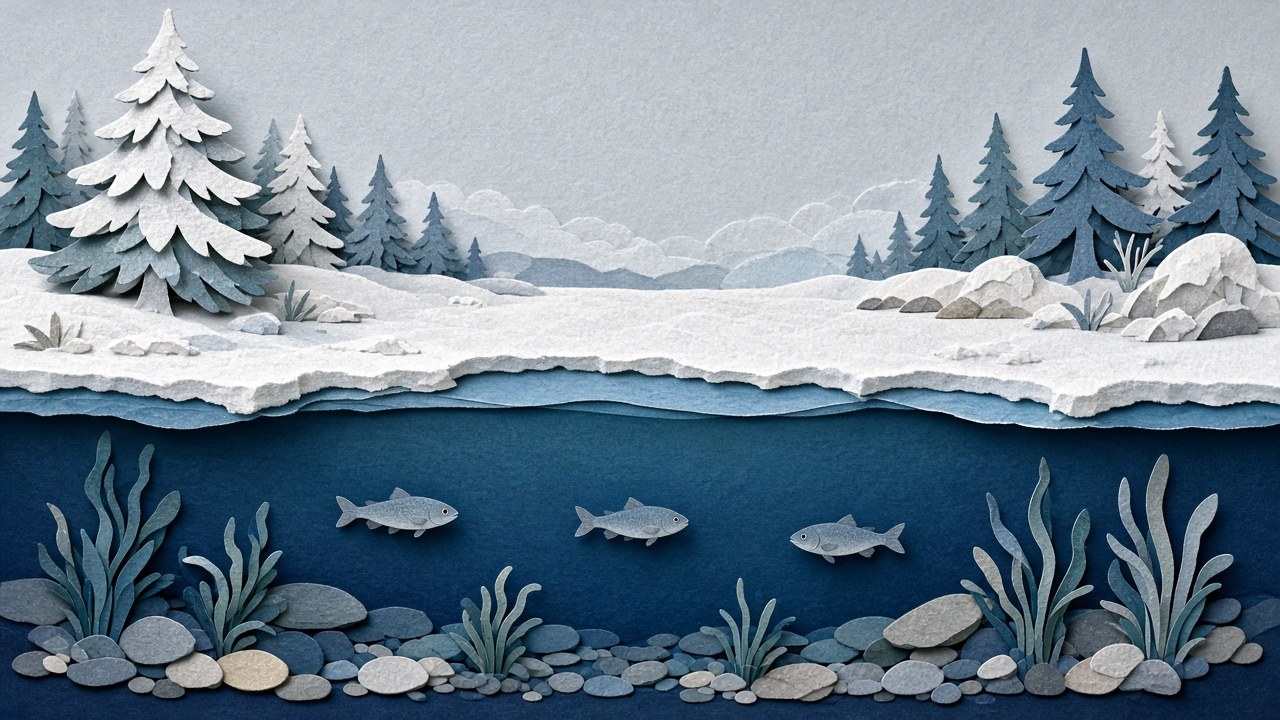
Illustration: a frozen lake in cross-section. Ice stays on top, so liquid water and fish survive underneath.
The strange 4 °C maximum
Water’s oddness starts before it freezes. LibreTexts notes that liquids normally get denser as they cool, because their molecules slow down and move closer together. Water does this too, until about 4 °C. Below that, it starts getting less dense again, as the hydrogen bonds begin forming the hexagonal network even in the liquid.
USGS gives the peak precisely: 0.9998395 g/mL at 4.0 °C (39.2 °F). Its table shows water at 1.00000 g/cm³ at 4 °C, compared with 0.99987 at 0 °C and 0.95865 at 100 °C.
That peak is so dependable that it serves as a yardstick. USGS explains that a hydrometer, a weighted glass float used to measure liquid density, reports relative density, or specific gravity. For liquids, the reference is usually water at its maximum density, at 4 °C. Hydrometers are used to check salinity in school science classes, estimate the fat content of milk, and track how much sugar is left in home-brewed beer and wine.
Why it matters: lakes that don’t freeze solid
That small quirk has big consequences in winter. As a lake cools, USGS explains, water near 4 °C is denser than water at 0 °C, so it sinks to the bottom. The coldest water stays at the surface and freezes there first. LibreTexts finishes the story: the ice layer “does not sink,” so liquid water remains underneath “all winter long,” and fish and other organisms survive.
Imagine the opposite. USGS points out that if water were densest at its freezing point, the cold surface water would sink and lakes could freeze from the bottom up. And because water holds heat so well, some frozen lakes might not fully thaw in summer. LibreTexts is blunter: if ice sank as it froze, “entire lakes would freeze solid.” USGS calls this property “critical for all life on earth.” It also notes a more everyday consequence: if ice sank, we couldn’t skate or ice fish without scuba gear.
Icebergs, seawater and “heavy ice”
Salt changes the numbers slightly. Dissolved material makes water denser, and NOAA puts seawater at about 1.03 g/mL. Odinity’s lab on solution density and partial molar volume measures that kind of change in salt solutions. Icebergs, which are frozen fresh water, still float in the sea. NOAA notes that because the densities of ice and seawater are so close, icebergs ride “low” in the water. Meltwater from icebergs behaves the same way: being fresh, it forms a layer on top of the denser seawater.
An iceberg, in NOAA’s definition, is a great chunk of ice that has broken off an ice sheet, a glacier or another iceberg. Icebergs come in very different shapes. Those in the North Atlantic are irregular and sharply crested, thousands of feet wide and hundreds of feet thick. Antarctic icebergs usually have flat tops. A single one can cover several miles and be 2,000 feet thick or more. All that ice is floating, and most of it is hidden below the surface.
The RMS Titanic met its fate in April 1912. NOAA’s activity says the ship struck an iceberg estimated at 70 to 150 meters long, and it sank with the loss of 1,513 lives. Icebergs drifting that far are relatively rare, NOAA notes. It estimates that of the 15,000 to 30,000 icebergs Greenland’s glaciers produce each year, only about 1% ever reach the Atlantic Ocean.
And not all ice floats. USGS describes “heavy ice,” made from heavy water, D2O, in which both hydrogen atoms are replaced by deuterium. Deuterium is a form of hydrogen with a neutron as well as a proton. Heavy ice is about 10.6% denser than normal water, so heavy-ice cubes sink to the bottom of an ordinary glass.
What’s settled and what’s subtle
Settled:
- Ice is about 9% less dense than liquid water, because hydrogen bonds lock its molecules into an open hexagonal lattice.
- Liquid water is densest at about 4 °C, so lakes freeze from the top down.
- Ice is one of the few solids less dense than its own liquid.
Subtle:
- The “10% above water” rule is approximate. It changes with trapped air in the ice and with salt in the water.
- USGS cautions that “the real-world explanation of water density is more complicated,” because natural water carries dissolved minerals, gases and salts that shift its density.
The next time you watch an ice cube bob in a drink, remember the hexagonal framework that keeps it afloat. It’s the same structure that keeps fish alive under a frozen lake.