

The Doppler Effect: Why a Passing Siren Changes Pitch
An ambulance races toward you with its siren wailing. The instant it passes, the pitch drops. The siren itself never changed its note. What changed was how often its wave crests reached your ears. That’s the Doppler effect, and the same principle helps forecasters spot tornadoes, lets NASA track spacecraft across the solar system, and is a close cousin of the redshift that revealed the expanding universe.
A prediction about colored stars
The effect is named for Christian Doppler, an Austrian mathematician and physicist who lived from 1803 to 1853. According to the Complete Dictionary of Scientific Biography, he presented his idea in a paper read on May 25, 1842, while he was a professor in Prague. Its title translates as “On the colored light of the double stars and certain other stars of the heavens.”
Doppler nearly wasn’t in Prague at all. In 1835, the biography says, he had sold his possessions and got as far as Munich on his way to emigrate to America when he was offered a teaching post in Prague. In 1850 he became full professor of experimental physics at the University of Vienna, the first such post in Austria. He suffered from lung disease and died in Venice in 1853, at 49.
Doppler derived the correct basic formula for a moving source or a moving observer. He extended it to both moving at once in 1846. But his big astronomical claim was wrong. He believed all stars were intrinsically white and that the colors of double stars came from their motion. The biography calls that reasoning “not always very cogent.”
The first experimental check used sound, not starlight. In 1845, the scientist Buys Ballot tested it at Utrecht, in the Netherlands, using “a locomotive drawing an open car with several trumpeters.” Observers heard the expected shift in pitch. Buys Ballot also criticized the unsound assumptions behind Doppler’s star colors, and Doppler’s replies, the biography says, were “rather stubborn and unconvincing.” Both were partly right. The principle was sound, and the star colors were not caused by it.
How the Doppler effect works
A sound is a series of pressure waves. Its pitch depends on how many wave crests reach your ear each second, its frequency. NASA’s Basics of Space Flight guide explains what motion does to that count, and the same logic applies to sound, radio and light.
- Distance not changing. The waves arrive at the same rate they’re sent out, and you hear the true pitch.
- Distance shrinking. Each time the source sends out a wave, it has moved a little closer. Each crest has less distance to travel than the one before, so the crests arrive more often. The frequency rises, and the pitch goes up.
- Distance growing. Each new crest starts a little farther away, so the crests arrive less often. The frequency drops, and the pitch goes down.
The National Weather Service describes it with a train whistle. As the train approaches, its sound waves are “compressed,” raising the pitch. As it moves away, they’re “stretched,” lowering it. “The faster the train moves, the greater the change in the whistle’s pitch.”
Two details are easy to miss:
- Only motion along the line of sight counts. The DSB notes that Doppler’s formula covers motion along the line between source and observer. So a source moving across your view, getting neither nearer nor farther, produces little or no shift.
- The shift lasts only while the distance changes. NASA points out that the received wave returns to normal the moment the motion toward or away stops.
That’s why the siren’s drop is so abrupt. As it approaches, the ambulance is almost all toward-you motion. A moment later, it’s almost all away.
For the math of how a wave travels, see Odinity’s project on partial derivatives, diffusion and waves, which works through solutions to the wave equation.
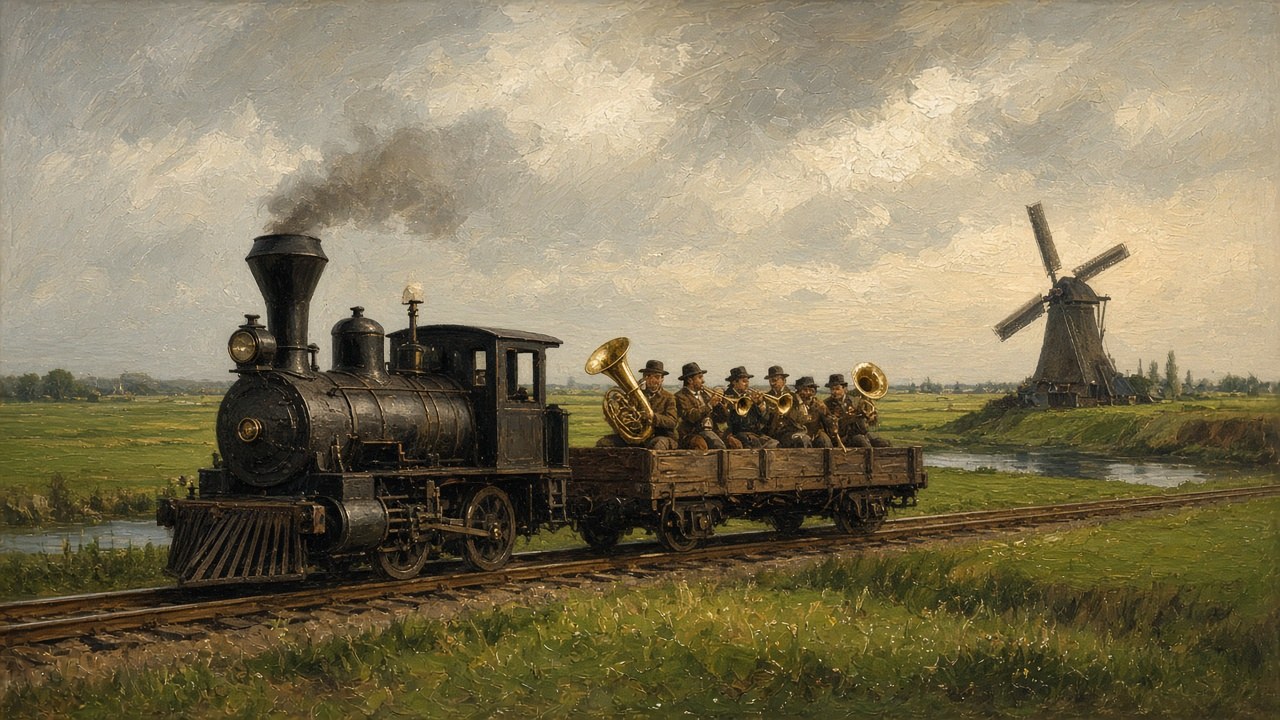
Illustration: an imagined scene of Buys Ballot’s 1845 test, with musicians on an open railway car.
Seeing the wind: Doppler radar
The most familiar everyday use is probably on your weather app. The National Weather Service’s NEXRAD radars send out bursts of energy that bounce off raindrops, snowflakes, hail, even bugs and birds. A small fraction comes back. The radar measures how strong that echo is, how long it took to return, and its Doppler shift. The NWS describes the shift as a change in “phase” of the returning pulse.
That phase change tells the radar whether the target is moving toward it or away, and how fast. From that, forecasters estimate the wind. The NWS says this ability to “see” the wind is what lets it detect tornadoes forming and issue warnings with more notice.
The radar does all this very fast. It pulses up to around 1,300 times a second, yet it’s actually transmitting for only about seven seconds each hour. It spends the remaining 59 minutes and 53 seconds listening for echoes.
Tracking spacecraft by their radio tone
NASA uses the same effect to follow its spacecraft. The radio signal from a probe arrives slightly higher in frequency when the distance is shrinking and lower when it’s growing. NASA’s guide lists everything that adds to that shift:
- the spacecraft’s own path
- its orbit around a planet such as Mars
- Earth’s yearly trip around the Sun
- Earth’s daily spin, which adds an upward shift as a spacecraft rises in the east and a downward one as it sets in the west
Comparing the signal at two widely separated ground stations, a technique called differenced Doppler, lets navigators reconstruct a spacecraft’s path in three dimensions.
Light, redshift and the expanding universe
Doppler was right that light should shift too, even though star colors weren’t the evidence. The DSB credits H. Fizeau with pointing out in 1848 that the useful measurement is the shift of spectral lines. That’s why the principle is sometimes called the Doppler-Fizeau principle. Real astronomical use had to wait for proper spectroscopes, beginning with William Huggins in 1868. The astronomer Belopolsky first confirmed the optical effect in the lab in 1901.
Light from a source moving away shifts toward longer, redder wavelengths, a redshift. Light from an approaching source shifts toward the blue. But the most famous redshift in astronomy has a different cause. NASA’s Hubble team explains that as space expands, galaxies move farther apart and “their light elongates while becoming a redder color.” They call this cosmological redshift. Edwin Hubble found that the farther away a galaxy is, the bigger its redshift. The light isn’t shifted by a galaxy speeding through space like a train. It’s stretched along the way because space itself is expanding while the light travels.
The DSB adds that the Doppler principle has been “modified by relativity theory.” The simple sound-wave picture is a starting point for light, not the whole story.
What’s settled and what’s still being refined
Settled:
- Relative motion along the line of sight changes the observed frequency of any wave: sound, radio or light.
- Doppler radar and spacecraft tracking depend on this every day.
- Distant galaxies show redshifts that grow with distance.
Still being refined:
- The exact rate of cosmic expansion.
- The nature of the dark energy that NASA says “seems to be accelerating” it. Astronomers are still using Hubble, and now the James Webb Space Telescope, to refine those measurements.
Next time a siren drops in pitch as it passes, that’s the same physics. Doppler worked it out for starlight in 1842, and a railway full of trumpeters confirmed it for sound three years later.