
How Does PCR Work? Copying DNA a Billion Times in an Afternoon
Suppose you have a single strand of hair, a speck of blood or a few bacteria swabbed from someone’s nose. Each holds DNA, but far too little to study. Within a few hours, a benchtop machine can turn that trace into more than a billion copies of one chosen stretch of DNA. That’s the polymerase chain reaction, PCR. So how does PCR work? It comes down to three ingredients: heat, two short pieces of made-to-order DNA, and an enzyme from a microbe that lives in hot springs.
The problem PCR solved
The National Human Genome Research Institute (NHGRI) explains the bottleneck. Genetic analysis needs a significant amount of DNA, so “studies of isolated pieces of DNA are nearly impossible without PCR amplification.” Its nickname is “molecular photocopying.”
The technique was first presented in 1985. Its inventor, Kary B. Mullis, born in Lenoir, North Carolina, in 1944, shared the 1993 Nobel Prize in Chemistry “for his invention of the polymerase chain reaction (PCR) method.” The other half of the prize went to Michael Smith for site-directed mutagenesis. The Royal Swedish Academy of Sciences’ press release says Mullis described getting the idea “during a night drive in the Californian mountains.”
By the time of the prize, only eight years after it was first presented, the committee could already call PCR “one of the most widespread methods of analysing DNA.”
How does PCR work? The three-step cycle
Remember that DNA is two strands twisted into a double helix and held together by matched letters: A pairs with T, and G pairs with C. Each strand can serve as a template for building its partner. PCR exploits this in a repeating cycle.
1. Separate the strands. The sample is heated so the DNA “denatures,” in the NHGRI’s words, splitting into two single strands.
2. Mark the target. PCR copies only the stretch you choose. To pick it, researchers synthesize two short single-stranded DNA pieces called primers, or oligonucleotides. The Nobel press release explains that they’re designed to bind “to opposite strands of the DNA segment it is wished to replicate.” One primer marks one end of the target on one strand, and the other marks the opposite end on the other strand.
3. Build the copies. At the primers, a DNA polymerase, the enzyme that builds DNA, starts reading the template and adding matching building blocks. The result is two new double strands. As the NHGRI puts it, each new molecule contains “one old and one new strand.”
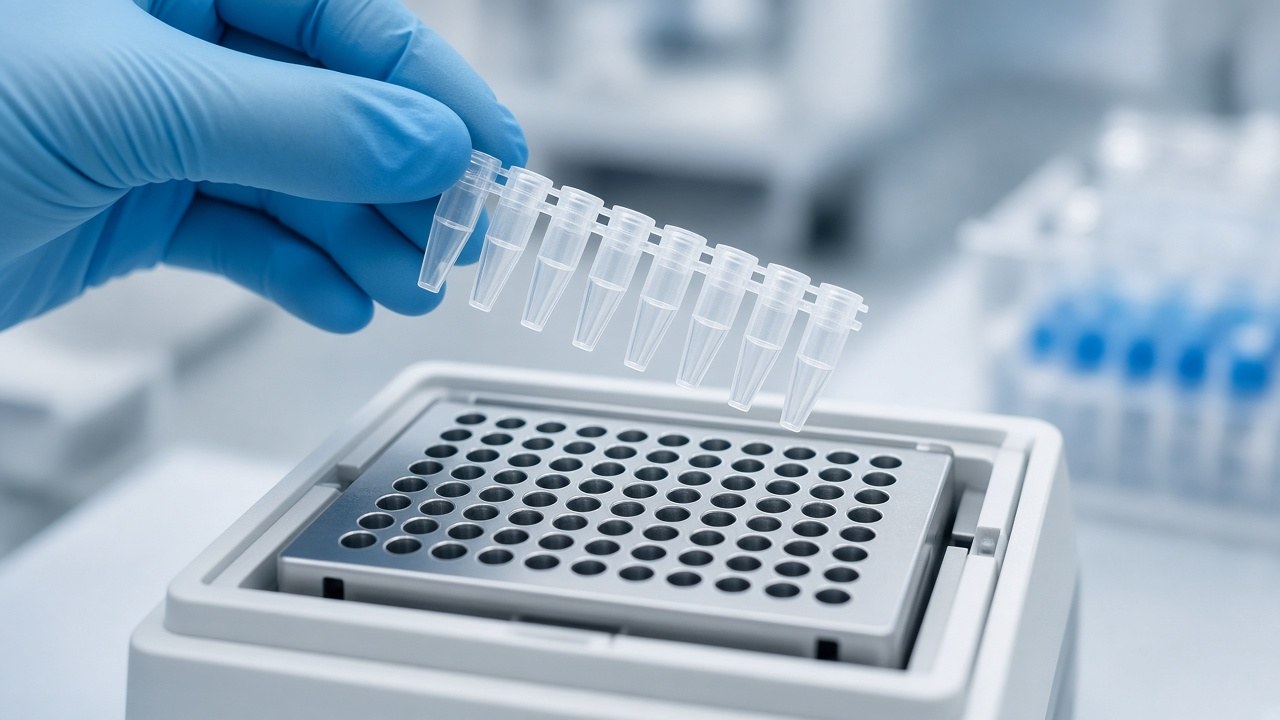
Then the sample is heated again, the strands come apart, and the cycle repeats. A machine called a thermocycler runs the process automatically, changing the temperature of the reaction every few minutes.
What goes in the tube
Besides the sample DNA, the reaction needs the raw materials for new strands. The Nobel facts page describes “the DNA building blocks that have been added” being bonded to each strand. Those building blocks are the four deoxyribonucleotides. Chien’s 1976 study found that the Taq enzyme needs all four, plus a divalent metal ion, ideally magnesium. The student fruit-fly study linked below lists a typical mix: buffer, magnesium chloride, the four nucleotides (dNTPs), forward and reverse primers, and Taq polymerase. This is a description, not a protocol. Real reactions are set up and run under lab supervision.
The power of doubling
The “chain reaction” part is the arithmetic. Each cycle, in the words of the Academy’s press release, doubles “the number of copies of the desired DNA segment.” Every copy made in one round becomes a template in the next.
- One molecule becomes 2, then 4, then 8.
- After 10 doublings, there are about a thousand copies.
- After 20, about a million.
- After 30, about a billion.
That matches the NHGRI’s description: 30 or 40 cycles lead to “more than one billion exact copies of the original DNA segment,” all within a few hours. The 1993 press release quotes a range of 20 to 60 cycles, which it says can give “millions of DNA copies in a few hours.”

Illustration: a Yellowstone hot spring, the kind of habitat where Thermus aquaticus, the source of Taq polymerase, was found.
The hot-spring enzyme that made it practical
There’s a catch in the cycle. Every round includes a step hot enough to pull DNA strands apart, so the copying enzyme has to cope with repeated heating. The answer came from a microbe that thrives in heat.
In 1969, Brock and Freeze described a new bacterium, Thermus aquaticus, in the Journal of Bacteriology. They had isolated it from thermal springs in Yellowstone National Park and from a spring in California. Enriching it from samples required incubation at 70 to 75 °C, and it grew best at about 70 °C. It also turned up in man-made hot habitats like hot tap water. In 1976, Chien and colleagues purified its DNA polymerase. They found it had a “temperature optimum of 80 degrees C” and noted that its heat requirement set it apart from the polymerase of E. coli.
That enzyme is now known as Taq polymerase, from T. aquaticus. In 1988, Saiki and colleagues reported in Science that using it in PCR “greatly simplifies the procedure.” By letting the copying run at higher temperatures, it “significantly improves the specificity, yield, sensitivity, and length of products.” They amplified single-copy genomic sequences by a factor of more than 10 million. They copied DNA segments up to 2,000 base pairs long. And they detected a target present only once in a sample of 100,000 cells.
What PCR is used for
The NHGRI lists uses including DNA fingerprinting, detecting bacteria and viruses, and diagnosing genetic disorders. It notes that most mapping techniques in the Human Genome Project relied on PCR. The 1993 press release adds forensics, since PCR makes it possible to analyze “the DNA in a single drop of blood or in a hair.” It also mentions studies of how species are related.
It’s also a staple of biology teaching labs. Students on Odinity have used it to:
- identify bacteria swabbed from the nose, in a skin microbiota lab report
- check where a transposon landed in glowing bacteria, in a pGLO lab
- amplify a fruit fly gene, in a study of the eyeless gene in Drosophila melanogaster
In each case the PCR products were then checked by gel electrophoresis.
What’s settled, and what PCR can’t do
Settled:
- The cycle of separating strands, binding primers and extending them works, and it doubles the target each round.
- A heat-stable polymerase like Taq is what makes the cycle practical to automate.
- Few methods in molecular biology are as widely used.
Limits to keep in mind:
- You have to know where to aim. The primers are designed to bind at the ends of a chosen segment, so PCR copies a targeted stretch, not a whole genome.
- Length. The NHGRI describes PCR as copying “small segments” of DNA. The 1988 Taq paper reported segments up to 2,000 base pairs as readily amplified.
- Sensitivity cuts both ways. It follows that a method able to find one target among 100,000 cells can just as easily amplify a stray molecule that shouldn’t be there. That’s one reason the products are checked, for example on a gel, rather than taken on trust.
- Early predictions. The 1993 press release looked ahead to uses such as gene therapy. Those were forecasts at the time, not results.
In 1993 the Academy’s press release observed that, in principle, PCR needs “only a test tube and some heat sources.” The rest is a pair of well-chosen primers and an enzyme borrowed from a Yellowstone hot spring.