
Simple vs Fractional Distillation: How to Choose and Why Columns Work
Two liquids that mix completely can still be pulled apart by heat, because one evaporates more readily than the other. The choice in the teaching lab is usually simple vs fractional distillation: a straight path from flask to condenser, or the same setup with a column inserted in between. The column looks like a small addition, but it changes what the apparatus can do. Whether you need it comes down to how far apart the boiling points are.
What distillation is actually doing
When a mixture of two miscible liquids boils, both components go into the vapor, but not equally. Lisa Nichols’ Organic Chemistry Lab Techniques (Butte College, on LibreTexts) explains this with Raoult’s law: a compound’s vapor pressure “is lessened when it is part of a solution, and is proportional to its molar composition.” Written out, PA = P°AχA. Dalton’s law then adds the partial pressures to give the total.
Two consequences follow, both spelled out in the same chapter.
The vapor is enriched, not pure. The lower-boiling component has the higher vapor pressure, so it makes up a bigger share of the vapor than of the liquid. Condensing that vapor gives a distillate richer in the more volatile liquid, but still a mixture.
Mixtures don’t boil one component at a time. Nichols calls it “a common misconception” that an equimolar mixture of A (boiling point 50 °C) and B (100 °C) boils at 50 °C. Working through the vapor pressures, that mixture starts boiling at 66 °C. As A is removed, the pot gets richer in B and the temperature has to climb, reaching 70 °C at one later composition. Components with similar boiling points “boil together,” which is why a mixture distills over a range of temperatures while a pure compound holds steady at its boiling point.
Simple distillation: one equilibrium step
In a simple distillation, vapor rises from the pot, passes the thermometer and goes straight into the condenser. In effect it is one vaporize-and-condense cycle. Nichols’ worked curve for the equimolar A/B example gives a first distillate of 81 mol% A, an improvement but far from pure.
The textbook’s measured examples show where this is good enough and where it isn’t:
- Boiling points 99 °C apart: a 75:25 mol% mixture of 1-chlorobutane (78 °C) and p-cymene (177 °C) gave a first distillate of 99.5 mol% 1-chlorobutane. One step was nearly enough.
- Boiling points 41 °C apart: a 75:25 mixture of ethylbenzene (136 °C) and p-cymene gave a simple-distillation distillate of only 90 mol% ethylbenzene.
Simple distillation also has everyday uses where one component barely evaporates at all. Nichols lists purifying water, since salts and microorganisms in seawater are non-volatile. It can also clean up a reagent: in one example, a partly oxidized benzaldehyde sample was purified, and IR confirmed that the benzoic acid O–H band was gone.
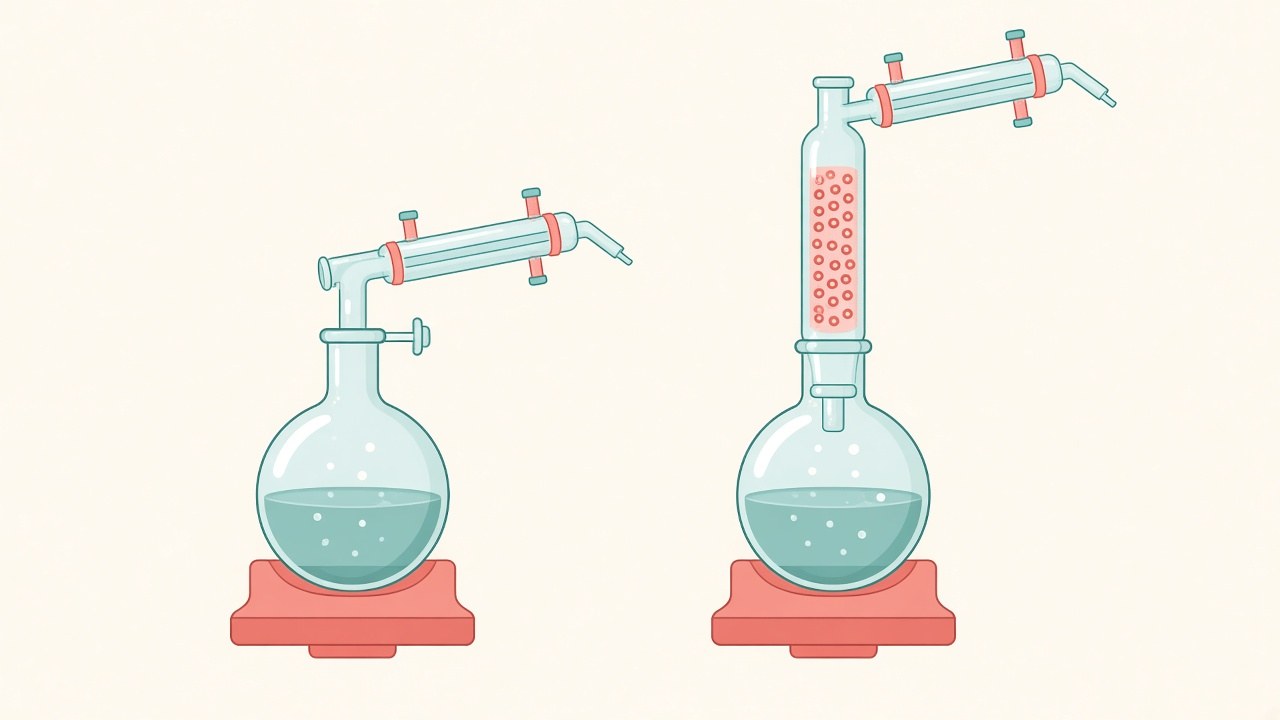
Illustration comparing a simple setup with a fractional setup that adds a packed column (artist’s impression).
Fractional distillation: many steps in one column
If one cycle enriches the vapor, a second cycle on that distillate enriches it further. A fractionating column, Nichols writes, “essentially allows for many successive distillations to take place at once, without dismantling the apparatus.” Vapor condenses on the column’s glass indentations or packing, gets reheated by rising vapor, and evaporates again. Each vaporization-condensation event is called a “theoretical plate.”
On the same A/B curve, one plate gives 81% A and a second plate gives 96% A. The chapter adds that a 50:50 mixture of two components whose boiling points differ by only 20–30 °C “would require at least three theoretical plates to obtain a distillate with > 95% purity.”
Not all columns are equal. In Nichols’ column comparison:
- A Vigreux column (glass indentations) has the least surface area. It separates least well but recovers the most material.
- Glass beads have high surface area. They separate best but lose the most sample wetting the packing.
- Steel wool sits in between, depends on how tightly it’s packed, and can’t be used with acidic vapors.
With the 41 °C ethylbenzene/p-cymene mixture, a bead column gave 97 mol% ethylbenzene, against 92% for steel wool, 92% for a Vigreux and 90% for simple distillation.
Running a column also takes more care. The pot must be heated harder, and the chapter gives a “rule of thumb” that the pot needs to be about 30 °C hotter than the top of the column for material to rise. Wrapping the column in glass wool and foil helps it hold heat. You should see droplets on the packing, but never a large pool of liquid. A river of liquid moving up the column is called flooding, and the fix is to let it drain and heat more gently.
How to choose between simple vs fractional distillation
Nichols’ overview gives the working cutoff. Simple distillation is used when components have “widely different boiling points (greater than a 100 °C difference in boiling points).” When the difference is less than 100 °C, a simple distillation “will fail to purify the mixture completely,” and fractional distillation improves the odds.
Odinity’s simple and fractional distillation lab report shows the cutoff in action. PubChem’s HSDB entries list cyclohexane at 80.7 °C and toluene at 110.6 °C, only about 30 °C apart. In that experiment the simple distillation gave scattered temperatures and no clean separation. The fractional run, with a column packed with metal sponge, showed two distinct temperature plateaus, one for each liquid.
Other Odinity lab reports show the same comparison with water mixtures. In a methanol and water distillation report, the fractional run showed a sharp temperature jump once the methanol was mostly gone, while the simple run never did. In an acetone and water experiment, the two methods gave nearly identical temperature records, a reminder that student runs don’t always show the textbook difference.
Where neither method works: azeotropes
Raoult’s law describes ideal mixtures, and some mixtures aren’t ideal. When unlike molecules attract or repel each other differently than like ones, a mixture of a particular composition can boil at a constant temperature as if it were a pure substance. That is an azeotrope.
Nichols’ best-known example is 95.6% ethanol and 4.4% water: “it is impossible to distill 100% pure ethanol when water is in the distilling pot.” No number of theoretical plates gets past that point, which is why “absolute ethanol” needs extra drying steps. The chapter notes that Lange’s Handbook of Chemistry lists roughly 860 known two- and three-component azeotropes, including a cyclohexane–water azeotrope that boils at 70 °C. For a lab that works with ethanol and water, see Odinity’s ethanol from fermentation by simple and fractional distillation.
Where fractional distillation shows up outside the lab
Crude oil is a mixture of hydrocarbons with roughly 5 to 40 carbon atoms. Nichols notes that refineries use fractional distillation to split it into fractions with similar boiling points, and therefore similar properties: gasoline, diesel, kerosene and jet fuel. On a smaller scale, chemists crack dicyclopentadiene above 150 °C to recover reactive cyclopentadiene. The monomer and dimer boil far apart, but the reaction temperature is close enough to the dimer’s boiling point that a fractional setup is needed.
What’s settled and what’s a rule of thumb
Settled:
- For ideal mixtures, Raoult’s and Dalton’s laws predict that the vapor is enriched in the more volatile component.
- Each equilibrium vaporization-condensation step enriches it further.
- Mixtures boil over a temperature range.
- Azeotropes cap what ordinary distillation can do.
Rules of thumb:
- the 100 °C cutoff between simple and fractional
- the “at least three plates” estimate for a 20–30 °C gap
- the 30 °C pot-to-column temperature difference
- column choice by surface area
Nichols adds a caution worth keeping: “In practice, fractional distillations still often produce mixtures,” and purity is easiest when there is little impurity to begin with. For checking the purity of what you collect, Odinity’s melting point and boiling point lab covers the basics.
Hazard data: both liquids in the cyclohexane/toluene example are classified in company reports to the European Chemicals Agency that PubChem aggregates.
- Cyclohexane (4,880 reports):
- H225, highly flammable liquid and vapor (>99.9%)
- H304, may be fatal if swallowed and enters airways (>99.9%)
- H315, skin irritation (>99.9%)
- H336, drowsiness or dizziness (99.8%)
- H400 and H410, aquatic toxicity (>99.9% and 98.1%)
- Toluene (9,036 reports):
- H225 (98.5%)
- H304 (99.8%)
- H315 (98.5%)
- H336 (98.3%)
- H361, suspected of damaging fertility or the unborn child (95.3%)
- H373, organ damage through prolonged or repeated exposure (98.4%)
- H412, harmful to aquatic life with long lasting effects (16.5%)
https://www.findreal.me : Free science‑backed assessments for personality, career, IQ & EQ. Private instant results. Uncover your true self right now.