
Asteroid Bennu Salt Reveals an Ancient Briny World
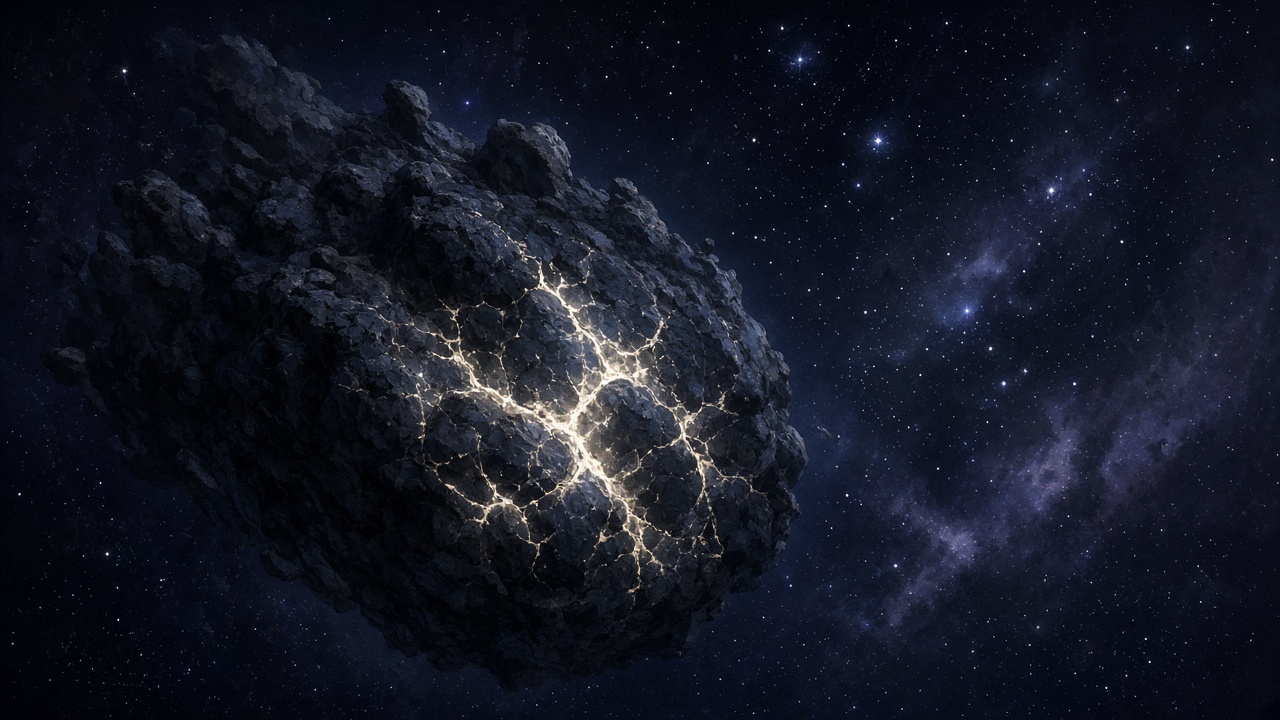
Nobody is allowed to lick a piece of asteroid Bennu (the samples are sealed away under nitrogen), but if you could, a few spots might be very faintly salty. When scientists looked closely at grains of the asteroid Bennu brought back to Earth by NASA, they found the asteroid Bennu salt minerals: table salt, its potassium cousin, and a set of sodium-rich minerals that on Earth form when a salty lake dries up. The salts are a chemical record of salty water that evaporated inside a larger parent asteroid early in the Solar System’s history.
The finding, published in Nature in January 2025, comes from a team of more than 60 scientists led by Tim McCoy, curator of meteorites at the Smithsonian’s National Museum of Natural History, and Sara Russell of the Natural History Museum in London. It is also a story about patience. Some of these salts were vanishing from the samples in a matter of months once they met ordinary air.
How a piece of Bennu got to a lab
NASA’s OSIRIS-REx spacecraft launched on September 8, 2016, and traveled to Bennu, a near-Earth asteroid. On October 20, 2020, it collected rocks and dust from the surface. On September 24, 2023, it released a capsule over Earth that parachuted down to a Defense Department range in Utah. According to NASA, the capsule held 121.6 grams of Bennu (about 4.3 ounces), the largest asteroid sample ever collected in space and more than twice what the mission needed.
Much of that material is clay. The Nature paper notes that clay-like phyllosilicate minerals make up about 80% of the sample by volume, alongside sulfides, the iron oxide magnetite, and carbonates. Those are all minerals that form when water reacts with rock. That water didn’t do its work on Bennu itself. The authors describe it as a “rubble pile” that assembled within the last 65 million years from debris of a larger parent asteroid. That parent body is where the water did its work, early in the Solar System’s history.
What the asteroid Bennu salt minerals are
The team used electron microscopes, X-ray methods and ion mass spectrometry to identify the salts grain by grain. They’re tiny, mostly microscopic. Here’s what they reported:
- Halite and sylvite (sodium chloride and potassium chloride), as grains smaller than 5 micrometers, most under 1 micrometer.
- Sodium carbonate in veins up to 20 micrometers wide and 200 micrometers long, made of needles less than a micrometer wide. The best match is a hydrated sodium carbonate called trona. The authors say they can’t rule out nahcolite, a sodium bicarbonate mineral, or a mix of the two.
- Sodium sulfate, probably the mineral thénardite, as grains about 5 micrometers across.
- Sodium fluoride, rare grains about a micrometer across, possibly the mineral villiaumite.
- Magnesium sodium phosphate, which forms bright coatings on some particles.
- A hydrated sodium-calcium carbonate matching gaylussite or pirssonite.
The authors write that this variety of salts, especially sodium-rich ones, sets Bennu apart from meteorites, where minerals formed by evaporation are rare.
If you want a down-to-earth comparison, Odinity’s archive has student lab work on the same mineral families: measuring carbonate in water, finding chloride content, and a short essay on anhydrite, a calcium sulfate mineral.
Why meteorites missed this
This is the part I find most striking. The salts were disappearing from the samples.
One grain of the sodium-calcium carbonate, re-examined about five months after first study, had altered heavily and grown sodium chloride crystals on its surface. It had been sitting in an air-filled desiccator. A particle with halite and sylvite, re-imaged after eight months under similar conditions, had lost those grains entirely, leaving empty holes. The paper puts the humidity in those air-filled cabinets at roughly 10–40%. Samples kept in nitrogen, at far below 1% relative humidity, held on to their sodium-rich salts.
That has a big implication for meteorites, which typically sit in Earth’s air for years to centuries before anyone studies them. The authors cite earlier work showing salt minerals growing on the surface of the Winchcombe meteorite days to months after it fell in England, and work suggesting that sulfate veins in some carbon-rich meteorites formed on Earth, not in space. Their own data support that view. They also suggest that some of the missing sodium, chlorine, fluorine and sulfur that scientists see in meteorites could be partly explained by salts that dissolved away in the air. Their conclusion is blunt: without sample return and careful storage in nitrogen, “this full array of salts would not have been discovered.”
A salt lake in California is the best match
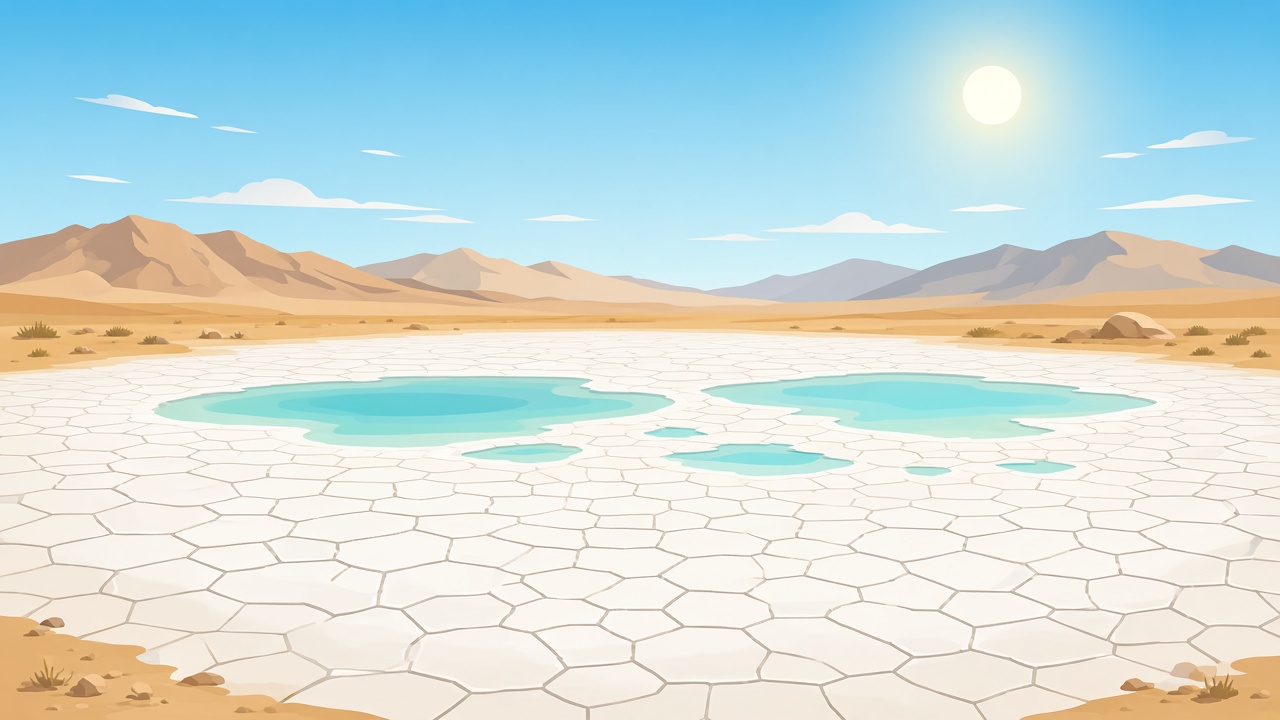
On Earth, this mix of minerals has a familiar home: closed basins, where a body of water gets little or no new inflow, so its salts concentrate as it evaporates or freezes. The authors chose Searles Lake in California, one of the best-studied examples, as their closest analogue. Bennu’s samples contain six minerals also found there: calcite, dolomite, gaylussite or pirssonite, thénardite, trona and halite.
From that, the team sketched a sequence. Early on, as water reacted with rock on the parent asteroid, it formed carbonates such as calcite and dolomite, plus magnetite and the calcium phosphate apatite. As the remaining brine evaporated and grew more concentrated, it left behind a late set of sodium salts: sodium phosphate, then sodium carbonate and sulfate, then table salt with potassium chloride, then sodium fluoride. Preliminary calculations suggest at least 60–70% of the water had to evaporate before sodium carbonate and sodium chloride could form.
A note on certainty: for four of the six shared minerals, the samples don’t show which formed first. The team adopted the Searles Lake order as a working assumption. So the overall picture of an evaporating brine is well supported by the minerals, but the exact sequence leans on an Earth analogy.
Warm evaporation or freezing
A brine can concentrate in two ways: water evaporates, or water freezes out as ice and leaves the salt behind. The minerals offer clues. Gaylussite forms below about 40 °C, pirssonite below about 55 °C, and trona forms at equilibrium above about 20 °C. Modeling of the Searles Lake salts points to 20–29 °C, and the authors note that this range fits Bennu’s minerals and the temperatures inferred from its sulfide minerals.
Their reading is that evaporation, not freezing, controlled the brine, at least up to the point where sodium carbonate formed. They’re careful about it: trona can also form when a brine flash-freezes alongside sodium chloride, although that pairing isn’t seen in the Bennu samples. Freezing after the sodium carbonate formed is still possible. They also say they have “far fewer constraints” for Bennu’s parent body than for Searles Lake, including on the starting composition of the fluid.
Where did the brine sit? Single-mineral veins point to salts crystallizing in cracks. But whether a fluid moving only through cracks could evaporate that much is, in the paper’s word, “unconstrained.” The authors favor a picture in which meter-scale pockets of brine fed the cracks. That’s consistent with spacecraft images of veins in Bennu’s boulders, which spectra suggest are mainly carbonates. It’s a proposal rather than a demonstration.
Why it matters beyond Bennu
Brines are some of the most interesting environments in planetary science. The paper notes that sodium carbonate and hydrated sodium chloride have been identified by their spectra in bright spots on the dwarf planet Ceres. Salty ice grains from the plumes of Saturn’s moon Enceladus, sampled by the Cassini spacecraft, contained sodium carbonate and sodium phosphate. The authors argue that Bennu’s ancient brine produced salts similar to those now emerging on Ceres, and that similar brines probably still exist inside Ceres and Enceladus today.
Bennu isn’t alone among sampled asteroids, either. Grains from asteroid Ryugu, returned by Japan’s Hayabusa2 mission, contain calcium-magnesium carbonates, magnesium-sodium phosphate and sodium carbonate, according to studies the paper cites.
The paper also touches on the bigger question of life’s chemistry, carefully. A companion study published the same day in Nature Astronomy, led by Daniel Glavin and Jason Dworkin of NASA’s Goddard Space Flight Center, found nucleobases in Bennu samples, including all five that life on Earth uses in DNA and RNA (adenine, guanine, cytosine, thymine and uracil). The chemistry points to an origin in space, not contamination from life on Earth. Phosphate and salts are both present too. But the authors call this combination “an intriguing, but untested, environment” and say experiments are needed to see whether more complex molecules such as nucleotides could have formed under those conditions. Nobody has shown that they did.
What we know and what we don’t
Well established: Bennu samples contain a range of salts, including sodium carbonate, sodium sulfate, halite, sylvite, sodium fluoride and sodium-bearing phosphates. Some of them break down in ordinary air within months, and nitrogen storage preserved them.
Reasonable interpretation: the salts formed as a brine evaporated on Bennu’s parent asteroid early in Solar System history, much as salts form in closed lake basins on Earth, and probably at mild temperatures.
Still open: the exact order the minerals formed in, how much freezing played a part, where the brine physically sat inside the parent body, and whether that briny chemistry could have done anything toward the chemistry of life. One more limit worth noting: these are microscopic grains from a small number of particles, studied by one team in one paper.
The bigger lesson is almost humbling. For decades, meteorites have been our main window into asteroids, and that window has been quietly fogged by Earth’s air. It took a sealed capsule, a nitrogen-filled lab, and a few patient months of watching salt disappear to see what had been there all along.