
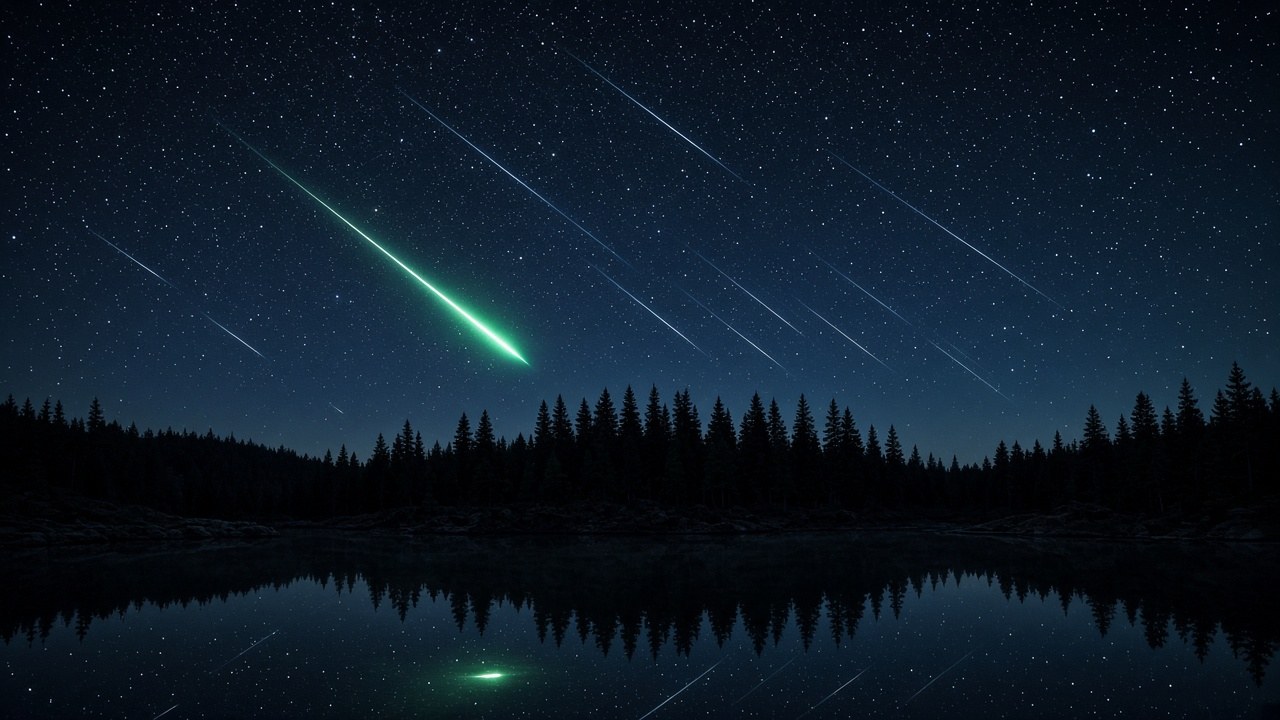
The Leonid Meteor Shower: Comet Dust and History’s Great Meteor Storms
In November 1966, skywatchers saw Leonid meteors arriving at a rate of thousands per minute. NASA describes it as meteors appearing “to fall like rain.” Tonight the same shower returns, though it’ll be far gentler. The Leonid meteor shower peaks around Nov. 17, 2026. Here’s when to look, what you can realistically expect, and why this modest shower is famous for some of the greatest meteor storms on record.
When to see the Leonid meteor shower in 2026
The three main references give slightly different peak times, mostly because they measure different things:
- Active period: Nov. 6 to 30, according to the International Meteor Organization (IMO), NASA and the American Meteor Society (AMS).
- Peak night: NASA and the AMS list the night of Nov. 16–17, which is tonight.
- Predicted maximum: the IMO’s 2026 calendar puts the regular maximum, when Earth crosses the plane of the comet’s orbit, at Nov. 17, 23:45 UT. That’s 6:45 p.m. EST on Nov. 17. The calendar also notes an alternative prediction by Maslov of Nov. 17 at 16:00 UT, or 11 a.m. EST.
- Rates: the IMO expects a zenithal hourly rate (ZHR) of about 15. That’s the number one observer would see under a perfectly dark sky with the radiant directly overhead. NASA warns that real-world rates are “often as low as about three meteors per hour.”
That ZHR of 15 is an idealized figure. It assumes the radiant is straight overhead and the sky is perfectly dark. Under a suburban sky, with the radiant lower and some moonlight, you’ll see fewer. NASA’s “fewer than 3 meteors per hour” for a dark sky is a better guide to an ordinary year. Patience matters more than equipment. NASA’s advice is simply to lie back and take in as much of the sky as possible, and to give it time, since the show runs until dawn.
In practice, both of the predawn windows either side of the predicted maximum are worth trying: the early hours of tomorrow, Nov. 17, and of Nov. 18. NASA says the Leonids are best viewed from about midnight local time, and the show lasts until dawn.
The Moon: the IMO notes that the Leonid maximum falls when the Moon is near first quarter, and its 2026 lunar table lists first quarter on Nov. 17. The AMS says the Moon will be 39% lit, a waxing crescent, on the peak night, and that “moonlight may obscure fainter meteors while the Moon is above the horizon.”
How to watch
NASA’s tips are simple. Get well away from city and street lights, dress for winter temperatures and lie flat on your back with your feet toward the east. Then look up and take in as much sky as you can. Give your eyes about 30 minutes to adjust to the dark.
You don’t need to stare at Leo. The meteors seem to come from a point in the constellation, called the radiant, but they cross the whole sky. NASA points out that meteors seen away from the radiant look longer and more spectacular. Those close to it look short, a perspective effect called foreshortening.
Where Leonids come from
Every meteor shower is Earth plowing through a stream of debris. When a comet swings near the Sun, NASA explains, the dust it gives off spreads into a trail along its orbit. Earth passes through that trail at the same time each year, and the bits burn up in our atmosphere as streaks of light.
The Leonids’ parent is comet 55P/Tempel-Tuttle. It was discovered independently twice, by Ernst Tempel in 1865 and Horace Tuttle in 1866. It goes around the Sun once every 33 years. NASA puts its nucleus at only about 3.6 kilometers (2.24 miles) across, small for something that has produced such displays.
Leonids are also among the fastest meteors. The IMO lists their entry speed as 71 km/s, and NASA gives 44 miles (71 km) per second. NASA describes Leonids as bright meteors that “can also be colorful.” They’re known for fireballs, which come from larger particles of comet material and shine brighter than magnitude −3, and for “Earth-grazers,” which skim close to the horizon with long, colorful tails.
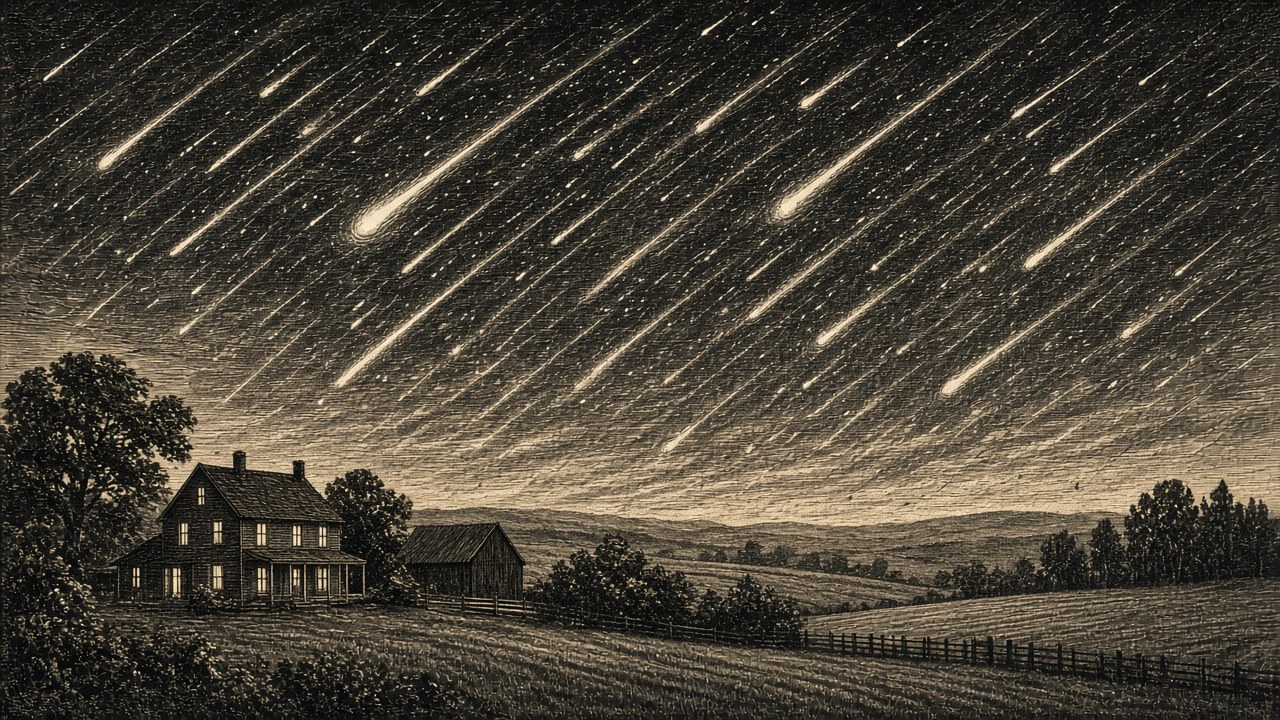
Illustration: an old-style engraving of a meteor storm, the kind of display the Leonids have produced in storm years.
Why the Leonids make meteor storms
Most years the Leonids are a light shower. But every 33 years or so, NASA explains, viewers may see a Leonid storm, with hundreds to thousands of meteors per hour. A storm is defined as at least 1,000 meteors per hour.
The AMS lists Leonid storms in 1833, 1866, 1966, 1999, 2001 and 2002. NASA counts 2002 as the most recent. The famous 1966 storm produced “thousands of meteors per minute” during a 15-minute period.
The timing isn’t a coincidence. The AMS explains that storms are best seen when the comet is near perihelion, its closest point to the Sun. But it isn’t fresh dust from the comet we see. It’s debris shed on earlier passes, which happens to be densest at the same time.
That’s why forecasters model individual dust trails, each labeled by the year the comet shed it. The oldest one in this year’s list dates to 1533, so that dust has been drifting along the comet’s orbit for nearly 500 years. For 2026, the IMO calendar lists several encounters calculated by the dynamicists Vaubaillon and Sato, all weak or low level:
- Nov. 17, 10:33 UT: a trail from 1533 (weak, Sato).
- Nov. 18, 21:55 UT: a trail from 1800 (low level, Vaubaillon).
- Nov. 19, around 03:30 to 03:50 UT and again around 16:30 UT: trails from 1699 and 1600.
Vaubaillon’s note says the 1800 trail reaches Earth but doesn’t hold enough meteoroids “for a significant outburst.” Sato suggests that lower ejection speeds than in some recent cases “may imply a modest increase of meteor activity.” In other words, a slight bump is possible. A storm isn’t expected.
What comes next for the Leonids
Tempel-Tuttle’s next perihelion is due on May 20, 2031, according to the IMO, so the meteoroids we see this year are running ahead of the comet. That return, and the one in 2064, might seem like the moment for another storm. The AMS isn’t optimistic. It says “it appears that Earth will not encounter any dense clouds of debris until 2099.” The comet’s returns in 2031 and 2064 may not bring storms, though they “may” bring good displays with rates topping 100 per hour.
Meteors have puzzled people for a long time. Francis Bacon’s list of things sharing “the nature of heat” included “fiery meteors” alongside thunderbolts and volcanoes, as Odinity’s selection of Aristotle, Bacon, Descartes and Boyle shows. Today we know a Leonid is a grain of dust from Tempel-Tuttle, burning up high in the atmosphere at about 71 kilometers per second.
What’s settled and what’s uncertain
Settled:
- The Leonids come from comet 55P/Tempel-Tuttle.
- They’re active Nov. 6 to 30 and peak around Nov. 17.
- They hit the atmosphere at about 71 km/s.
- Storms come from older dust trails crossed near the comet’s return.
Uncertain:
- The exact hour of the 2026 peak. The IMO quotes two predictions about eight hours apart.
- Whether the weak trail encounters will add anything noticeable.
- How strong future returns will be. Forecasts depend on modeling dust trails laid down centuries ago.
Whatever happens, it costs nothing to look. Go out after midnight, let your eyes adjust and you may catch one of the fastest meteors there is. For more detail, see NASA’s Leonids page.