
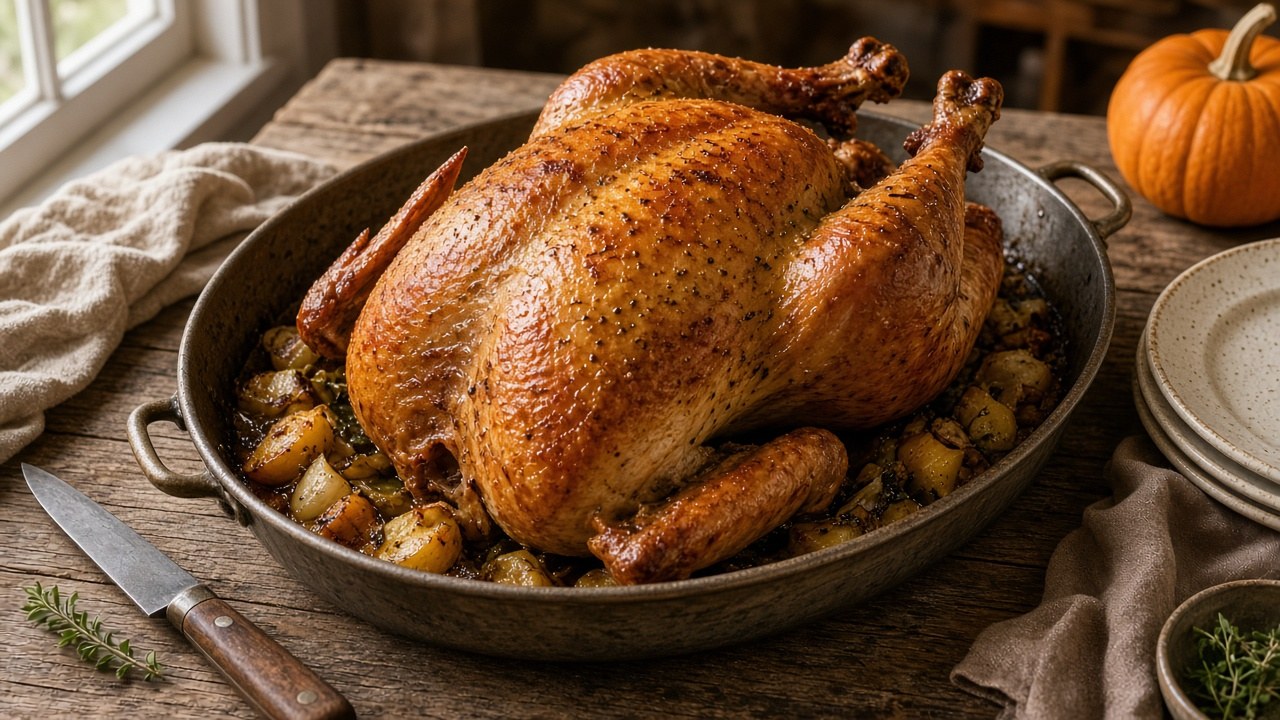
The Maillard Reaction: The Chemistry That Browns Your Thanksgiving Turkey
The turkey goes in pale and comes out golden brown, and the kitchen smells completely different by then. Much of that change on Thanksgiving, Nov. 26, comes from one family of chemistry. The Maillard reaction is the reaction between amino acids and sugars that browns roasted meat, bread crust and coffee beans, and it builds a wide range of flavor and aroma molecules along the way. More than a century after it was first described, food chemists are still working out its details.
A browning reaction without enzymes
Food browns in two very different ways. A 2025 review in Foods by Leina El Hosry and colleagues explains that the enzyme polyphenol oxidase uses oxygen to link phenolic compounds into brown pigments. The Maillard reaction, they write, also makes brown colors, “but it occurs without the involvement of any enzyme catalysis.” That’s why chemists call it non-enzymatic browning.
The reaction is named for Louis Camille Maillard, a French chemist. The review says he discovered the browning in 1912 when he heated a solution containing a sugar and an amino acid. The reaction does far more than color food. According to the review, it produces the “pleasant flavor” and “appealing color” of foods such as bread, coffee and chocolate. It can also cause off-flavors and discoloration and reduce the nutritional value of proteins.
How the Maillard reaction works, step by step
The two ingredients are a reducing sugar, such as glucose, and a molecule with a free amino group, usually from an amino acid, peptide or protein. A chemistry text from LibreTexts puts it simply: “An amino group from a protein combines with a reducing sugar to produce a brown colour.” The El Hosry review splits what follows into roughly three stages.
Stage 1: sugar meets amine
The review calls the early stage “odorless and colorless.” The amino group attacks the sugar’s carbonyl group (its C=O), and the two condense into a compound called a Schiff base, with water as the leaving group. That product is reversible. It then undergoes the Amadori rearrangement, in which the carbonyl shifts from the sugar’s first carbon to its second, giving “a more stable ketoamine compound.”
Stage 2: the aroma factory
Next, the Amadori products break apart into highly reactive fragments, especially α-dicarbonyl compounds. In the Strecker degradation, these fragments react with amino acids to release volatile Strecker aldehydes that “contribute to the characteristic aroma and flavor.” The same stage produces furans, which add a “nutty, caramel-like aroma,” and pyrazines, which the review describes as “responsible for the roasted, nutty flavors in several foods and beverages.”
Stage 3: the brown polymers
In the final stage, small molecules join into melanoidins, which the review describes as “high molecular weight, brown-colored compounds with a complex structure.” These give a crust its color. A separate 2024 review chapter, “The Maillard reactions: pathways, consequences, and control,” sums up the whole process. “The simple nucleophilic attack of an amine onto a carbonyl group,” it says, sets off “a series of parallel and subsequent reactions, occurring simultaneously,” producing “a vast array of low and high mass compounds.”
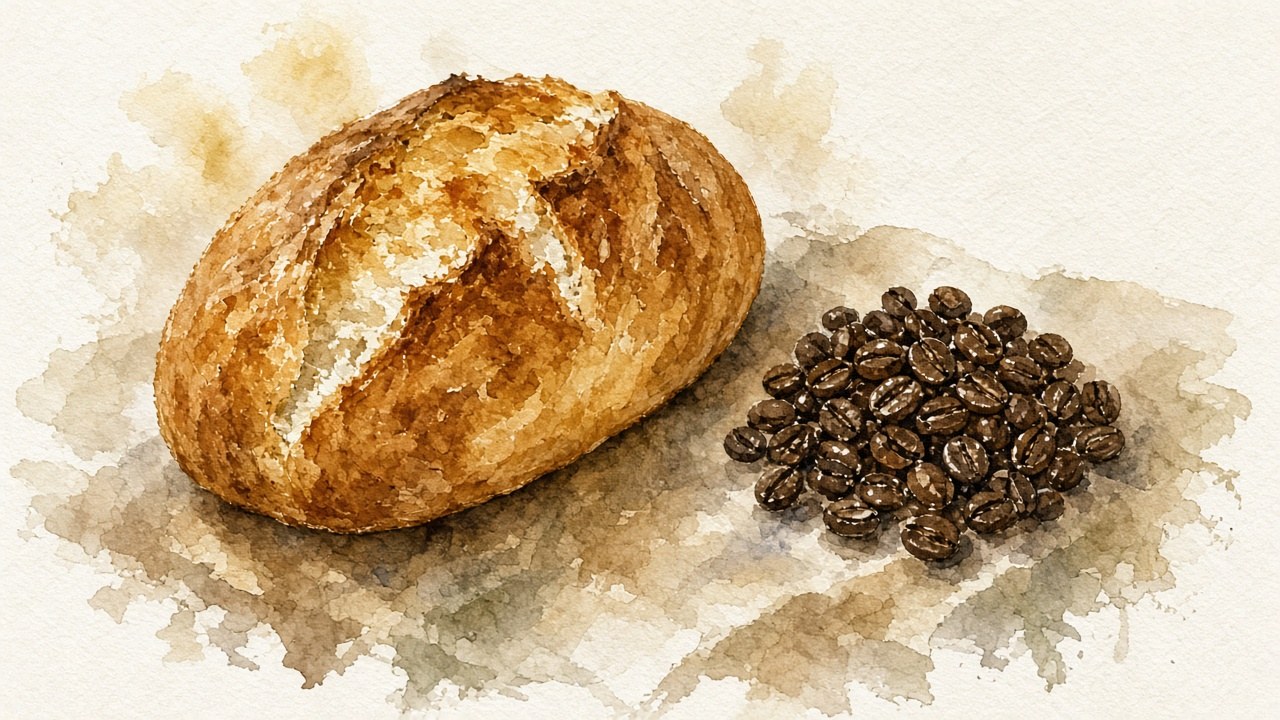
Illustration: bread crust and roasted coffee beans, two foods browned by the Maillard reaction.
What speeds it up: heat, water and pH
Heat. “The higher the temperature, the faster the reaction,” the El Hosry review says, in line with standard rate laws. But it also corrects a common misconception. The Maillard reaction doesn’t only happen at high temperatures. It can run slowly in cold storage and, in some cases, below freezing. One study the review cites found Maillard products building up in meatballs stored at −18 °C. Heat just makes it go much faster. The review notes that in baking, crust browning typically occurs at around 160 °C.
Water. Too much water holds the reaction back. The review says the reaction rate typically peaks at a water activity of about 0.6 to 0.7. Beyond that, “the reaction slows due to excessive free water diluting the reactants.” Its summary figure lists the conditions that speed the reaction: moderate water activity (0.5–0.8). It slows when water activity is below 0.4 or above 0.9. The review also describes baking in three phases, “dough expansion, surface desiccation, and crust browning.” The surface has to dry out before it browns.
pH. Only the unprotonated, basic form of an amino group can attack a sugar. That means acidity slows the reaction. “At pH values below 6, the rate of the Maillard reaction is very low,” the review states. Alkaline conditions (pH 7 and above) speed it up and favor the nitrogen-containing ring compounds behind roasted aromas.
Which sugar. The type of sugar matters too. The review notes that glucose and fructose react differently. It also says monosaccharides react faster than larger sugars, because bigger molecules are more crowded around their reactive groups. Ordinary table sugar, sucrose, is a disaccharide. When it’s split into glucose and fructose, the products are the simpler sugars. You can follow that splitting in Odinity’s lab on the inversion of sucrose, which tracks it with polarized light.
Maillard reaction vs. caramelization
Both turn food brown, so the two are often confused. The American Society of Baking explains the difference: Maillard reactions “require the availability of sugars and free amino groups,” while caramelization “takes place using only sugars as substrates.” Caramelization, it says, is “a poorly understood series of pyrolysis reactions” that happen when sugars are heated strongly. The starting temperature depends on the sugar: about 150 °C for fructose and 180 °C for maltose. Both reactions can happen at the same time, and the El Hosry review names them as “the two non-enzymatic browning reactions” responsible for color and aroma during baking.
Meat is a Maillard food. The review says the reaction is used in meat processing “to change the color and flavor of the meat,” and it lists amino acids, reducing sugars, fats and thiamine as key flavor precursors in meat. A pan of sugar melting into caramel, with no protein present, is caramelization.
The downside chemists are watching
The same reaction that makes flavor can also make unwanted compounds. According to the U.S. Food and Drug Administration, acrylamide “forms from sugars and an amino acid (asparagine)” during high-temperature cooking such as frying, roasting and baking. The FDA says boiling and steaming “do not typically form acrylamide.” It adds that acrylamide is found mainly in plant foods such as potato and grain products and coffee, and forms at lower levels or not at all in dairy, meat and fish.
The FDA says acrylamide “caused cancer in animals in studies where animals were exposed to acrylamide at very high doses.” It reports that in 2010 a joint FAO/WHO expert committee concluded it is a human health concern and called for more long-term studies. The El Hosry review also lists heterocyclic amines, furans and N(6)-carboxymethyllysine among the harmful compounds the reaction can generate. This is a chemistry article, not dietary guidance. For what agencies currently advise, see the FDA’s acrylamide questions and answers.
Chemists track browning by measuring it. The review cites color measured as absorbance at 420 nm, the same kind of light-absorption measurement explained in Odinity’s piece on why proteins absorb at 280 nm.
What’s settled and what’s still open
Settled chemistry:
- The reaction starts when an amino group attacks a reducing sugar’s carbonyl.
- It passes through Schiff base and Amadori products to Strecker aldehydes, pyrazines and brown melanoidins.
- It speeds up with heat, at moderate water activity and at higher pH.
- Caramelization is a separate, sugar-only browning reaction.
Still being worked out:
- The 2024 chapter says research is focusing on how α-dicarbonyl intermediates form and transform, and on working out the structures of melanoidins in different foods.
- The health effects of Maillard products are uncertain. The El Hosry review notes “contradictory information” about them and says more research is needed.
- Caramelization itself is still “poorly understood,” according to the baking society.
Maillard first described this reaction in 1912, and researchers are still adding to the list of what it makes.