
DART Asteroid Impact How NASA Moved an Asteroid
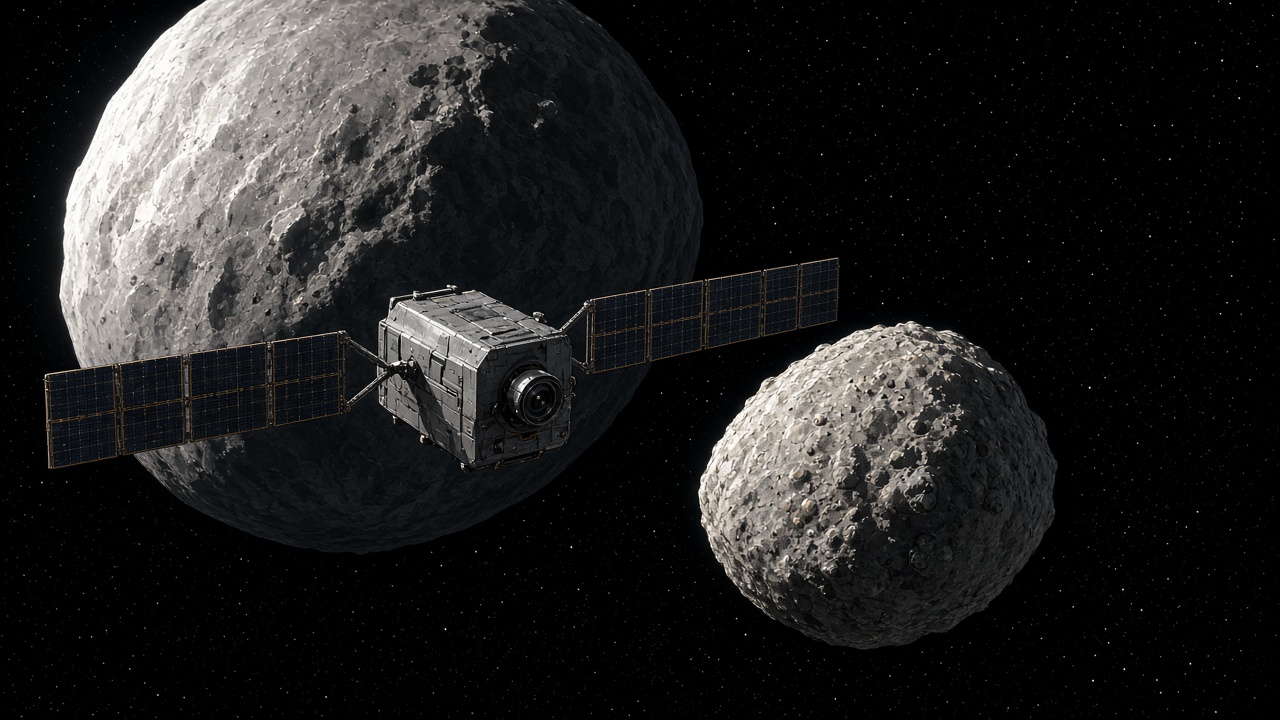
On 26 September 2022, at 23:14 UTC, a spacecraft with two 8.5-meter solar panels flew straight into an asteroid moon called Dimorphos, on purpose. The DART asteroid impact (DART stands for Double Asteroid Redirection Test) was humanity’s first real test of whether we can change an asteroid’s path by hitting it. It worked better than the simplest prediction. And the surprise in the results was where most of the push came from: not the spacecraft itself, but the rubble it blasted off the asteroid, which supplied about as much push as the spacecraft did, or more.
Why NASA hit a moon instead of an asteroid
Dimorphos orbits a larger near-Earth asteroid called Didymos. Neither poses any threat to Earth. A 2026 study notes that DART could not have put the system on a collision course, and that Earth remains safe from it for at least the next 100 years. The pair was chosen because of a measuring trick. According to the 2023 Nature paper by Cristina Thomas and colleagues, a moon orbiting its parent can be timed from Earth. As Dimorphos passes in front of and behind Didymos, the pair’s combined brightness dips slightly, and telescopes can time those dips precisely. Hitting a single asteroid that orbits the Sun would have changed its path by an amount far too small to measure quickly. Hitting the moon of a binary changes a 12-hour orbit, which ground telescopes can track night after night.
Before the impact, Dimorphos circled Didymos once every 11.92 hours (11.92148 hours, according to Thomas and colleagues). DART was aimed head-on into its leading side, to slow it down, pull it slightly closer to Didymos and so shorten that period.
The DART asteroid impact, second by second
The impact itself is described in a 2023 Nature paper led by R. Terik Daly. DART flew the last four hours on autopilot. Its onboard navigation system took over 4 hours and 5 minutes before impact, first steering toward Didymos because Dimorphos was too faint to see. It picked out Dimorphos 73 minutes before impact and began steering toward it at 50 minutes. The camera kept streaming images to Earth to the very end. The last full image was taken 1.818 seconds before impact, at a scale of 5.5 centimeters per pixel.
Those images showed a world nobody had seen before. Dimorphos turned out to be a squashed ball about 151 meters across, covered in boulders, with no clear craters. The team read that as a sign of a young surface and of a loosely packed “rubble pile,” like the asteroids Bennu and Ryugu. DART struck within 25 meters of the asteroid’s center, between two large boulders about 6 meters long. Its two solar panels clipped the boulders just before the main body hit.
What changed, and by how much
Before the impact, the team expected a simple, clean collision, with all of DART’s momentum absorbed and nothing thrown back, to shorten the orbit by roughly 7 minutes. Thomas and colleagues reported the measured change as 33.0 minutes, plus or minus 1.0 minute, shortening the orbit to about 11.37 hours. Two independent analyses, one using telescope brightness data alone and one combining radar with the timing data, got the same answer. Dimorphos now completes an extra orbit roughly every 9.8 days compared with its old pace.
Later work sharpened the number. In 2024, a team led by Shantanu Naidu at NASA’s Jet Propulsion Laboratory reported in the Planetary Science Journal a total change of 33 minutes and 15 seconds, accurate to within about 1.5 seconds. The impact cut 32 minutes and 42 seconds immediately, and the period kept shrinking over the following weeks, which NASA attributes to Dimorphos continuing to shed material. NASA says Dimorphos now orbits about 37 meters closer to Didymos, in a slightly elongated orbit.
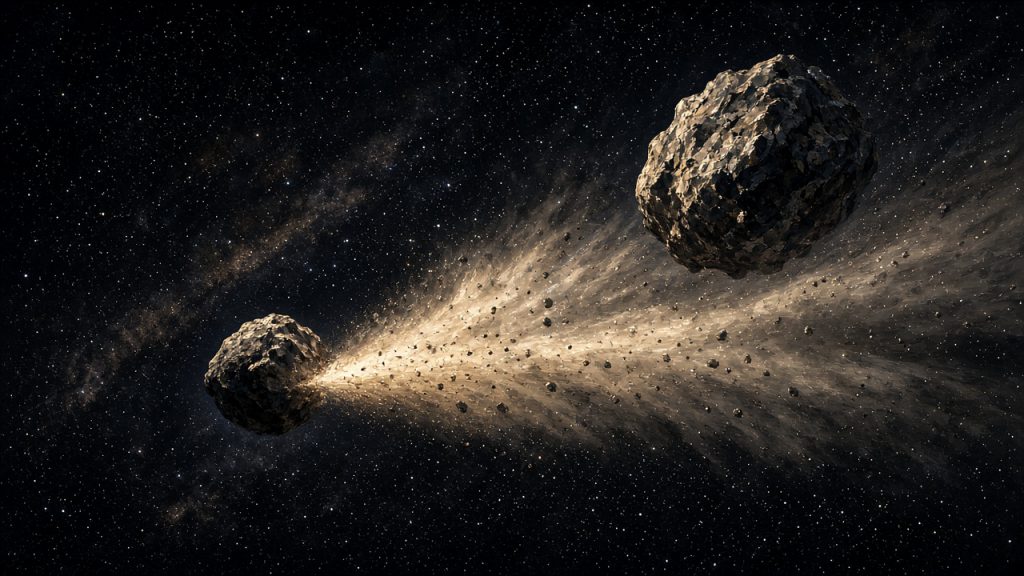
Illustration of the debris plume after the impact. The recoil from this material did much of the pushing (artist’s impression).
Why the debris mattered
The real story is in that gap between 7 minutes and 33. When DART hit, it blasted out a huge plume of rock and dust, seen by Earth and space telescopes and by a small Italian probe, LICIACube, which flew past about 168 seconds after impact. That material shot away in roughly the direction DART came from, and like the recoil of a rifle, it shoved Dimorphos the other way.
Scientists measure this with a number called β (beta), the momentum enhancement factor. It is the total push the asteroid received divided by the push from the spacecraft alone. A β of 1 means the debris added nothing. A β above 2 means the debris pushed harder than the spacecraft did. In a second 2023 Nature paper, Andrew Cheng and colleagues worked out that the impact cut Dimorphos’s orbital speed by 2.70 millimeters per second. From that, they calculated β.
There was a catch. Working out β requires the mass of Dimorphos, and DART never measured it. Daly’s team estimated a density of 2,400 kilograms per cubic meter by assuming Dimorphos is as dense as Didymos, an assumption they said “cannot be rigorously tested from DART data.” At that density, Cheng’s team found β = 3.61. Across a plausible range of densities, it ran from 2.2 to 4.9. Either way, the debris contributed more push than the spacecraft did.
The push you could see from the Sun’s point of view
In March 2026, a study in Science Advances led by Rahil Makadia of the University of Illinois Urbana-Champaign added a new result. Because Didymos and Dimorphos are bound together, some of the debris escaped the pair entirely and nudged the whole system’s path around the Sun. Volunteer astronomers recorded 22 “stellar occultations” between October 2022 and March 2025, moments when the asteroid passed in front of a star and briefly blocked it. Using those, the team measured a change in the system’s speed around the Sun of 11.7 micrometers per second (plus or minus 1.3). That shortened its 770-day orbit around the Sun by about 0.15 seconds. NASA calls it the first time a human-made object has measurably altered a celestial body’s path around the Sun.
The same study weighed Dimorphos indirectly and found it lighter than assumed, with a density of about 1,540 kilograms per cubic meter. Using that lower mass, it put Dimorphos’s β at about 2.1. That looks like a conflict with Cheng’s 3.61, but the authors explain it isn’t. The 3.61 figure assumed the 2,400 density. Once the new density is plugged into Cheng’s own density-to-β relationship, the two results agree statistically. Both studies point the same way: the debris roughly doubled, or more than doubled, what the spacecraft could do alone.
What’s settled and what’s still open
Settled:
- DART hit its target autonomously, and Dimorphos’s orbit around Didymos shortened by about 33 minutes. Independent teams and methods agree.
- Ejecta recoil added substantially to the push. Every published estimate of β is above 1, and most are around 2 or higher.
- The impact also slightly changed the pair’s orbit around the Sun.
Still open:
- The mass and inner structure of Dimorphos. Every β estimate depends on mass, and the published densities differ. Daly’s team said Hera “will determine the masses and densities” and test the equal-density assumption.
- Whether DART reshaped Dimorphos. NASA’s summary of the Naidu study says the asteroid went from a squashed ball to an elongated “watermelon” shape. That conclusion comes from orbit modeling, not from images taken after the impact.
- How well DART’s β applies to other asteroids. Cheng’s team notes that different combinations of strength, porosity and friction can give similar β values in simulations. A tougher, denser asteroid might not throw off as much debris.
- Warning time. Daly’s team stresses that a kinetic impactor needs years, preferably decades, of warning. That makes finding asteroids early as important as hitting them.
The next answers are close. The European Space Agency’s Hera spacecraft, launched on 7 October 2024, has arrived at the Didymos system in November 2026, a month earlier than first planned, and has begun what the agency calls its early characterisation phase, to carry out a close-up “crash scene investigation.” If you want another look at what rubble-pile asteroids are made of, our story on the salty minerals found in samples from asteroid Bennu covers the asteroid that Dimorphos’s surface resembles.