
White Sands Footprints and the Dating Debate
For much of the twentieth century, the standard picture of the first Americans was “Clovis first”: the makers of distinctive stone spear points, named for a site near Clovis, New Mexico, were thought to be the continent’s earliest people, arriving about 13,000 years ago. Older sites gradually won acceptance, and before 2021 the earliest widely accepted dates sat around 16,000 years ago. Then, in 2021, a team reported human footprints pressed into ancient mud at White Sands National Park in New Mexico, with dates of about 23,000 to 21,000 years. If those White Sands footprints are really that old, people were walking in the American Southwest at the coldest point of the last ice age, when ice still blocked the land route from Asia. The dates have been argued over ever since, and both sides have published real evidence. Here’s what the tracks show, what the dating fight is actually about, and what remains unsettled.
A lake that became dunes
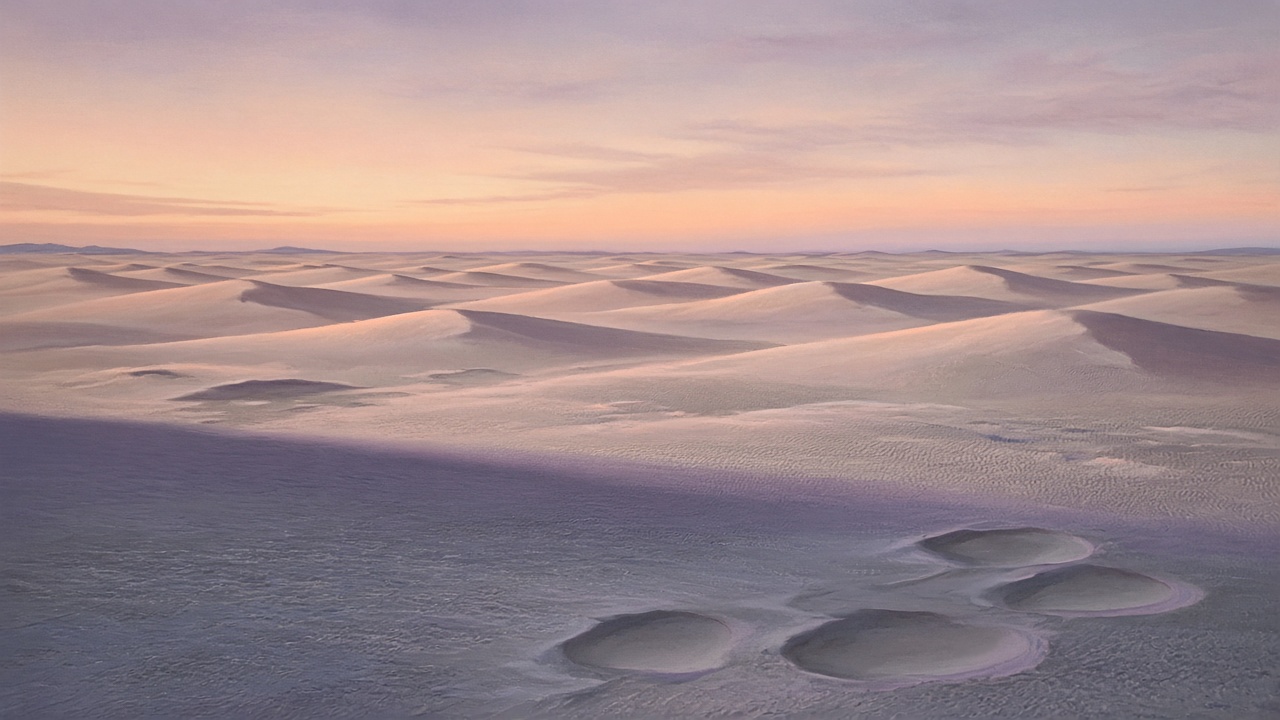
White Sands is famous for its white gypsum dunes, but those are recent. The National Park Service explains that during the ice age the Tularosa Basin held a large body of water, Lake Otero, in a climate wetter than today’s desert, with grasslands stretching for miles. Plant-eaters including ancient camels, Columbian mammoths and Harlan’s ground sloth fed there, and predators including the dire wolf and the American lion followed them. Their tracks, and human ones, were buried and preserved.
The park’s account of the research says a trench dug into the gypsum soil on the park’s western playa found human footprints in several layers of sediment. Above and below those prints were seeds of an aquatic grass, Ruppia cirrhosa, and radiocarbon dating of those seeds gave calibrated ages of 22,860 (±320) and 21,130 (±250) years ago. The park summarizes the result as humans living in the Tularosa Basin for at least 23,000 years, against the earlier expectation of roughly 13,500 to 16,000 years ago.
The tracks themselves tell small human stories. In 2018, researchers found a set they believe belonged to a woman who walked nearly a mile, with a toddler’s prints appearing beside hers now and then. The prints widen and slip where she was carrying the child, and they suggest she shifted the child from side to side and set it down at times. The park also reports that most of the prints in that study, judged by stature and walking speed, seem to come from teenagers and children. And one set of human prints sits inside the prints of a giant sloth, which looks like stalking, though the park notes there’s no evidence the hunt succeeded.
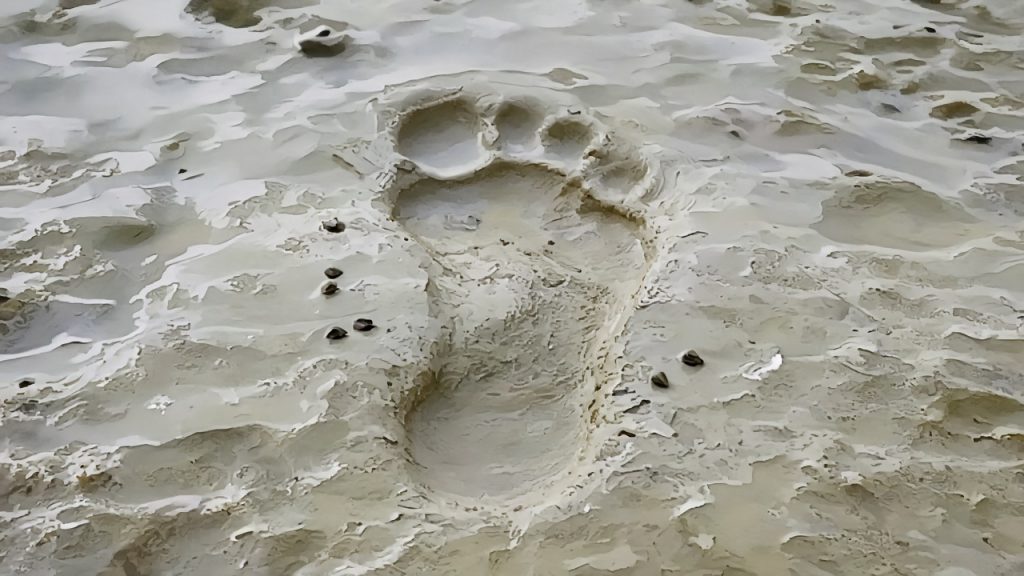
Illustration of a footprint in wet mud beside small seeds, the kind of material used to date the tracks (artistic, not the actual site).
Why the White Sands footprints dates were challenged
The problem is the plant that was dated. Ruppia cirrhosa grows in water, so it can take up carbon that has been sitting in groundwater for a long time. That “hard-water effect” would make its seeds look older than they are. The 2023 follow-up study in Science, led by Jeffrey Pigati and Kathleen Springer of the U.S. Geological Survey, lays out a second worry too: Ruppia seeds are tough and can survive for geological timescales, so old seeds might have been dug out of older deposits and redeposited with the footprints. If so, the seeds would only tell you that the prints are younger than the seeds, not how old they are.
Critics put numbers on the worry. Charles Oviatt, David Madsen, David Rhode and Loren Davis, writing in Quaternary Research in 2022, tested Ruppia collected in 1947 from Malpais Spring, near the basin. Those specimens, only decades old, returned a radiocarbon age of about 7,400 calibrated years. A plant that grew within living memory but dates as thousands of years old is direct evidence that something in the local water can skew the clock. Their conclusion was measured rather than dismissive: the footprints are “fascinating and potentially important,” but the ages “have larger uncertainties than has been reported,” and the prints should be dated by independent methods.
The reply: three clocks, one answer
The White Sands team did exactly that. For the 2023 paper they went back to the same layers and dated something that never lived in the water: pollen from land plants, which take their carbon from the air. They also dated the sediment itself with optically stimulated luminescence (OSL), which measures how long quartz grains have been buried in the dark.
The pollen, separated grain by grain with a technique called flow cytometry, gave calibrated ages from 23.4 ± 2.5 to 22.6 ± 2.3 thousand years. The uncertainties are large, the authors explain, because isolating the pollen required so much handling that the correction for stray modern carbon is about ten times the usual size. The three OSL samples, all from one level near the bottom of the footprint-bearing sequence, give a minimum age of more than 21.5 ± 1.9 thousand years. Both sets, the paper says, are statistically indistinguishable from the original seed ages, which ranged from about 22.9 to 21.1 thousand years across 11 samples and kept their correct order from bottom to top of the trench.
The authors’ argument is about agreement. Their phrasing is that resolving the controversy “requires that there is no combination of physical or chemical processes that could cause the ages of three independent chronologic data sets to converge on a single age range while simultaneously being incorrect or biased.” They conclude the framework is robust and that humans were present in North America during the Last Glacial Maximum, which they define as roughly 26,500 to 19,000 or 20,000 years ago.
Outside specialists quoted by Science magazine’s news coverage agreed. Thomas Higham of the University of Vienna called it “crucial and compelling confirmation,” and OSL specialist Helen Roberts of Aberystwyth University said it was “very striking how those ages come together despite those challenges.”
Why some specialists still aren’t convinced
The same news article records that the critics didn’t fold. Loren Davis of Oregon State University, who co-authored the critical papers, told Science that the sediment burying the prints could have been eroded out of much older deposits, and that the clay dated by OSL might be older lake-floor material redeposited on top of younger mud. The study’s authors say there’s no evidence of that erosion, but Davis wanted more OSL dates taken directly from the sediments holding the footprints.
On NPR, Davis went further. Because the quartz samples came from the very bottom of the sequence and the age range is wide, he said the results really only show “that the clay that underlies all the footprints is potentially as young as 16,000 and potentially older than 21,000.” His verdict: “I unfortunately don’t share their conclusions that they have resolved the issue of timing of when people were making these footprints.”
That objection was then put in print. A 2024 paper in the journal PaleoAmerica argues that all three methods can be read as giving maximum ages rather than true ones: the seed dates because of carbon-isotope evidence for age offsets, the OSL dates because of possibly incomplete resetting of the quartz and because the samples sit below most of the trackways, and the pollen dates because the samples may contain older, redeposited conifer pollen. The authors say these factors “imply a significantly younger chronology.” The Pigati team had anticipated the pollen point and tested it, dating conifer pollen from a modern playa surface at the park and finding it indistinguishable from today’s atmosphere, but the critics weren’t persuaded. The White Sands team replied in the same journal later that year, in a paper titled “The geochronology of White Sands Locality 2 is resolved,” arguing that each objection was without merit.
A third line of evidence
In 2025, a separate group led by Vance Holliday of the University of Arizona published an independent look at the ancient lake itself in Science Advances. They traced previously unrecognized lake and wetland beds along the escarpment and showed those beds can be followed directly into the alluvium that holds the tracks. Twenty-six new radiocarbon dates, 21 on wetland mud and five on Ruppia seeds, measured by two laboratories that weren’t involved in the original track dating, put that lake, wetland and stream record at older than 23,600 to about 17,000 calibrated years ago. Dates of about 22,400 to 20,700 years from one area, Gypsum Overlook, line up in both elevation and stratigraphy with the track layers dated at about 23,000 to 21,000 years.
This matters because it changes the shape of the argument. A critic now has to explain not just the seeds but the pollen, the luminescence and a whole adjacent lake sequence dated mostly on different material by different labs. Holliday’s group says outright that dismissing all of it “requires serendipity in the extreme.”
Even so, the 2025 paper doesn’t end the dispute, because it doesn’t touch the critics’ sharpest remaining point. The new dates come from the beds that interfinger with the track layers, not from something inside the footprints themselves, and the critics’ 2024 paper is still in print arguing the trackway chronology is younger. Convergence of several methods is strong evidence. It is not the same thing as proof that every method shares the same blind spot.
What it would mean, and what we don’t know
Well supported: the footprints are human, they sit in multiple layers alongside tracks of ice age megafauna, and three different dating methods applied to the same layers give overlapping ages between roughly 23,000 and 21,000 years. A fourth study of the surrounding lake deposits is consistent with that.
Genuinely disputed: whether those ages are the true age of the footprints or merely a ceiling on it. The hard-water problem is real and demonstrated locally, the critics have published specific mechanisms that could make each method too old, and no single dated object is both undeniably the same age as a footprint and immune to every objection.
If the early dates hold, the consequences are large. The Pigati paper says the finding pushes back the peopling of the Americas by thousands of years and implies people and megafauna shared the landscape for several millennia. Science‘s news piece notes that an accepted arrival around 16,000 years ago has led archaeologists to focus on a Pacific coastal route, since the inland route through Canada was under ice. People in New Mexico by 21,000 years ago would mean the journey happened before those ice sheets closed.
The people whose connection to the place is oldest have their own view of the argument. Kim Charlie, an enrolled member of the Pueblo of Acoma who sits on its tribal historic preservation board and who herself found some of the prints, told Science: “These tracks trace back to us, back to the Indigenous people of North America.” She wishes the focus were less on the dates and more on what the prints record, including one set of two adults and a child whose feet slipped and slid in the mud. “This was a family,” she said.