
Rogue Waves Are Real: What Science Now Knows
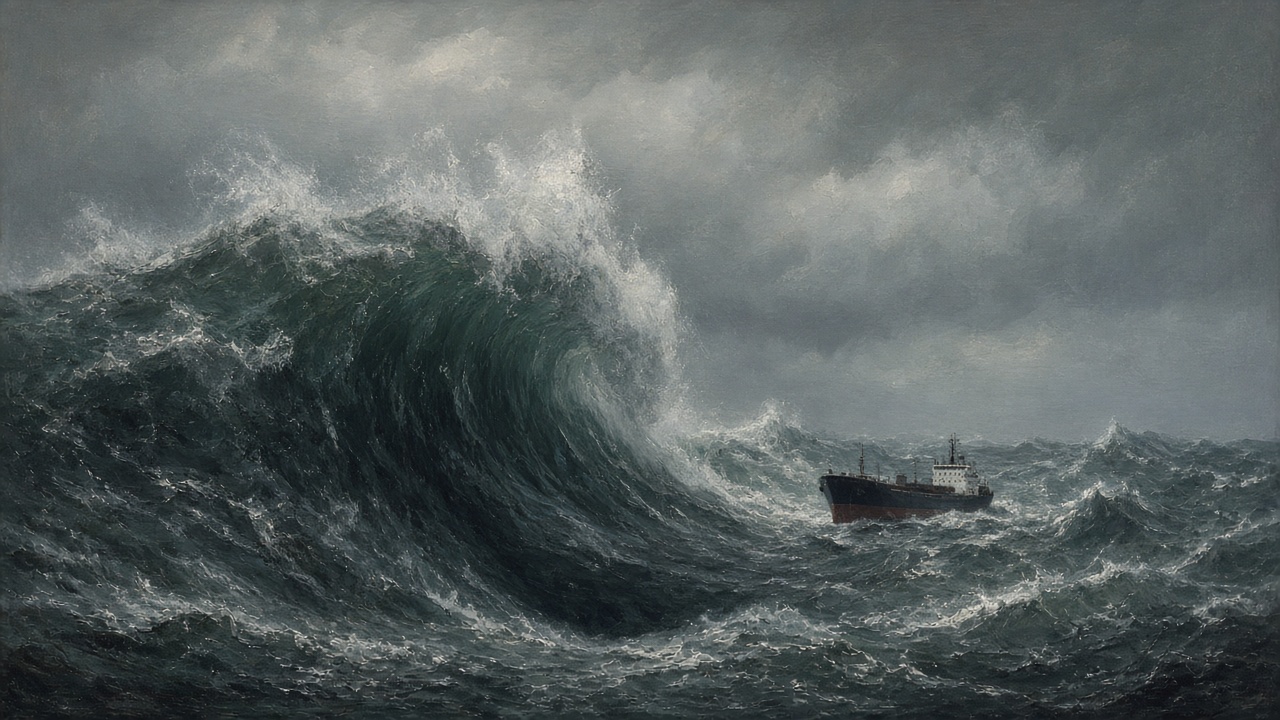
For centuries, sailors told stories about “walls of water” that rose out of nowhere and smashed ships, and for a long time those stories were treated as exaggeration. NOAA’s National Ocean Service puts it plainly: rogue waves, also called freak or killer waves, “have been part of marine folklore for centuries, but have only been accepted as real by scientists over the past few decades.” What changed wasn’t the ocean. It was the instruments. Once scientists could measure waves continuously, the monsters started showing up in the data.
What counts as a rogue wave
NOAA describes rogue waves (which scientists also call “extreme storm waves”) as waves more than twice the size of the surrounding waves. They are very unpredictable and often arrive from directions other than the prevailing wind and waves. Witnesses describe them as “walls of water,” steep-sided with unusually deep troughs in front.
Scientists use a more precise yardstick, based on significant wave height. That’s the average height of the highest third of the waves, a standard measure of how rough the sea is. A 2021 study in Scientific Reports by Dion Häfner, Johannes Gemmrich and Markus Jochum says a rogue wave “is commonly defined as any wave that is higher than 2 or 2.2 times the significant wave height.” There’s a separate test for the crest, the part above the average sea surface. A 2016 study by Francesco Fedele and colleagues uses a crest more than 1.25 times the significant wave height. So a rogue wave isn’t defined by an absolute size. A 5-meter wave counts as a rogue in a sea whose significant wave height is 2 meters, while a 15-meter wave is unremarkable in a storm whose significant wave height is 10 meters.
The wave that changed minds
The turning point came on 1 January 1995 at the Draupner platform in the North Sea. A downward-pointing laser on the platform recorded a wave 25.6 meters high, from trough to crest, in a sea whose significant wave height was about 12 meters. The details come from a 2019 study in the Journal of Fluid Mechanics by Mark McAllister and colleagues at the University of Oxford and the University of Edinburgh. The crest alone reached 18.5 meters. The authors describe the Draupner wave as “one of the first verified measurements of a freak wave.” Its height was 2.13 times the significant wave height, comfortably over the rogue threshold.
Draupner wasn’t a one-off. The Fedele study discusses two more rogue waves measured since then. One is the Andrea wave, recorded in 2007 by lasers on the Ekofisk platform in the North Sea. The other is the Killard wave, recorded in 2014 by a buoy off the west coast of Ireland.
How common are rogue waves?
More common than “once in a lifetime” suggests, though each one is still rare for any given spot. Häfner and colleagues analyzed buoy records from 158 locations around the US coasts and overseas territories, using a dataset of about 1.5 billion individual waves. About 100,000 of those waves were more than twice the significant wave height. Per wave, the chance ranged from roughly 3 in 100,000 to 2 in 10,000, depending on sea conditions.
The Fedele paper cites a separate analysis of 122 million waves that found 3,649 rogue events, about one in every 33,000 waves. It also notes that, by the crest definition, a rogue crest turns up on average about once in every 10,000 waves. The authors stress that this is a probability per wave at one point. A ship crossing an ocean meets an enormous number of waves, so, as Häfner’s team notes, “the total risk to encounter a rogue wave will be dramatically higher” than the per-wave figures.
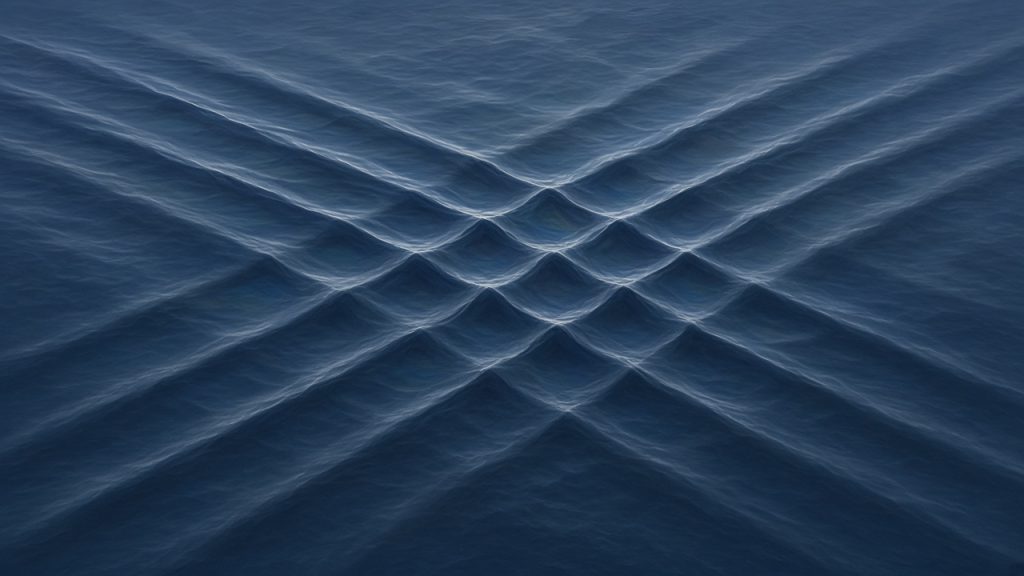
Illustration of two wave systems crossing, one of the conditions linked to the Draupner wave (artistic).
Why rogue waves form: the big debate
Here’s where science is still arguing. The McAllister paper describes two leading explanations for rogue waves in the open ocean.
1. Constructive interference (“dispersive focusing”). Ocean waves of different lengths travel at different speeds. Now and then, many of them line up so their crests coincide, and the sea briefly piles up into one huge wave. NOAA calls this the most common route: swells crossing at different speeds and directions sometimes “coincide and reinforce each other.” Real waves aren’t perfectly smooth sine curves. They have sharper crests and flatter troughs, and those “second-order” effects add a bit more height.
2. Modulational instability. Under certain conditions, a regular train of waves is unstable. Energy can flow nonlinearly from neighboring waves into one, growing it far beyond what simple adding-up would predict. Fedele and colleagues note this idea has been widely used to explain rogue waves since the 1990s, and it has been demonstrated in laboratory tanks and mathematical studies. But it works best when waves are long-crested and all travel the same way. McAllister’s team adds that it applies most strongly to seas that are narrow in both frequency and direction, in deep enough water.
Recent field studies lean toward the first explanation. Fedele’s team analyzed the Draupner, Andrea and Killard sea states and concluded that “the main generation mechanism for rogue waves is the constructive interference of elementary waves enhanced by second-order bound nonlinearities and not the modulational instability.” Their reasoning: real ocean seas are short-crested and multidirectional, so energy can spread sideways instead of focusing. Häfner’s billion-wave analysis reached a similar conclusion from a different direction, using machine learning on buoy data. The strongest predictor of rogue-wave risk turned out to be a statistical property called crest-trough correlation, roughly how closely the height of a crest is matched by the depth of the trough beside it. It’s calculated from the wave spectrum and is closely tied to how wave energy is spread across frequencies. Parameters tied to nonlinear focusing, such as wave steepness and the “Benjamin–Feir index,” were weak predictors. The authors suggest “everyday” rogue waves are mostly rare but natural outcomes of ordinary wave statistics.
That doesn’t settle it for every case. McAllister’s team notes that modulational instability “has been observed in the real ocean,” and that some studies suggest crossing seas at certain angles can even enhance it. Häfner’s team suggests the term rogue wave might be better reserved for truly different waves, such as those caused by modulational instability, rather than any wave that crosses an arbitrary threshold.
What recreated the Draupner wave in a tank
In 2019, McAllister and colleagues tried to rebuild the Draupner wave at scale in a circular wave tank at the University of Edinburgh’s FloWave facility, which can send waves in from every direction. When all the waves traveled the same way, breaking capped the height and they couldn’t reproduce Draupner. They managed it only when two wave systems crossed at a large angle, between about 60 and 120 degrees. In those crossing seas, the breaking wave behaved differently, throwing up near-vertical jets of water instead of toppling over. That supports earlier proposals that crossing seas created the Draupner wave.
The authors are careful about limits. The Draupner wave was a single laser measurement, and lasers can be confused by spray, so “it should be associated with a level of uncertainty.” Their tank also didn’t include wind or currents. Hindcasts of the storm also disagree on how much crossing there was. One 2011 study suggested about 80 degrees, while the Fedele study’s hindcast didn’t show crossing at all, though those authors called for a higher-resolution hindcast.
Other ingredients: currents and the seafloor
NOAA also lists ocean currents as a cause. When storm waves run into a strong current flowing against them, the interaction can push waves together into very large ones. NOAA names the Gulf Stream and the Agulhas Current off southern Africa as places where this is seen, and says such waves tend to last longer. Häfner’s team agrees there is “good evidence” that currents, winds and local seafloor shape matter in specific places. Their buoy dataset couldn’t capture those factors, and they found no notable difference between shallow and deep water in their data.
What’s still unknown
- The full recipe. Häfner and colleagues write that the causes of real-world rogue waves are “still unknown, and heavily debated.” Constructive interference explains most measured cases, but not necessarily all of them.
- Forecasting. There is “so far no reliable forecast” for rogue waves, according to Häfner’s team. They argue that the statistical property they identified can be computed from the wave forecasts that agencies already make, which could improve risk warnings.
- Data gaps. Most long records come from buoys near coasts and from a few platforms. Buoys can underestimate the very highest crests, and the open ocean far from shore is sparsely measured.
The sailors were right about one thing: walls of water exist. Where they were probably wrong was in thinking those waves were supernatural. Most of the evidence now suggests they’re the ocean doing ordinary physics on a very unlucky day. For more on the energy that ocean waves carry, see an analysis of wave energy phenomena, or a student talk on the Pelamis “sea snake” wave-energy machine.