
How Does Carbon Dating Work? Libby’s Clock Made of Carbon-14
Every living thing on Earth carries a faint radioactive signature, a tiny share of its carbon that is slowly ticking away. While a tree or an animal is alive, that share stays topped up. The moment it dies, the clock starts. Measure how much is left, and you can tell roughly when it died, whether it’s a bone, a scrap of linen or a plank from a pharaoh’s boat. So how does carbon dating work? It rests on a chain of physics that starts high in the atmosphere, an idea from a chemist in Chicago in the 1940s, and decades of careful correction that are still going on.
Where carbon-14 comes from
Most carbon is carbon-12, which is stable. A tiny fraction is carbon-14, also called radiocarbon, which is radioactive. It was first made in a lab in 1940 by Martin Kamen and Samuel Ruben, using a cyclotron at Berkeley, according to the American Chemical Society’s history of the method.
Nature makes it too. In 1939 the physicist Serge Korff found that cosmic rays striking the upper atmosphere produce neutrons. Korff predicted that those neutrons would react with nitrogen-14, the most common atom in air, to make carbon-14. The new carbon-14 combines with oxygen into carbon dioxide and mixes through the air like any other CO2.
The amount is minuscule. Starting from Korff’s estimate of about two neutrons per second for each square centimeter of Earth’s surface, Willard Libby calculated, as the ACS describes, that there should be roughly one carbon-14 atom for every 1012 carbon atoms, about one in a trillion.
Libby’s idea
Libby, a chemistry professor at the University of Chicago, began this work in 1945 and proposed the dating method in Physical Review in 1946. His insight was that carbon-14 in the air would find its way into living matter. Plants take in carbon dioxide; animals eat plants. So everything alive should be “tagged” with the same small share of carbon-14 as the atmosphere.
When an organism dies, it stops taking in carbon. Its carbon-14 keeps decaying, but nothing replaces it. The ACS calls the result a time capsule with a steadily falling carbon-14 count. Libby and others established the half-life of carbon-14 as 5,568 years, a figure later revised to 5,730 ± 40 years. After one half-life, half the carbon-14 is gone. After two, three-quarters. Compare what’s left with what a living sample holds, and you have an age.
For this to work, Libby needed two assumptions to hold, the ACS notes. First, the amount of carbon-14 in the atmosphere had to have stayed roughly constant for thousands of years. Second, carbon had to move freely between the air, oceans and living things, so that everything alive carried the same ratio. With no historical data on cosmic rays, Libby simply assumed they had been steady. The ACS says this later turned out to be “generally true,” and as we’ll see, that word “generally” matters.
How does carbon dating work in practice?
The hard part was measuring it. In the 1940s no Geiger counter was sensitive enough to pick out the trickle of decays from natural carbon-14 against the background radiation all around us. Libby’s group solved this with an “anti-coincidence counter.” A ring of Geiger counters around the sample chamber detected background radiation, such as cosmic rays passing through, so it could be eliminated. Add a thick shield and a new method for reducing samples to pure carbon, and the system was sensitive enough to work.
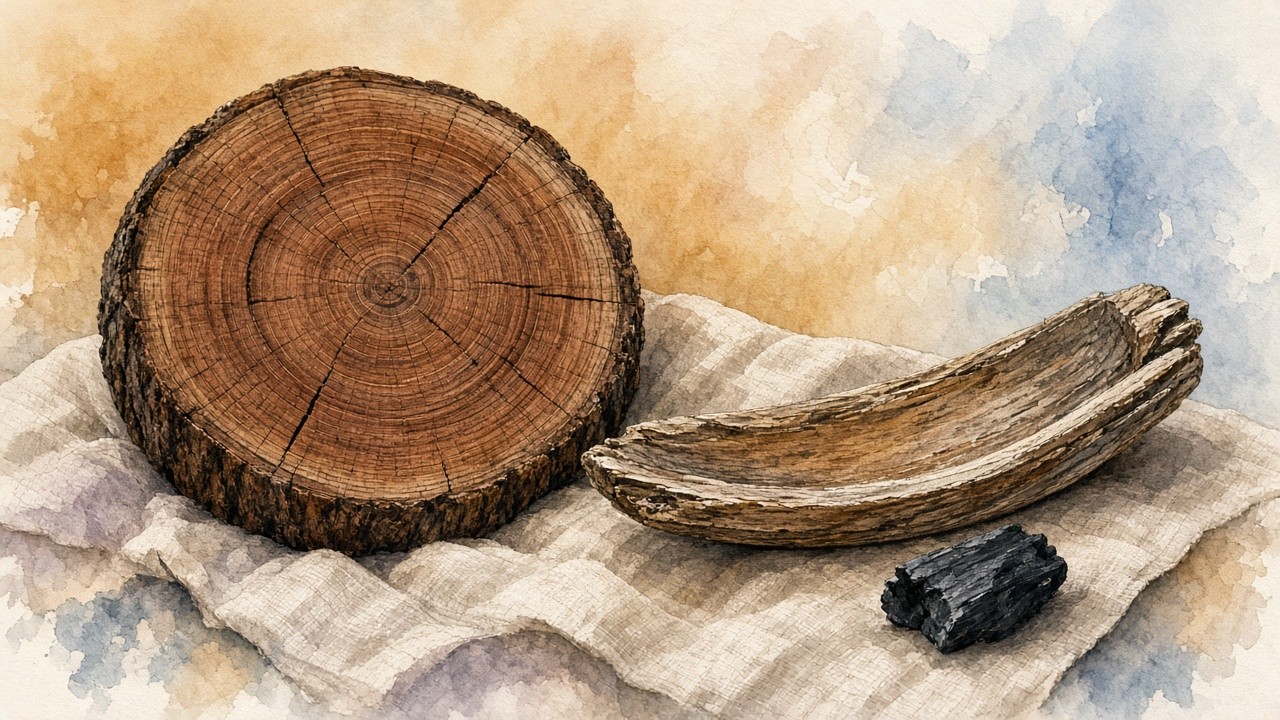
Then came the test. Libby’s team dated objects whose ages were already known. They used samples of redwood and fir whose ages could be counted from their growth rings. They also used museum artifacts, including a piece of timber from the funerary boat of the Egyptian pharaoh Senusret III, whose age was known from the record of his death. In 1949 Libby and Arnold published the results in Science as “Age determinations by radiocarbon content: checks with samples of known age”. Their “Curve of Knowns” showed the radiocarbon ages falling within a narrow statistical range of the true ones.
The method shook up whole fields. According to the ACS, radiocarbon dating gave archaeology and geology their first objective way to attach numbers to organic remains, rather than just putting layers in order. Using wood from trees once buried under glacial ice, Libby showed that the last ice sheet in northern North America retreated 10,000 to 12,000 years ago, not 25,000 years as geologists had thought. Libby won the 1960 Nobel Prize in Chemistry “for his method to use carbon-14 for age determination in archaeology, geology, geophysics, and other branches of science.”

Illustration: cosmic rays streaming into the upper atmosphere, where the neutrons they produce turn nitrogen into carbon-14.
Why raw radiocarbon ages need correcting
Libby’s assumption of a steady atmosphere was close, but not exact. The amount of carbon-14 in the air has wobbled over time. That means a “radiocarbon age” computed straight from the decay math isn’t quite a calendar age.
The fix is calibration. The 2020 paper presenting IntCal20, the international calibration curve for the Northern Hemisphere, puts it plainly: radiocarbon ages “cannot provide absolutely dated chronologies” directly but “must be converted to calendar age equivalents using a calibration curve.” According to Reimer and colleagues, IntCal20 runs back to 55,000 calendar years before present. Back to about 13,900 years ago it is built from tree rings, which can be dated year by year. Older parts combine floating tree-ring sequences, lake and ocean sediments, cave formations (speleothems) and corals. The authors note that such curves “invariably require revision” as new data arrive, so calibration is a moving target that keeps improving.
There’s also a limit on age. The ACS says Libby first thought the method might reach 20,000 years. With better detection, it can now reliably date materials as old as about 50,000 years. Beyond that, so little carbon-14 is left that it’s hard to measure.
How humans have scrambled the clock
Two modern human activities have changed the atmosphere’s carbon-14, in opposite directions. Heather Graven of Imperial College London laid them out in a 2015 paper in PNAS.
The first is nuclear weapons testing. In the 1950s, bomb tests produced so much carbon-14 that it roughly doubled the atmosphere’s carbon-14 content. Since then that “bomb carbon” has been gradually soaking into the oceans and the biosphere.
The second is fossil fuels. Coal, oil and gas are so ancient that they hold no carbon-14 at all. Burning them pours carbon-14-free CO2 into the air and dilutes the ratio. Graven’s modeling found that under high-emission scenarios, by 2050 fresh organic material could have the same carbon-14 ratio as samples from around the year 1050, so radiocarbon dating couldn’t tell them apart. By 2100, under business-as-usual emissions, the atmosphere could look more than 2,000 years old. She concluded that radiocarbon dating “may no longer provide definitive ages for samples up to 2,000 y old.” These are model projections that depend on future emissions, not measurements, but they’re a striking twist: the burning of ancient carbon is making new things look old.
What’s settled and what isn’t
The basic physics of radiocarbon dating is solidly established. Carbon-14 forms from cosmic-ray neutrons and nitrogen, it moves through the carbon cycle, and it decays with a well-measured half-life. Libby’s tests against objects of known age have been repeated and extended for more than 70 years.
What keeps changing is the precision. Calibration curves are revised as new tree-ring, sediment and coral records come in, and older parts of the curve carry larger uncertainties than younger ones. Every radiocarbon date is really a range, not a single year. How fossil-fuel emissions will affect future dating depends on emissions choices that haven’t been made yet.
Radiocarbon isn’t the only clock in the atoms. Odinity’s study of detecting art forgeries with radioactive decay uses a different decay chain and the same exponential math to date paintings. For the reaction-rate side of that math, see the first-order kinetics lab on the inversion of sucrose. And for a broader look at nuclear processes in energy, read Nuclear Power: The Future of Energy.