
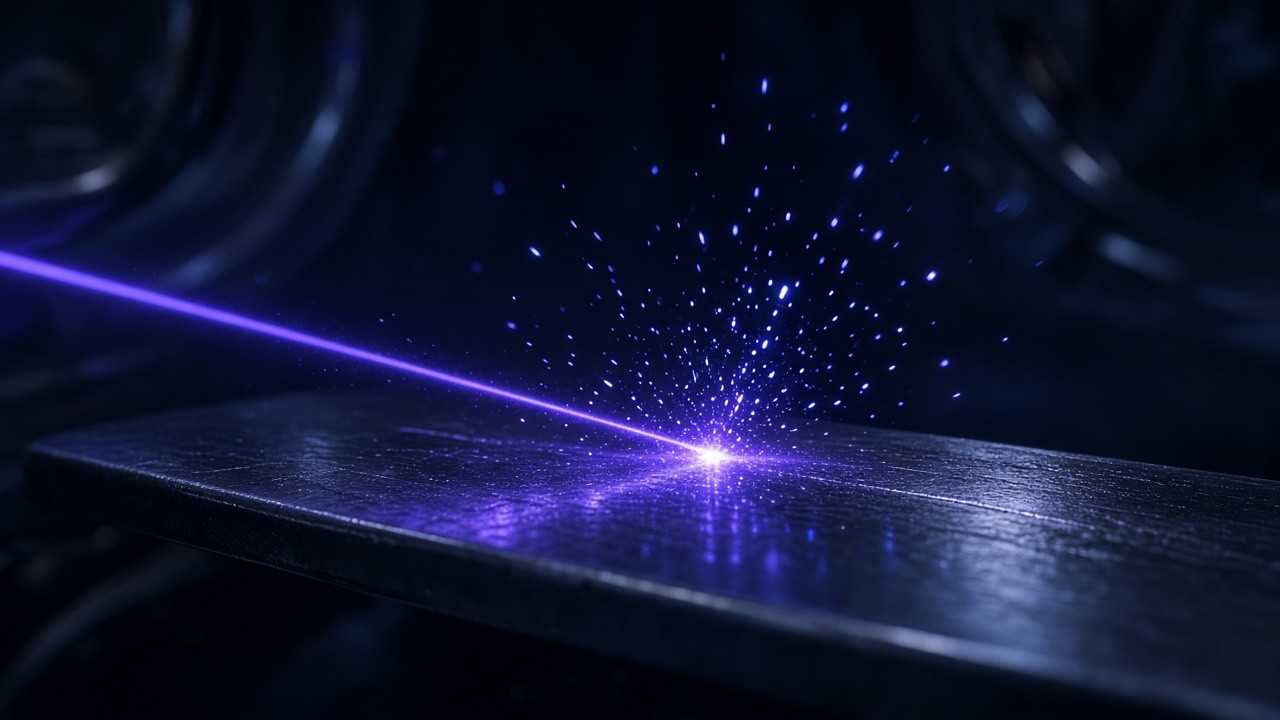
The Photoelectric Effect: The Experiment That Won Einstein His Nobel
Shine a dim violet light on a clean piece of a metal such as sodium or calcium and electrons fly off it at once. Shine a blinding red light on the same metal and nothing happens, however long you wait. That small puzzle is the photoelectric effect, and working out why it behaves this way pushed physics toward the idea that light comes in packets. It also won Albert Einstein his Nobel Prize, which went to him not for relativity but for “his discovery of the law of the photoelectric effect.”
A spark that behaved strangely
The story starts by accident. In 1887 Heinrich Hertz was busy proving that electromagnetic waves exist. Along the way he noticed something odd: when ultraviolet light fell on his metal electrodes, a spark jumped between them more easily. The American Physical Society’s history of the effect puts it simply. Ultraviolet light made a metal plate shoot sparks, and nobody knew why.
Others picked up the thread. Wilhelm Hallwachs showed that a negatively charged metal plate lost its charge when ultraviolet light hit it. In 1899 Philipp Lenard identified what was leaving the metal: electrons. Svante Arrhenius described this chain of discoveries in his speech presenting Einstein’s prize on December 10, 1922.
Lenard then measured the electrons and found a pattern that made no sense under the physics of the day. As the Nobel presentation speech put it, the speed of the escaping electrons did not depend on how intense the light was. Their number did. A brighter light freed more electrons, but not faster ones. Only changing the light’s frequency, its color, changed their speed.
Why the photoelectric effect broke classical physics
In the nineteenth-century picture, light is a continuous wave, and a wave’s energy depends on its brightness. A brighter wave should shake electrons harder and throw them out with more energy. A dim wave should take a while to deliver enough energy, so there should be a delay before anything comes out.
The OpenStax University Physics textbook lists three ways the real experiments refused to cooperate:
- No lag. Electrons appear as soon as light arrives, even when the light is very faint.
- Energy ignores brightness. The fastest electrons have the same kinetic energy whether the light is dim or bright.
- A cutoff. Below a certain frequency, which differs from metal to metal, no electrons come out at all, no matter how intense the light.
The third one is the red-light puzzle from the opening. A wave theory has no reason to care about color once you turn the brightness up far enough. Nature clearly did care.
Einstein’s answer: light in packets
In 1905 Einstein proposed a radical fix. He built on an idea from Max Planck, who in 1900 had explained the glow of hot objects by assuming energy is handed out in discrete chunks, or quanta. According to the APS, Planck regarded the chunks as a mathematical trick. Einstein took them literally. Light itself, he suggested, travels as packets of energy we now call photons, and each packet carries an energy proportional to its frequency.
That one assumption explains all three puzzles. One photon gives all of its energy to one electron, in one go, so there is no waiting. A brighter beam has more photons, so it frees more electrons, but each photon still carries the same amount of energy. And an electron needs a minimum amount of energy to escape the metal at all, a quantity called the work function. If a single photon is below that threshold, it doesn’t matter how many of them arrive. The Nobel committee’s summary makes the same point: the light quanta must exceed a minimum frequency.
Einstein’s law, as OpenStax writes it, is short: Kmax = hf − φ. The maximum kinetic energy of an ejected electron equals the photon energy (Planck’s constant h times the frequency f) minus the metal’s work function φ.
Some numbers from OpenStax make this concrete. Silver has a work function of 4.73 electron volts, so its cutoff wavelength is about 262 nanometers, well into the ultraviolet. Visible light can’t free electrons from silver at all. Sodium gives up its electrons more easily, with a cutoff near 504 nanometers, in the green part of the spectrum. Calcium has a work function of 2.71 electron volts, and violet light at 430 nanometers knocks electrons out of it with a maximum kinetic energy of just 0.17 electron volts.
The experimenter who tried to prove it wrong
A good theory makes a risky prediction, and Einstein’s did. If you plot the maximum electron energy against the light’s frequency, you should get a straight line. Its slope should be Planck’s constant, the same number Planck had found from glowing hot objects. In practice the maximum energy is measured with a “stopping potential,” the reverse voltage just strong enough to halt the fastest electrons.
The American physicist Robert Millikan set out to test it, and by his own account he did not expect Einstein to be right. An APS Physics “Quantum Milestones” feature quotes him calling the light-quantum idea “the bold, not to say the reckless, hypothesis.” In 1912 he considered a particle theory of light “quite unthinkable.”
The experiment was brutally hard. The metal surfaces had to be kept clean, so Millikan built what he called a “machine shop in vacuo,” a rotating knife inside an evacuated chamber that shaved the metal clean before each measurement. Combined with his own value for the electron’s charge from the famous oil-drop experiment, his results gave Planck’s constant as 6.57 × 10⁻²⁷ erg·seconds, with a precision of about 0.5 percent.
The 1916 paper in Physical Review confirmed Einstein’s equation, and Millikan still wasn’t happy about it. In a paper published earlier that year, he wrote that the equation could not “at present” be looked upon as resting on “any sort of a satisfactory theoretical foundation.” Years later, in his Nobel lecture, he described the result as coming “contrary to my own expectation.”
Both men were rewarded. Einstein’s 1921 Nobel Prize in Physics was handed over in 1922, and Arrhenius told the audience that Einstein’s law had been “rigorously tested” by Millikan and had “passed the test brilliantly.” Millikan got his own prize in 1923, “for his work on the elementary charge of electricity and on the photoelectric effect.”

Illustration: an imagined early lab setup in the spirit of Millikan’s “machine shop in vacuo,” with a lamp shining into a vacuum vessel.
What the photoelectric effect does today
For a while, the effect was mostly a puzzle for physicists. Now it’s in your pocket. The 2009 Nobel Prize in Physics went partly to Willard Boyle and George Smith for the charge-coupled device, or CCD, the image sensor that made digital photography practical. The Nobel Foundation’s explanation says the CCD “makes use of the photoelectric effect”: light hitting the silicon plate knocks out electrons in its photocells, millions of them on a chip the size of a stamp, and reading out those electrons builds the image.
Arrhenius also pointed to chemistry. In 1922 he said Einstein’s law had become “the basis of quantitative photo-chemistry,” the study of reactions driven by light, in the same way Faraday’s law underpins electrochemistry.
And researchers are still learning from the effect itself. The 2023 Nobel Prize in Physics honored Pierre Agostini, Ferenc Krausz and Anne L’Huillier for making pulses of light that last only attoseconds, billionths of a billionth of a second. According to the Nobel Foundation, Agostini produced a train of pulses each lasting 250 attoseconds, and Krausz isolated a single pulse of 650 attoseconds. Pulses that short can be used to measure how long it takes for an electron to be pulled away from an atom, and how that time depends on how tightly the electron was bound. In other words, the “no lag” that puzzled physicists in the 1900s is not literally zero. It is just far too short for any instrument of that era to see.
What’s settled and what’s still open
The core of the photoelectric effect is about as settled as physics gets. The equation Kmax = hf − φ, the cutoff frequency and the energy that doesn’t depend on brightness have been confirmed for more than a century, starting with Millikan’s skeptical test.
What remains active is the fine detail of how electrons leave atoms and solids on the shortest timescales. Attosecond experiments are a young field, and the 2023 Nobel materials describe them as tools for studying electron motion rather than a finished picture of it.
The deeper question, what a photon “really” is, never went away either. Even after his own experiment confirmed Einstein’s equation, Millikan said the theory behind it lacked a satisfactory foundation. Quantum mechanics later gave light a dual description, sometimes wave and sometimes particle. The photoelectric effect is one of the clearest places to see the particle side, but it doesn’t settle the philosophical argument on its own.
Want to see how energy and electric potential work in a classroom setting? Odinity has a student lab mapping electric fields and equipotentials, the same voltage idea behind the stopping-potential measurement. For light and electrons inside molecules rather than metals, see the particle-in-a-box lab on conjugated dyes. And the quantum dot nanocrystals experiment shows how the color of light ties to energy levels in tiny crystals.