

The Avogadro Constant: How Scientists Counted Atoms They Couldn’t See
Eighteen grams of water is a sip, barely enough to fill the bottom of a small paper cup. NIST’s chemists point out that it holds roughly 600 billion trillion water molecules. The Avogadro constant, 6.02214076 × 10²³ per mole, is the number that links a sample you can weigh to the atoms you can’t see. Pinning it down took more than a century, from a hypothesis about gases to a ball of silicon so round it set records.
What the Avogadro constant is
The NIST page introducing the SI constants explains: “The Avogadro constant defines the number of particles in a mole, the SI unit that expresses the amount of substance.” In other words, “Avogadro’s number of electrons equals one mole of electrons,” and the same number of water molecules makes one mole of water. A mole is a counting unit, like a dozen, only far larger.
Another NIST explainer adds that the counted things don’t have to be atoms. A mole of hydrogen molecules, carbon atoms or even golf balls “equals 6.022 x 10²³ of its constituents.” The word itself, NIST notes, didn’t appear until almost 1900. It was “taken from the abbreviation Mol, from the German word for ‘molecule’ (‘Molekül’).”
The constant is everyday working chemistry. In Odinity’s coulometric titration of acid, measured electric charge is converted to moles of electrons with Faraday’s constant, 96,485 coulombs per mole. In the gold and silver nanoparticle synthesis, Avogadro’s number appears directly in the equations for particle concentration.
Avogadro’s hypothesis, 1811
Amedeo Avogadro (1776–1856) never measured the number named after him. NIST describes him as “a law-trained Italian scientist.” His 1811 paper in the Journal de Physique included his famous hypothesis that “equal volumes of all gases, under the same temperature and pressure conditions, contain equal numbers of molecules.”
The idea came early. In NIST’s telling, Avogadro also argued that simple gases were made of molecules of several atoms, at a time when the atom itself wasn’t widely accepted. He called atoms “elementary molecules.” “It took 50 years for others to catch up,” and by then he had died. Historians still argue over why the idea was ignored for so long.
The hypothesis was powerful because it let chemists compare the weights of molecules they couldn’t see. If equal volumes hold equal numbers of molecules, the ratio of two gases’ densities is the ratio of their molecular weights. Jean Perrin, a physicist at the Sorbonne, explained this in his 1926 Nobel lecture, calling the hypothesis the foundation of his own research. He defined the gram-molecule as the mass of a gas that fills the same volume as 32 grams of oxygen. “The number N of the molecules constituting any gram-molecule is Avogadro’s number,” he said. Find that number, and “if molecules and atoms exist,” their absolute weights follow.
NIST says it was decided early in the 20th century to call the number of molecules in a gram-molecule of oxygen the “Avogadro number.” When the mole joined the SI in 1971, the name changed to the “Avogadro constant.”
How Perrin counted molecules he couldn’t see
Perrin’s 1926 Nobel Prize in Physics was awarded, according to the Nobel Foundation, “for his work on the discontinuous structure of matter, and especially for his discovery of sedimentation equilibrium.” The Nobel summary explains that whether atoms and molecules physically existed “was still a matter of dispute” in the late 1800s. Perrin argued that if molecules were real, tiny particles suspended in a liquid wouldn’t all sink to the bottom but would spread out through it. He showed this experimentally in 1908. He also confirmed Einstein’s theory that Brownian motion, the random jiggling of small particles in a liquid, comes from collisions with the liquid’s molecules.
His trick was to treat a suspension of visible grains like a miniature atmosphere. In a column of oxygen at 0 °C, Perrin noted, the density halves for every 5 kilometers of height. If his grains obeyed the same law, they would thin out with height too, but over microns instead of kilometers. The ratio between the two heights would give the grain’s effective weight relative to an oxygen molecule, and from that, Avogadro’s number.
It took patience. Perrin made spheres from resins such as gamboge and mastic. In his lecture he described processing “one kilogram of gamboge” over “several months of daily operations” to collect a few decigrams of grains about three-quarters of a micron across. In his best emulsion, the grain count halved with every 6 microns of height. That gave N = 68 × 1022.
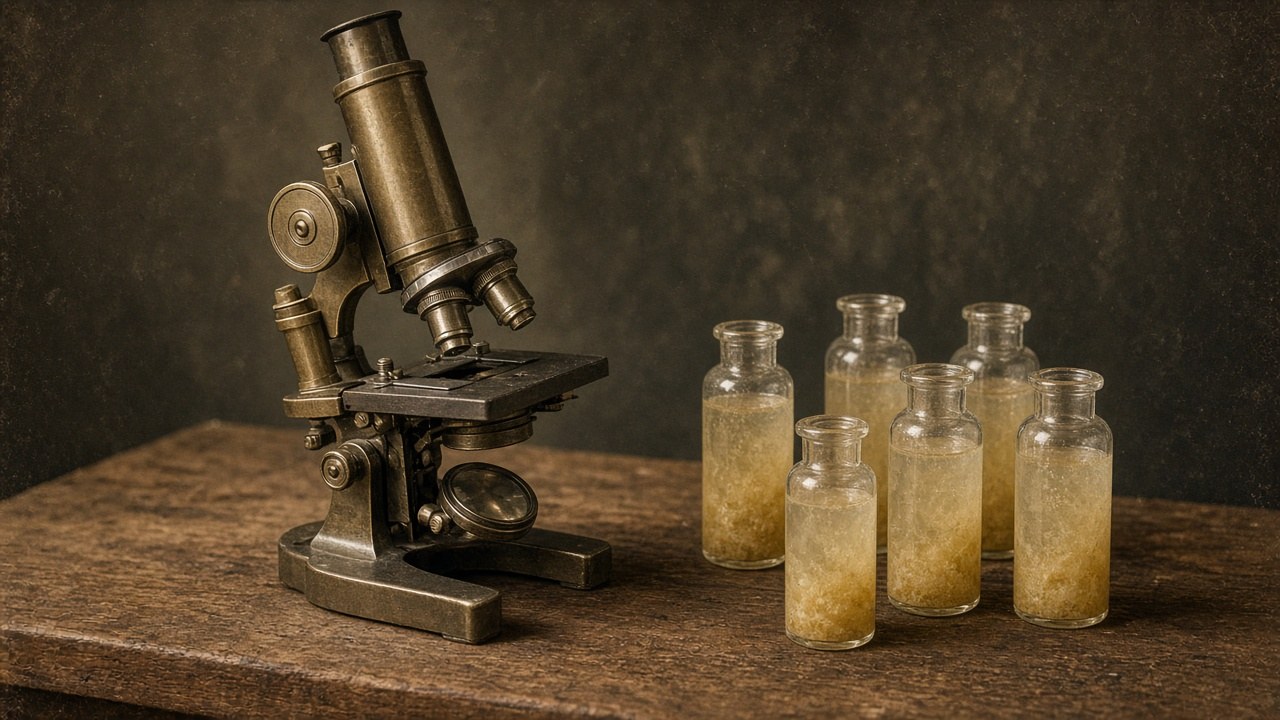
Illustration: an early 20th-century-style microscope and resin suspensions, evoking Perrin’s emulsion experiments.
One result alone wouldn’t have convinced anyone. The force of Perrin’s case was that very different experiments kept giving the same answer. He listed his own emulsion results:
- 68 × 1022 from the height distribution
- 62 × 1022 from emulsions behaving like liquids
- 60 × 1022 from fluctuations in concentrated emulsions
- 64 × 1022 from translational Brownian motion
- 65 × 1022 from rotational Brownian motion
Others got matching values by completely different methods. The blueness of the sky gave 65 × 1022. Black-body radiation gave 64 × 1022. Measurements of the electric charge on microscopic dust, culminating in Millikan’s in 1909, gave 61 × 1022. Counting helium atoms produced by radioactivity gave 62 to 70 × 1022. Earlier estimates from the kinetic theory of gases had ranged from 40 to 120 × 1022, an uncertainty Perrin put at “largely 100 per cent.”
Perrin argued that this collection of agreements “creates a certitude at least equal to that which we attribute to the principles of thermodynamics.” His crude average, 64 × 1022, is within about 6% of today’s value.
Counting atoms in a silicon sphere
The modern measurement relied on what NIST calls perhaps “the roundest objects in the world.” Beginning in the early 1990s, the International Avogadro Coordination used crystals of silicon-28 machined into 1 kg spheres, 94 mm across. They were 99.9995% silicon-28, so nearly every atom had the same mass, and the crystal spaced its atoms in a predictable pattern. NIST says the spheres were so smooth that, scaled up to the size of Earth, the gap between the tallest mountain and the deepest ocean would be just 3 to 5 meters. Each cost about $3.2 million.
The method is called X-ray crystal density. Optical interferometers measured the sphere’s width to nanometer precision, and X-ray crystallography measured the spacing of its crystal lattice. Combining those with the sphere’s mass and the molar mass of its silicon, measured by mass spectrometry, lets researchers determine how many atoms the sphere contains. A 2015 paper by the international team, published in Metrologia, reported NA = 6.022 140 75(12) × 1023 mol−1, with a relative uncertainty of 2.0 × 10⁻⁸. That’s about two parts in 100 million.
Under the old definition, a mole was the number of atoms in 0.012 kg of carbon-12, which tied it to the kilogram. That in turn was defined by a metal cylinder kept in a vault outside Paris. In what the BIPM calls the 2018 revision of the SI, which took effect on May 20, 2019, the mole was instead redefined by a fixed value of the Avogadro constant. NIST says several silicon-sphere measurements, with a combined uncertainty of 10 parts per billion, fed into that value. Today the CODATA listing at NIST gives NA = 6.022 140 76 × 1023 mol−1 with a standard uncertainty marked “(exact).” It’s now fixed by definition rather than measured.
What’s settled and what’s left
Settled:
- Atoms and molecules are real and countable.
- The Avogadro constant now has an exact value: 6.02214076 × 10²³ per mole.
- The mole is defined by that number rather than by a mass of carbon.
Still a matter for historians:
- Why Avogadro’s hypothesis was ignored for half a century is still debated, NIST notes.
The first estimates of Avogadro’s number came with an uncertainty of about 100%. Today the number itself is exact, by agreement, and it took a century of very different experiments to earn that.