
The Taurid Meteor Shower: Why November Brings Fireballs
Every autumn, Earth spends weeks ploughing through a wide, thin cloud of debris left by a small comet. Most of the meteors are faint and few, but now and then a bigger chunk lights up as a bright fireball. That’s the Taurid meteor shower. It’s never a dense shower, but it’s one of the best chances all year to see a fireball, and in 2026 both of its peaks fall on nights with little moonlight.
Taurid meteor shower 2026: dates and the Moon
The Taurids are really two showers, the Southern and Northern Taurids, which overlap in late October and early November. Here are the dates from the 2026/2027 calendars published by the International Meteor Organization (IMO) and the American Meteor Society (AMS):
- Southern Taurids: active September 20 to November 20, 2026. The peak night is November 4–5, with the Moon a waning crescent less than 20% lit, which the calendars call “generally favorable lunar conditions, with limited moonlight interference.”
- Northern Taurids: active October 20 to December 10, 2026. The peak night is November 11–12, with the Moon only about 7% lit as a thin waxing crescent, or “very favorable lunar conditions, with little or no moonlight interference.”
You may see a different Southern Taurid date elsewhere. The Royal Observatory Greenwich lists the Southern maximum as October 10, 2026, on a night with a new Moon. The two sources aren’t really in conflict. The IMO and AMS calendars describe the Southern Taurids as “a complex shower made up of two main components”: an annual component that peaks around October 14 and a fireball-swarm component that peaks around November 5. Greenwich’s date appears to track the early peak, and the IMO and AMS calendars give the later one.
Don’t expect a storm. Greenwich estimates about 5 meteors per hour at maximum and calls the shower “not particularly dramatic.” A 2022 review of more than two decades of visual, optical and radar data by A. Egal and colleagues at the University of Western Ontario found the Taurids’ annual activity “generally low (less than 15 visual meteors per hour).”
Why the Taurids are known for fireballs
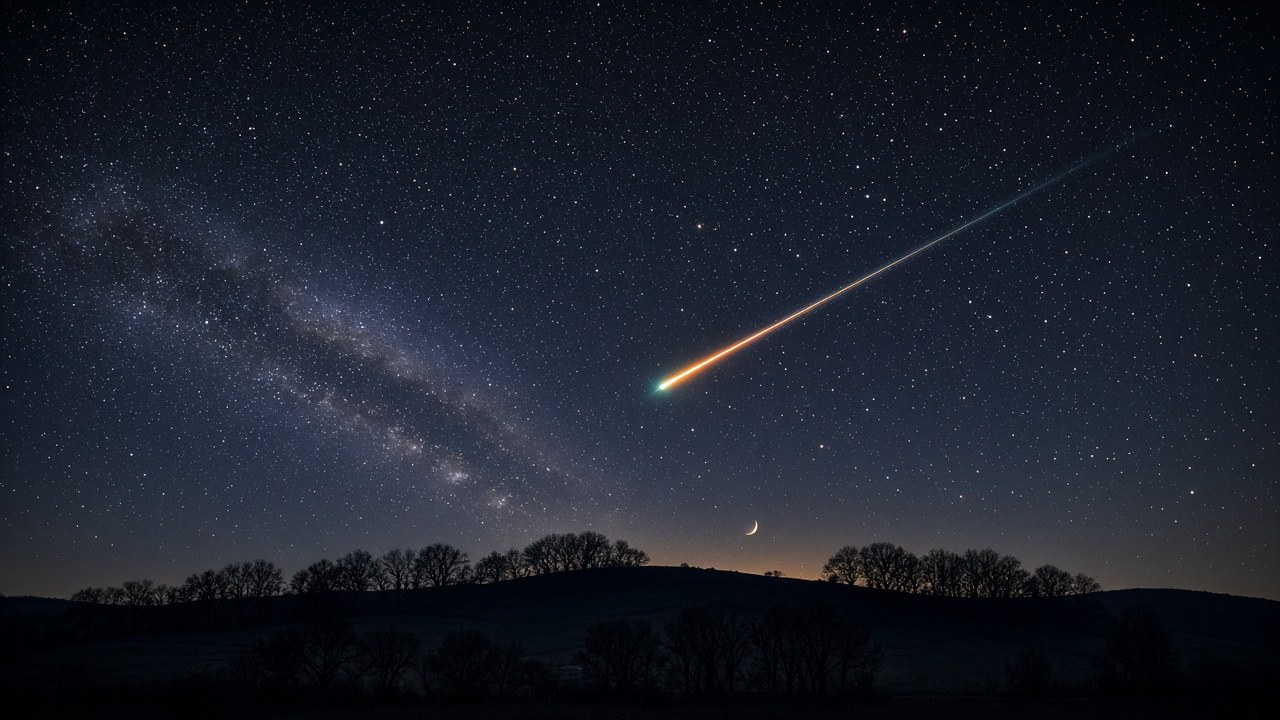
The Taurids are worth watching for quality more than quantity. NASA’s page on Comet 2P/Encke says the shower is “known for their fireballs.” A fireball is a meteor at least as bright as Venus, about visual magnitude −4. Fireballs can show larger explosions of light and color and last longer than an ordinary streak, NASA says, because they come from larger particles of cometary material.
The calendars add a seasonal twist. The Southern Taurids are “often responsible for an increased number of fireball reports from September through November,” and when both branches are active in late October and early November, “there is sometimes a notable increase in fireball activity.” Greenwich notes that this timing has earned them the nickname “Halloween fireballs.”
Speed plays a part too. Greenwich and NASA both give about 65,000 mph, roughly 29 km/s, and the AMS shower data lists 29 km/s for the Northern Taurids. Greenwich calls that “relatively slow,” which makes sense next to the Leonids, which the AMS lists at about 70 km/s. Even “slow” is fast by everyday standards. Kinetic energy grows with the square of speed, the same ½mv² that Odinity’s student lab on work and kinetic energy measures with carts and springs, so a particle at 29 km/s carries enormous energy for its mass.
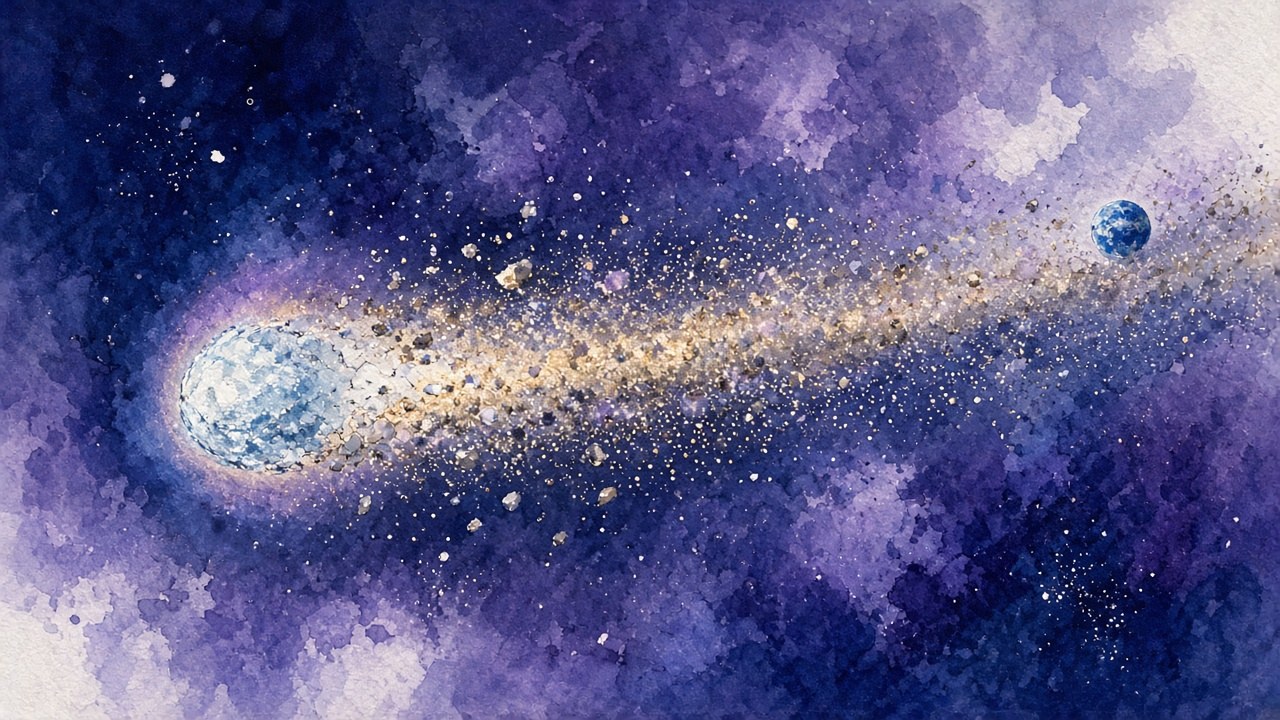
Illustration: a comet leaves a long trail of dust and grit, and Earth crosses the edge of it each autumn. The painting is not to scale.
Where the debris comes from: Comet Encke
Meteor showers happen when Earth passes through a stream of debris shed by a comet. For the Taurids, the source is Comet 2P/Encke. According to NASA, Encke is a small comet with a nucleus about 4.8 kilometers (2.98 miles) across, and it orbits the Sun every 3.30 years, one of the shortest orbital periods of any known comet. Pierre Méchain discovered it in 1786, but later sightings weren’t recognized as the same object until Johann Franz Encke calculated its orbit.
Encke’s debris stream is unusually spread out. Greenwich explains that “the comet stream is very spread out and dispersed,” which is why Earth takes so long to cross it and why we see two branches, north and south. The Egal review adds that the same complex also produces daytime showers in spring, the Beta Taurids and Zeta Perseids, and it calls the Taurids “among the most enigmatic of all the major showers.”
Greenwich adds a deeper backstory. Encke and the Taurids “are believed to be remnants of a much larger comet, which has disintegrated over the past 20,000 to 30,000 years.” Treat that as the leading interpretation rather than a precise date, because how big the original body was is still being tested.
Swarm years: when the Taurids get busier
Some years produce far more Taurid fireballs than others. The best-supported explanation is a resonance with Jupiter. In 1993, the astronomers Asher and Clube proposed that some Taurid debris is trapped in a 7:2 resonance with Jupiter, completing seven orbits for every two of Jupiter’s. The Egal review explains that the resonance keeps those meteoroids bunched together along the orbit instead of letting them spread out, creating a “Taurid resonant swarm.” When Earth passes near the swarm, roughly every 3–7 years, fireball rates go up.
The evidence for the swarm has grown. In 2015, a swarm year, the European Fireball Network recorded 144 Taurid fireballs. In a 2017 paper, P. Spurný and colleagues reported that 113 of those fireballs shared a well-defined set of orbits, with semimajor axes of 2.23–2.28 AU that “indeed overlap with the 7:2 resonance.” The meteoroids ranged in mass from 0.1 gram to more than 1,000 kilograms.
2026 is not expected to be a swarm year for the autumn Taurids. In their 2022 review, Egal and colleagues list future swarm years as 2022, 2025 and 2032 for the autumn showers, and 2026 and 2029 for the daytime Taurids. Those daytime Taurids are a separate shower that arrives in daylight in spring, so the review notes only a large rise in fireball rates would be detectable. This November should therefore be a normal Taurid season, which can still bring the odd fireball on a dark night.
What’s still uncertain
The Taurids attract big claims, so it helps to separate what’s measured from what’s proposed.
- Measured: Fireball cameras confirm a resonant swarm at sizes up to about a meter. A 2025 telescope survey in The Planetary Science Journal by Paul Wiegert and colleagues states plainly that meteor observations “have confirmed the TS’s existence at meter and smaller sizes.”
- Not confirmed: large swarm asteroids. Spurný’s team argued that two 200–300-meter asteroids, 2015 TX24 and 2005 UR, belong to the 2015 branch and that more large objects are “very likely.” Dedicated telescope searches since then haven’t confirmed any. The Wiegert survey found its results “consistent with no Taurid swarm members observed.” A 2025 Zwicky Transient Facility search led by Jasmine Li and Quanzhi Ye set a limit of no more than 9–14 objects about 100 meters or larger in the swarm, and estimated that the original parent body was about 10 km across.
- Puzzling: radar doesn’t see the swarm at all. The Egal review found “no presence of the swarm in radar data,” which suggests that small particles leave the resonance faster than fireball-sized ones.
- Hypothesis, not established: a link to the Tunguska event. The Egal review notes that the swarm “was suggested as an explanation” for several unusual events, including strong fireball activity in November 1951, a 10-day bombardment of the Moon by meteoroids in June 1975, “and possibly even the Tunguska event.” That “possibly” matters. The Tunguska idea is a proposal from the scientific literature, not a demonstrated connection.
How to watch
Greenwich’s advice is simple. Find a dark site with an open view of the sky, keep direct lights out of your eyes, and give your eyes time to adjust. Binoculars and telescopes don’t help, because the shower spreads across the whole sky. The meteors appear to come from the constellation Taurus, which gives the shower its name. For the Northern peak on November 11–12, Greenwich notes that the crescent Moon sets early, so later in the evening is best. Bring a chair and warm clothes, because, as Greenwich puts it, meteor watching “is a waiting game.”
With rates of a handful an hour, the Taurids won’t put on a crowded show. They’re better for something rarer: a single bright fireball from the very old debris of a comet that circles the Sun every 3.3 years.