
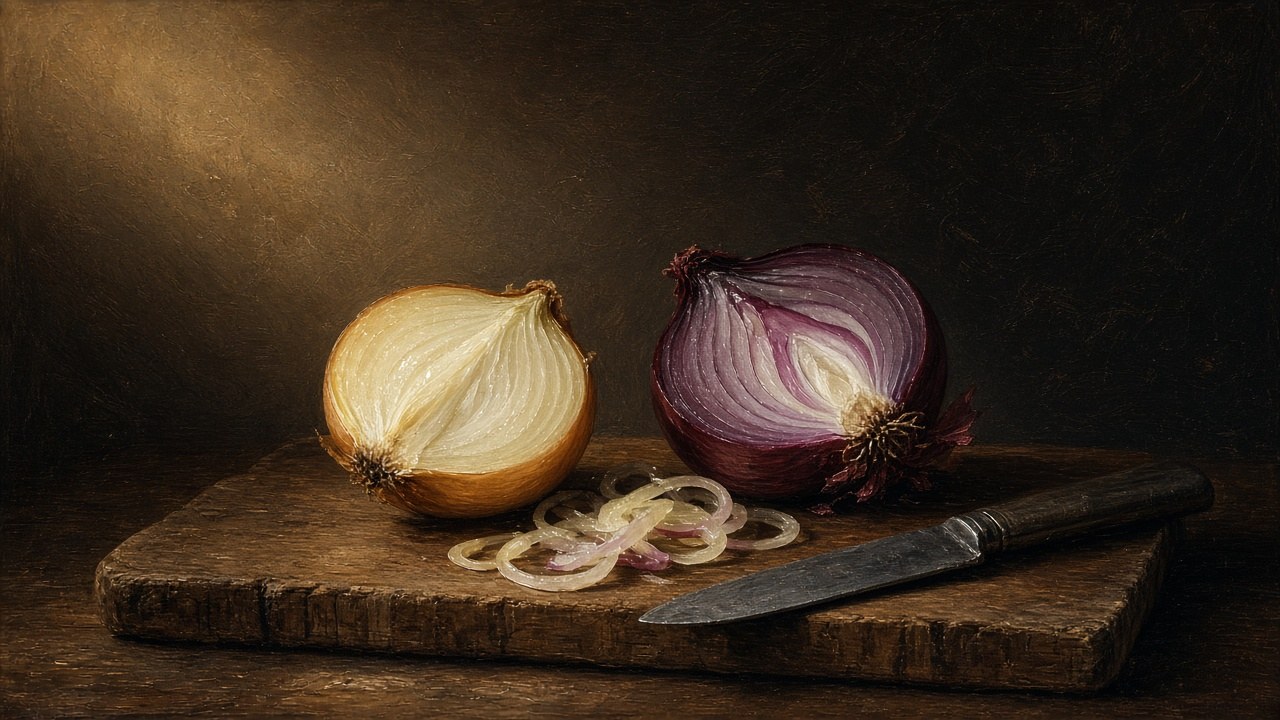
Why Onions Make You Cry: The Enzyme Behind the Tears
Slice into an onion and your eyes soon start to sting and water. Nothing in the whole onion is doing this. The irritant doesn’t exist until the knife goes in, and it’s made on the spot by a chain of chemistry that takes a fraction of a second. So why onions make you cry comes down to two enzymes, one unstable sulfur molecule and a discovery from 2002 that showed the textbook explanation was missing a step.
Why onions make you cry: a tear gas the onion makes on demand
The culprit is a small, volatile sulfur compound called syn-propanethial S-oxide, which chemists also call the lachrymatory factor (from lacrima, Latin for tear). The Royal Society of Chemistry’s Education site compares it to tear gas and makes a point that surprises most people: an intact onion contains none of it.
Instead, the onion stores the ingredients separately. Its cells hold an odorless sulfur-containing amino acid derivative, (E)-S-(1-propenyl)-L-cysteine sulfoxide, in the cytoplasm, while the enzyme that attacks it, alliinase, is kept in the vacuole, the cell’s internal storage compartment. A research highlight from Japan’s Photon Factory synchrotron describes it this way: damage to onion cells brings the vacuolar enzymes into contact with the cysteine sulfoxides in the cytosol. The RSC compares the arrangement to a glow stick, where nothing happens until you bend it and two chemicals mix.
The molecule itself took decades to pin down. According to the American Chemical Society’s Molecule of the Week, W. Niegisch and W. H. Stahl worked out its molecular formula in 1956. After many attempts by other researchers, E. Block and co-workers established its structure in 1979 and showed that it has the syn, or Z, configuration. About 5% of the natural substance is the anti (E) form.
The step everyone missed
For years, the accepted story had one enzyme in it. Alliinase cuts the cysteine sulfoxide and makes 1-propenesulfenic acid, and that acid was assumed to rearrange into the tear-producing compound by itself.
In 2002, a team led by S. Imai at House Foods in Japan tested that assumption. Their short paper in Nature reported that the lachrymatory factor “is not formed as a by-product” of the alliinase reaction. A separate, previously unknown enzyme makes it. They named it lachrymatory factor synthase, or LFS. The discovery later won the 2013 Ig Nobel Prize in Chemistry, the Photon Factory highlight notes.
There was also a good chemical reason to doubt the “it happens by itself” version. A 2017 crystal-structure paper from Case Western Reserve University, published in ACS Chemical Biology and available free in PubMed Central, explains that the spontaneous route was first proposed from gas-phase experiments. In that route, a hydrogen hops from the oxygen to a carbon in a single intramolecular shift, a so-called [1,4]-sigmatropic rearrangement. That shift faces an energy barrier of about 33 kcal/mol, which makes it unlikely to happen at room temperature.
What happens in the moments after the cut
Put the pieces together and the sequence looks like this:
- The cut breaks cells. Alliinase from the vacuole meets the cysteine sulfoxide from the cytoplasm.
- Alliinase cleaves the precursor into (E)-1-propenesulfenic acid. This molecule is extremely short-lived. The Photon Factory team gives its half-life as several milliseconds under ambient conditions.
- Two things can happen to that sulfenic acid. Left alone, it condenses with itself into thiosulfinates and then into a cascade of other sulfur compounds, the source of much of the onion’s smell and flavor. Or LFS grabs it first.
- LFS rearranges it into syn-propanethial S-oxide, which evaporates and drifts toward your face.
The RSC describes the last step at the eye. The compound reacts with water on the eye’s surface to create an acid that stimulates a nervous response, and tears follow to wash the irritant away.
Compounds like this are rare. The 2017 paper notes that only four natural thioaldehyde S-oxides are known, and all of them come from plants.
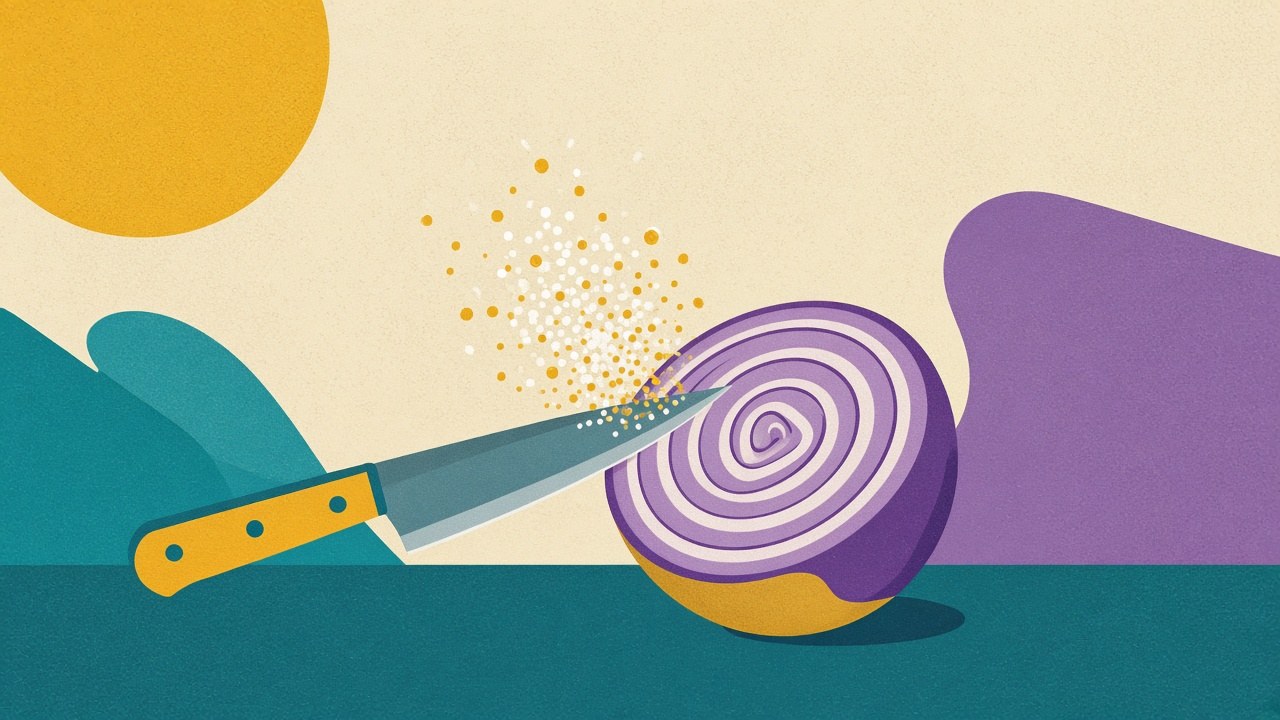
Illustration: a fine spray of droplets bursting from an onion as the knife breaks through.
How a tiny enzyme does such a precise job
LFS is small. The Photon Factory highlight puts it at 169 amino acids in total, with no cofactors or apparent modifications. Yet it produces the syn form specifically, not the anti form. A 2012 study in Bioscience, Biotechnology, and Biochemistry by Masamura and colleagues, available on J-STAGE, ran the reaction with purified alliinase and LFS in heavy water. It found that LFS reacted with the breakdown products of the (E) form of the precursor but not the (Z) form, and concluded that LFS is an (E)-1-propenylsulfenic acid isomerase. In other words, it moves a double bond without changing the molecule’s formula.
Crystal structures then showed the enzyme’s shape. The Case Western team solved LFS at 1.40 Å resolution on its own and at 1.90 Å bound to crotyl alcohol, a stable molecule that mimics the fleeting substrate. The fold turned out to be a “helix-grip” shape, a member of the START protein superfamily that plants also use for abscisic acid hormone receptors, even though LFS shares only about 18% of its sequence with those receptors. Two charged amino acids, glutamate 88 and arginine 71, sit in the pocket next to the bound mimic.
A 2020 study in ACS Catalysis by Arakawa and colleagues at the University of Tokyo and House Foods, summarized in the Photon Factory highlight, went further. They solved four structures at 1.7–2.1 Å, then combined mutations, molecular dynamics and quantum-mechanics calculations. Their proposed mechanism has two sequential proton transfers. Glutamate 88 shuttles a proton within the substrate, arginine 71 tunes glutamate 88’s acidity so the shuttle works, and tyrosine 114 holds the right carbon in place. Their structures and simulations also suggest that the pocket holds the substrate in a bent, syn-like conformation, which helps explain why only the syn product comes out.
That mechanism is a proposal backed by structures of substrate mimics and by computer simulations, not a direct snapshot of the real substrate, which lasts only milliseconds. The Case Western group proposed its own catalytic mechanism from its structures, and the details are still being refined.
What a tearless onion revealed
If one enzyme makes the tear gas, switching it off should make a tearless onion. The 2002 Nature paper suggested exactly that. In 2008, Colin Eady’s group at New Zealand’s Crop and Food Research institute, working with House Foods, reported in Plant Physiology that they had used RNA interference to silence the LFS gene in six onion plants. LFS activity fell by up to 1,544-fold, and wounded tissue produced much less lachrymatory factor. In bulbs, the reduction ranged from about 6- to 28-fold depending on the plant.
The sulfur didn’t simply disappear. With LFS gone, more sulfenic acid went down the other branch, toward thiosulfinates, and the onions made more of several sulfur compounds that had been found only in traces before, or not at all. The authors linked some of these compounds to sweeter onion flavors. They noted that formal taste testing required regulatory approval that hadn’t yet been granted, and the study involved only a handful of plants.
The paper also explains why some ordinary onions seem milder. Varieties sold as low-tear, such as Vidalia, get there by taking up less sulfur or growing in sulfur-poor soil, so they build up fewer of these sulfur compounds overall. The RSC adds that red and white onions tend to cause the most tears, while spring onions contain lower levels of the enzymes involved.
Why would a plant bother? The 2017 paper describes the pathway as part of the onion’s “chemical warfare against microbes and animals.” The lachrymatory factor is thought to be a deterrent, a defense against being eaten rather than something aimed at cooks.
Kitchen tricks: myth versus evidence
Everyone has a favorite trick. Here’s what the sources behind this article actually support.
- A sharp knife, used slowly: some physical evidence. A 2025 Cornell study in PNAS filmed onion cutting with high-speed cameras. Droplets come out in two stages: a fast initial burst, then slower break-up of fluid threads. Blunter or faster blades “significantly increase both the number and energy” of ejected droplets. The onion’s tough skin layers resist the blade, so the soft tissue underneath gets compressed before it ruptures and sprays. The paper measured droplets leaving the cut at 1 to 40 meters per second, while chefs’ knives, timed from cooking videos, move at about 0.1 to 1 meter per second. Cornell’s news office adds that the spray can travel up to two-thirds of a meter. The study’s limit: it measured droplets, not tears or the irritant gas in the air.
- Chilling the onion first: plausible, but unproven here. The RSC says cooling “might help to reduce the volatility” of the gas. Enzyme reactions generally slow at lower temperatures, as an Odinity student lab on how temperature changes amylase activity shows for a different enzyme. None of the sources here measured chilled onions directly.
- Goggles or contact lenses: a physical barrier. The RSC writer, a contact lens wearer, says lenses reduce the effect for her compared with glasses, and suggests swimming goggles. That’s a personal observation, not a study.
- “Tearless” onions: real, with conditions. Genetic silencing of LFS works in the lab. Low-sulfur varieties are milder for a different reason: less sulfur in the bulb overall.
What we know and what’s still open
Settled:
- The tear-producing compound is syn-propanethial S-oxide, formed only when cells are damaged.
- Two enzymes are needed: alliinase makes 1-propenesulfenic acid, and lachrymatory factor synthase converts it.
- Strongly supported, though so far from a single study: silencing LFS sharply reduces the irritant and shifts the onion’s sulfur chemistry.
Emerging or open:
- The exact step-by-step catalytic mechanism of LFS. Current models rest on structures of substrate mimics and on simulations.
- How cutting technique changes the amount of irritant that actually reaches the eyes, as opposed to droplet counts.
- How the reshuffled sulfur compounds in LFS-silenced onions affect flavor. Formal taste panels were still pending in the 2008 study.
If you like the enzyme side of this story, an Odinity kinetics lab on tyrosinase shows how chemists measure an enzyme’s speed and how inhibitors change it. Activity assays of that general kind are how the 2008 team put a number on the 1,544-fold drop in LFS activity.
The next time an onion makes you cry, the knife is the trigger. The plant has been carrying the two ingredients in separate compartments all along, and the cut lets them meet.