
Prince Rupert’s Drop: The Glass Tear a Hammer Can’t Break
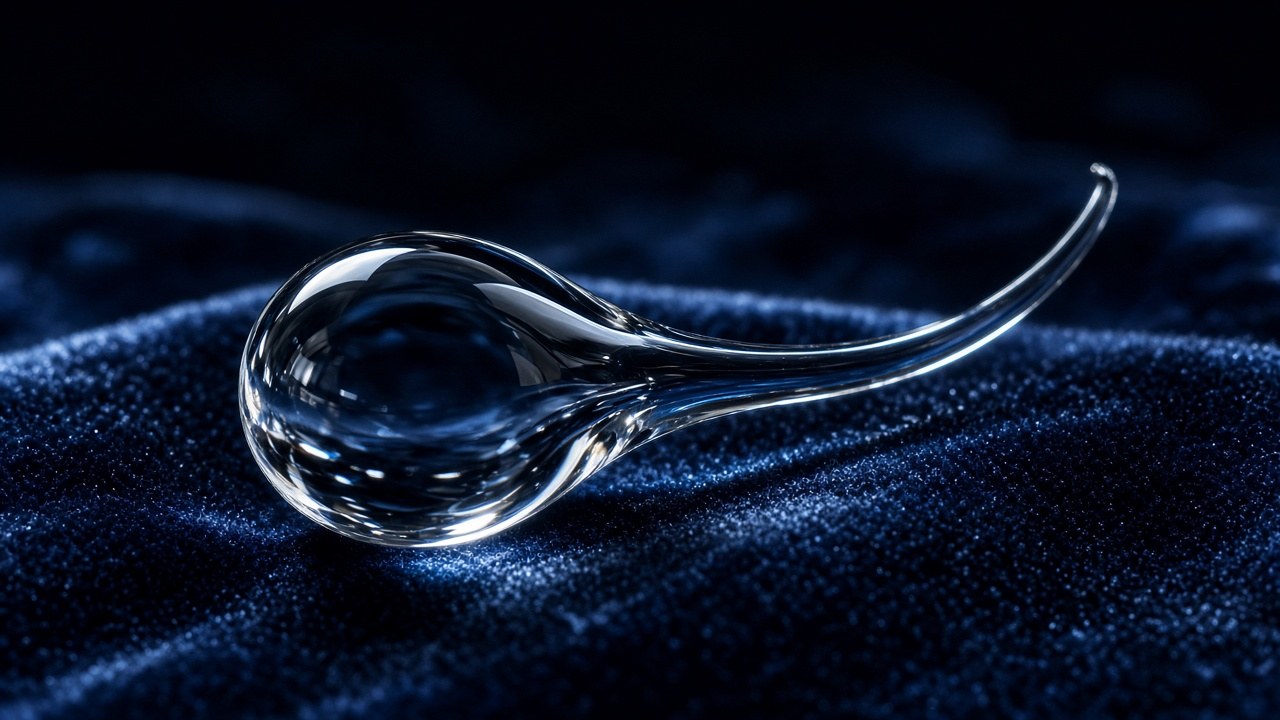
Hit the round end of this glass teardrop with a hammer and it survives. Snap the thin tail with your fingers and the whole thing bursts into powder with a sharp pop. A Prince Rupert’s drop is nothing more than a blob of molten glass dropped into cold water, yet it puzzled 17th-century scientists for decades. Only in the last few decades has anyone measured what’s going on inside. The answer is a lesson in residual stress, the same physics that makes some modern glass hard to break.
How a Prince Rupert’s drop is made
The recipe is short. A 2016 paper in Applied Physics Letters by Hillar Aben and colleagues at Tallinn University of Technology, Purdue University and the University of Cambridge describes the drops as made of “a silicate glass of a high thermal expansion coefficient” with the shape of a tadpole. The head is typically 5–15 mm across and the tail 0.5–3.0 mm. Purdue’s account of the work says the drops are made by letting red-hot blobs of molten soda-lime or flint glass fall into cold water. That rapid cooling is called quenching. Head and tail together run to about four inches.
Robert Hooke described the same process in Micrographia (1665). Small parcels of “coarse green Glass” were taken from the furnace on the end of an iron pipe and “suffered to drop from thence into a Bucket of cold Water,” then left until they had cooled.
The drops reach the Royal Society
The drops arrived in London as a royal curiosity. A 1986 article in Notes and Records of the Royal Society by Brodsley, Frank and Steeds quotes the Society’s minutes for 4 March 1660–61: “The King sent by Sir Paul Neile five little glass bubbles, two with liquor in them, and the other three solid, in order to have the judgement of the society concerning them.” The Society’s amanuensis made more two days later, and they “succeeded in the same manner.” Sir Robert Moray, the Society’s president, gave a full report of the experiments on 14 August 1661. Purdue’s account credits Prince Rupert with bringing the drops to England and presenting them to Charles II, and his name stuck: the 1986 article notes that these “glass bubbles” were what were “later to be called ‘Prince Rupert’s drops’.” The Applied Physics Letters paper notes another name, Batavian tears.
The paradox was already clear then. The 1986 article sums it up: the head “withstands hammering on an anvil, or, as a more modern test, squeezing in a vice, indenting its steel jaws, without fracture,” yet breaking the tail with finger pressure “caused the whole to explode into powder.”
Hooke’s surprisingly modern guess
Hooke ran careful tests. He snapped tails in open air and under water, and the drops “flew violently, with a very brisk noise, into multitudes of small pieces, some of which were as small as dust.” Some fragments even pierced his skin. That hazard is real: a bursting drop throws sharp glass in every direction, and making drops means handling molten glass, so they are not a casual kitchen-table experiment. He ground away nearly two-thirds of a drop’s round end without setting it off, but nipping off the tip of the tail made the rest fly “all into sand.”
Two of his experiments stand out. In the first, he coated drops in isinglass glue and wrapped them in kid leather before breaking the tail. The drop cracked and jolted his hand but kept its shape, now opaque and riddled with ring-shaped flaws running from the blunt end to the tip. In the second, he heated drops red hot and let them cool slowly. They “quite lost all their fulminating or flying quality” and became softer and easier to snap, like ordinary annealed glass.
His explanation was that the cold water cools and hardens the outside of the drop at once, while the inside is still hot and expanded. As the inside cools, it can’t shrink freely because the hard crust is in the way, so “the Particles remain under a kind of tension and flexure.” He compared the arrangement to an arch whose parts hold each other up until one piece is loosened. Hooke’s own reasoning was in terms of particles and “springs,” but the core idea, locked-in stress from uneven cooling that annealing releases, is close to the modern view. You can read Hooke in his own words, on other subjects, in Odinity’s primary-source readings from Hooke, Newton and Voltaire.
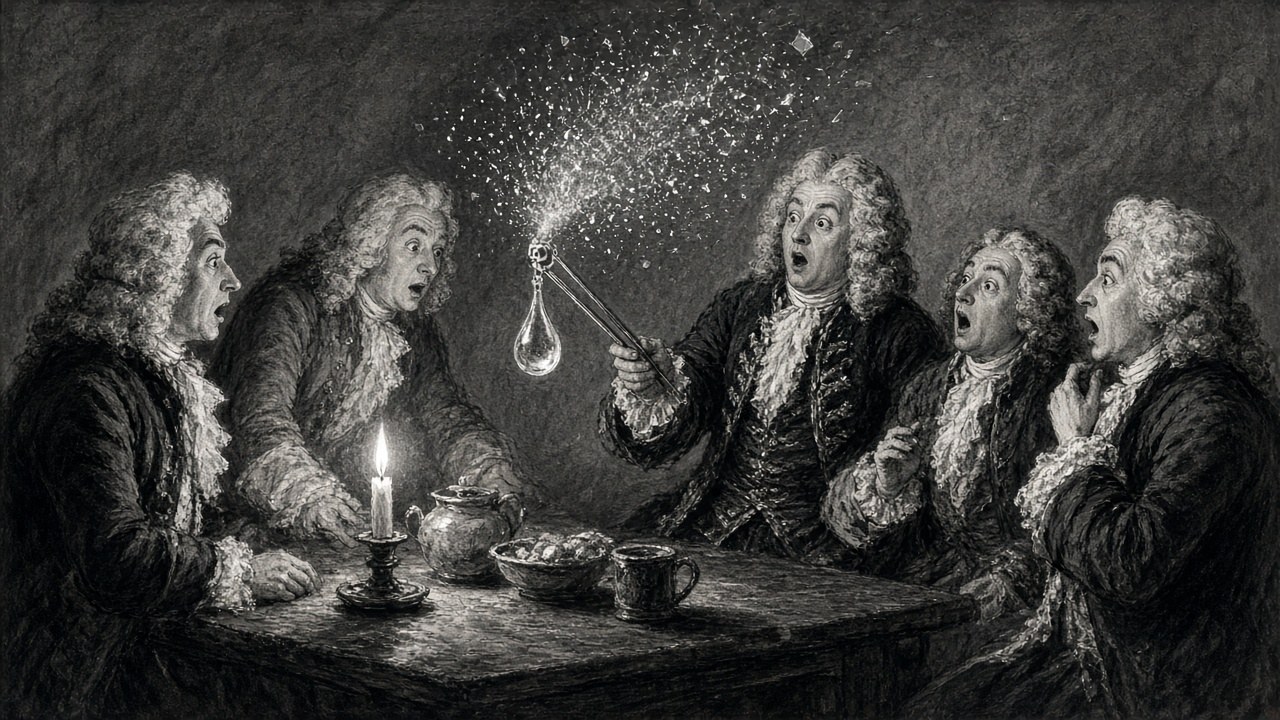
Illustration: an imagined 17th-century demonstration of a glass drop bursting into fragments.
The physics: compression outside, tension inside
Purdue’s summary gives the modern picture. The surface of the drop cools faster than the interior. That produces compressive stress on the surface, balanced by tensile, or pulling, stress inside.
The two kinds of stress matter because glass fails in tension. Purdue postdoctoral researcher Koushik Viswanathan, a co-author of the paper, put it simply: “The tensile stress is what usually causes materials to fracture… But if you could change the tensile stress to a compressive stress, then it becomes difficult for cracks to grow.” A crack that starts at a squeezed surface is being pushed closed, so it can’t spread.
The 2016 study put numbers on this. The team used integrated photoelasticity, a technique pioneered by Aben. Polarized light shows stress in transparent material as colored bands, and Purdue’s account says the team then used math similar to that of medical CT scans to rebuild the stress distribution in three dimensions. According to the paper’s abstract:
- The surface of the head is under compressive stress of 400–700 MPa. Purdue’s account puts the stresses at around 50 tons per square inch, which matches the top of that range, and calls them comparable to some grades of steel.
- Those stresses suppress Hertzian cone cracking, a cone-shaped crack, whether the load comes from a small hammer or from compression between platens.
- The head can survive compression between tungsten carbide platens up to about 15,000 N.
- At very high loads, the authors argue, the glass deforms plastically, and that eventually destroys the drop.
For a sense of scale, 15,000 N is roughly the weight of a 1.5-tonne mass, pressing on a head only 5–15 mm across. The tonne figure is a simple conversion, not a number from the paper.
Why the tail is the weak point
The head is protected by its compressed skin. The tail isn’t. It’s thin enough that finger pressure breaks it, and once it breaks, cracks get into the interior, where the glass is in tension.
That’s where the explosion comes from. Purdue’s account says that in 1994, Srinivasan Chandrasekar and Cambridge physicist Munawar Chaudhri filmed drops disintegrating at nearly a million frames per second. Cracks raced from the tail toward the head at more than 4,000 mph, about 1.8 kilometers per second. Chandrasekar describes what happens: “within a few microseconds the entire thing shatters into fine powder.” That 1994 work explained the tail. The 2016 study explained the head.
The behavior is a sharp version of what a torsion test comparing ductile steel with brittle cast iron shows on Odinity. Brittle materials fail with little deformation once a crack can grow.
From curiosity to tougher glass
The same principle, a surface under compression, is used deliberately in strengthened glass. Purdue’s account calls the drops’ formation “similar to processes used to make shatter-resistant glasses like those in today’s cellphone screens.” Chandrasekar points out that the first patents to strengthen glass came in the 19th century, “so there was a time lag of more than 200 years.”
Hooke’s annealing experiment shows the other side. Reheat the drop, let the stresses relax as it cools slowly, and it becomes ordinary, breakable glass. The strength was never in the glass itself. It came from the way it cooled.
What’s settled and what’s still debated
Settled:
- Rapid quenching leaves the surface in compression and the interior in tension.
- The compressed surface of the head, measured at 400–700 MPa, stops cracks from forming or spreading under impact.
- Breaking the tail lets cracks into the tensile interior, and they run through the drop at more than a kilometer per second.
- Slow reheating and cooling (annealing) removes the effect, as Hooke found in the 1660s.
Less settled:
- How the drop finally fails under extreme compression. The 2016 authors “argue” that plasticity is involved, an interpretation rather than a direct observation.
- How well one set of measurements generalizes. Drops vary in size, glass type and cooling, and Purdue notes that a study published as recently as 2013 offered an explanation the team considers incorrect.
A Prince Rupert’s drop holds a huge amount of energy locked in by its own cooling. As long as the surface stays compressed it’s very hard to break, and once a crack reaches the interior the drop comes apart almost instantly.