

How Do Birds Navigate? The Compasses Inside a Migrating Songbird
Right now, on autumn nights, millions of small songbirds are flying south in the dark. Most of them fly alone, and many of the young ones are making the trip for the first time, with no parent to follow and no idea what their destination looks like. Yet they head in the right direction. How do birds navigate like that? Biologists now know that birds carry several compasses: one that reads the sun, one that reads the stars, and one that senses Earth’s magnetic field. On top of those they build a learned “map.” How the magnetic sense works at the level of molecules is still an open question, and it is one of the most intriguing in biology.
Two problems: which way is south, and where am I?
The modern framework goes back to the German ornithologist Gustav Kramer. In a 2022 open-access review, Roswitha and Wolfgang Wiltschko of Goethe University Frankfurt explain that Kramer saw navigation as a two-step process, which he called the map-and-compass model.
- The map step: the bird works out where it is relative to its goal, which gives it a course to fly.
- The compass step: it finds that direction in the world and follows it.
A first-time migrant has no map. The Wiltschkos describe how, for that first trip, the map step is replaced by a genetic program that tells the bird to fly a set direction for a set time. Hand-raised garden warblers that had never seen the sky still headed southwest in early autumn and switched to southeast later in the season. That matches the bend in their population’s real route through Iberia into Africa.
The difference between young and experienced birds shows up clearly in displacement experiments. When migrating starlings were caught and moved hundreds of kilometers sideways to their route, the young birds kept flying in their inherited direction and ended up somewhere new. Adults that had already spent a winter in the wintering area corrected their course and headed for it.
How do birds navigate by the sun?
Kramer described the sun compass in birds in 1950, the same year Karl von Frisch reported it in honeybees. The trouble with the sun is that it moves. Using it as a compass means knowing what time it is, and birds use their internal circadian clock for that.
The classic test is the clock-shift experiment, which the Wiltschko review describes. Researchers keep birds under artificial lighting that starts and ends six hours early. After about five days, the birds’ internal clocks have shifted. Released under the real sun, homing pigeons then misjudge its position and fly off in a predictably wrong direction. In the Northern Hemisphere, a forward shift turns them counterclockwise and a backward shift turns them clockwise. The experiment shows that the sun gives them only a compass, not their position: the shifted birds still know where home is, but they point the wrong way to get there.
Pigeons have to learn their sun compass. Birds that had only ever seen the afternoon sun couldn’t use it in the morning. Interestingly, day-migrating birds on migration didn’t respond to clock shifts as expected, which suggests the sun isn’t their main compass for long migratory flights. Polarized skylight, which birds can see, also matters. At sunset, it helps at least some night migrants set their course.
The star compass, learned from a spinning sky
Night migrants have a second sky compass. In planetarium experiments in the 1960s, Stephen Emlen showed that indigo buntings oriented by the projected stars. When he reversed the sky, the birds reversed their headings.
Birds don’t use the star compass the way people often imagine, the Wiltschkos point out. It doesn’t involve the internal clock, and birds don’t seem to recognize individual stars. Instead, they learn the center of rotation of the night sky. In a 1970 experiment by Emlen, hand-raised young birds grew up under a planetarium sky that rotated around Betelgeuse in Orion instead of Polaris. In autumn, under a stationary sky, they flew away from Betelgeuse as if it were the North Star. Other researchers later replaced the stars with just 16 dots of light. As long as the pattern had rotated once a day while the birds were young, they used it to orient.
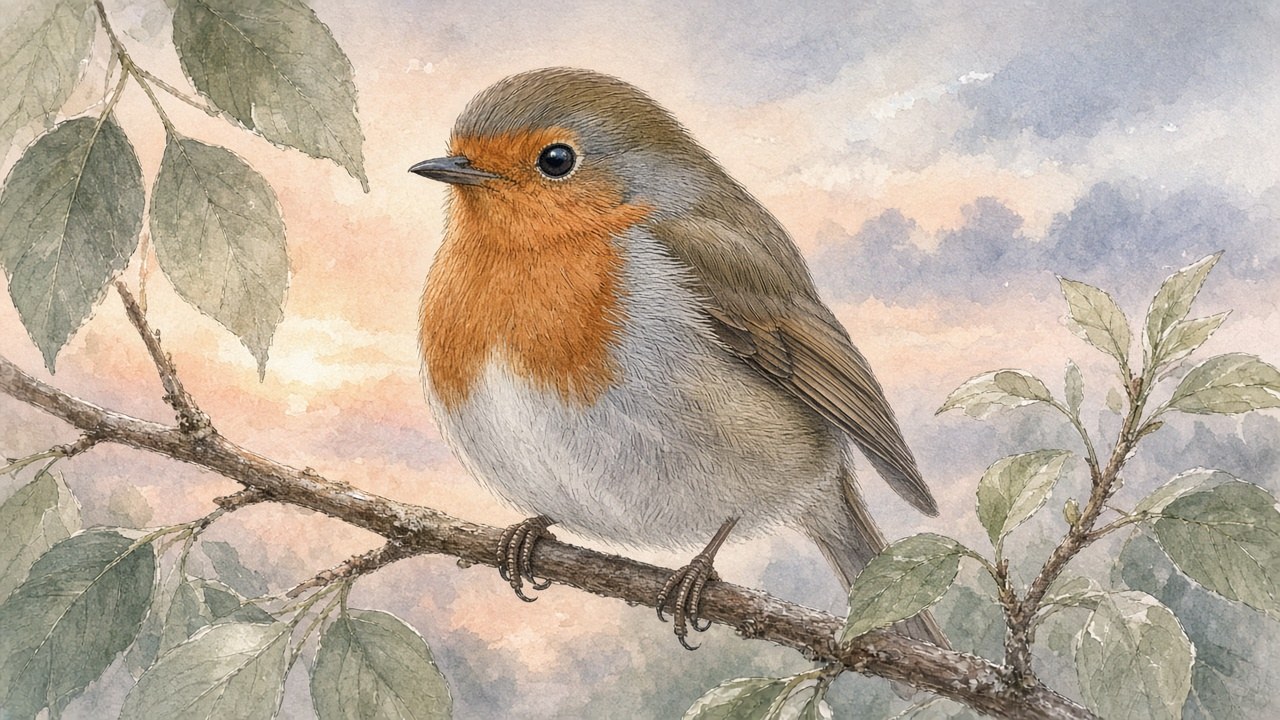
Illustration: a European robin, the species in which the bird magnetic compass was first shown.
A magnetic compass that can’t tell north from south
The magnetic compass was first shown in European robins. Moving the north of the magnetic field around a cage with electric coils made the birds shift their headings to match. The idea was met with skepticism at first. A magnetic compass has since been demonstrated in more than 20 bird species, including homing pigeons and domestic chickens.
It works differently from a human compass. According to the Wiltschkos’ 2019 review in Journal of the Royal Society Interface and their 2022 review, the bird’s compass has three distinctive features:
- It ignores polarity. It reads the tilt of the field lines instead. That means it doesn’t distinguish magnetic north from south. It distinguishes “poleward,” where the field lines dip into the ground, from “equatorward,” where they point up. The flip side is that the compass becomes ambiguous at the magnetic equator, and long-distance migrants have to reverse their heading when they cross it.
- It is tuned to the local field strength. Raising or lowering the field by about 25% disorients the birds at first, though they can adapt with time.
- It needs light. It works from ultraviolet to about 565-nanometer green light. Under yellow or red light, the birds are disoriented.
That last feature was a major clue. A compass that needs light points to the eye.
The quantum hypothesis: radical pairs in the eye
The leading explanation is called the radical pair mechanism. It was first proposed by Klaus Schulten and colleagues in 1978 and later developed by Thorsten Ritz. When light hits certain molecules in the retina, it can create a pair of radicals, molecules each carrying an unpaired electron. The two electrons’ spins are linked, and the pair switches between two quantum states. Earth’s magnetic field can nudge the balance between those states, depending on how the molecule is oriented relative to the field lines.
If many such molecules sit in cells facing every direction across the curved retina, the field could produce a pattern of activity that tracks the field lines. Because the effect depends on the axis of the field and not its polarity, it naturally produces exactly the kind of inclination compass the behavioral experiments found. That match is a big part of why the idea took hold.
The candidate molecule is cryptochrome, a light-sensitive protein, because it is the only known photopigment in animals that forms radical pairs. In 2021, a team reported in Nature (Xu et al.) that cryptochrome 4 from the European robin is magnetically sensitive in the test tube. It was more sensitive than the same protein from chickens and pigeons, which don’t migrate. Using targeted mutations, they traced the effect to four successive flavin–tryptophan radical pairs inside the protein.
That is strong support, but it isn’t proof. The robin experiment was done on purified protein, not in a living bird’s eye. The Wiltschkos’ own review points to a different cryptochrome, Cry1a, as a strong candidate. Their 2019 review is candid that “many details are still unclear,” including how a radical pair signal becomes a nerve signal.
The map: magnetic intensity and a second sense
A compass doesn’t tell a bird where it is. For that, experienced birds seem to use gradients. Earth’s magnetic field strength and the angle of its field lines both change between the poles and the equator. In the Wiltschkos’ 2022 review, these magnetic factors are “the ones best supported so far.”
Some of the evidence comes from magnetic pulses. In a 2013 study described by the Max Planck Society, Richard Holland and Barbara Helm caught wild robins at a migration stopover and gave some of them a brief, strong magnetic pulse. Then they tracked the birds’ departures with tiny radio transmitters. Adults that had migrated before flew off in the wrong direction more often than untreated birds, with the strongest effect in the first ten days. First-time migrants weren’t affected. “The pulse must have reset the robins’ magnetic maps,” Holland said. Young birds, relying on their inherited direction, had no map to reset.
A pulse like that would affect permanently magnetic particles, not radical pairs. That is why researchers suspect a second receptor based on magnetite, an iron oxide, possibly in the beak region, with signals carried by the trigeminal nerve. Even so, Holland told the Max Planck Society: “We still don’t know for sure where the receptor for this magnetic information is actually located.”
Smell is the most contested map cue. Italian researchers in the 1970s found that pigeons unable to smell got lost, but replications elsewhere gave mixed results. The Wiltschkos call it the most controversially discussed cue so far and say the debate “is still not finally resolved.”
What’s settled and what’s still open
Settled:
- Birds use a sun compass tied to their internal clock.
- Night migrants use a star compass learned from the sky’s rotation.
- Birds have a light-dependent inclination compass that reads the angle of the field lines, not their polarity.
- First-time migrants fly an inherited direction. Experienced birds can correct for displacement, which means they have a learned map.
Leading hypothesis:
- The magnetic compass runs on radical pairs in cryptochrome in the retina.
- The robin CRY4 result is the strongest molecular evidence so far, but it comes from protein in the lab, not a working bird.
Open:
- Which cryptochrome is the actual sensor.
- How the quantum signal reaches the brain.
- Where the magnetic map receptor is.
- Whether smell, infrasound or gravity add to the map.
Birds solve all of this every autumn night, and scientists still can’t fully explain how.