
The Discovery of Radium: How Marie Curie Found an Element by Its Glow
Marie Curie was born in Warsaw on November 7, 1867. Thirty-one years later, she and her husband Pierre announced an element nobody could yet see, weigh or hold. They knew it was there only because the ore they were studying gave off more radiation than it should have. The discovery of radium was announced in December 1898, but proving it took years of hard physical work. It produced the first woman Nobel laureate and helped found a new science. It also left a hazard the Curies didn’t understand, and their notebooks are still radioactive today.
A clue in the numbers
The story starts with Henri Becquerel. In 1896, he found that uranium gives off rays on its own. According to a NobelPrize.org history of the Curies, the discovery attracted little attention. Everyone was more excited about Röntgen’s X-rays.
Marie Curie chose the uranium rays as her research topic. She had an unusually sensitive instrument: an electrometer built by Pierre and his brother Jacques, based on the piezoelectric effect the brothers had discovered. In her 1911 Nobel lecture, she explained how it worked. The rays make the air conduct electricity, so a uranium sample placed between two charged metal plates produces a tiny current, and that current “will serve as a measure of the activity of the substance.”
Starting in 1897, she measured compound after compound. She found that among the known elements, only thorium behaved like uranium. She also found that the activity depended only on how much uranium or thorium a sample contained. It made no difference what compound the element was in, or whether it had been melted or dissolved. She called this property radioactivity and concluded it was “an atomic property.” In the words of the NobelPrize.org history, it “must be linked to the interior of the atom itself.”
Then came the clue. Some minerals were more active than their uranium content could explain. In her lecture, she reported that certain pitchblendes containing 75% uranium oxide were “about four times as radioactive as this oxide.” Chalcolite was about twice as active as uranium. She then made chalcolite in the lab from pure ingredients, and its activity matched its uranium content exactly. The extra radiation in the natural mineral had to be coming from something else, “a small quantity of a highly-radioactive material, different from uranium, thorium and the elements known at present.”
The discovery of radium, step by step
Pierre set aside his own research on crystals and joined her. They hoped the unknown element might make up several percent of the ore. It turned out to be far less, she said later. Their method was new: separate the ore chemically, then measure the radioactivity of every fraction to see where the activity went. Marie compared this to spectral analysis. The radiation itself acted as the tracer.
The activity followed two ordinary elements, bismuth and barium. By the end of June 1898, the bismuth fraction was about 300 times more active than uranium. In July, the Curies proposed a new metal, polonium, named after Marie’s native Poland. That paper was also the first time they used the word “radioactivity.” On December 26, 1898, in a note co-authored with G. Bémont, they told the French Academy of Sciences they had strong grounds for a second new substance. It behaved chemically almost like pure barium, and they proposed the name radium, from the Latin for “ray.”
Not everyone was convinced yet. As Curie put it in her Nobel lecture, at first it was “as if our substances had been, the one pure bismuth, and the other pure barium.” The only evidence for new elements was the radioactivity. To persuade chemists, she would have to isolate radium and measure its atomic weight.
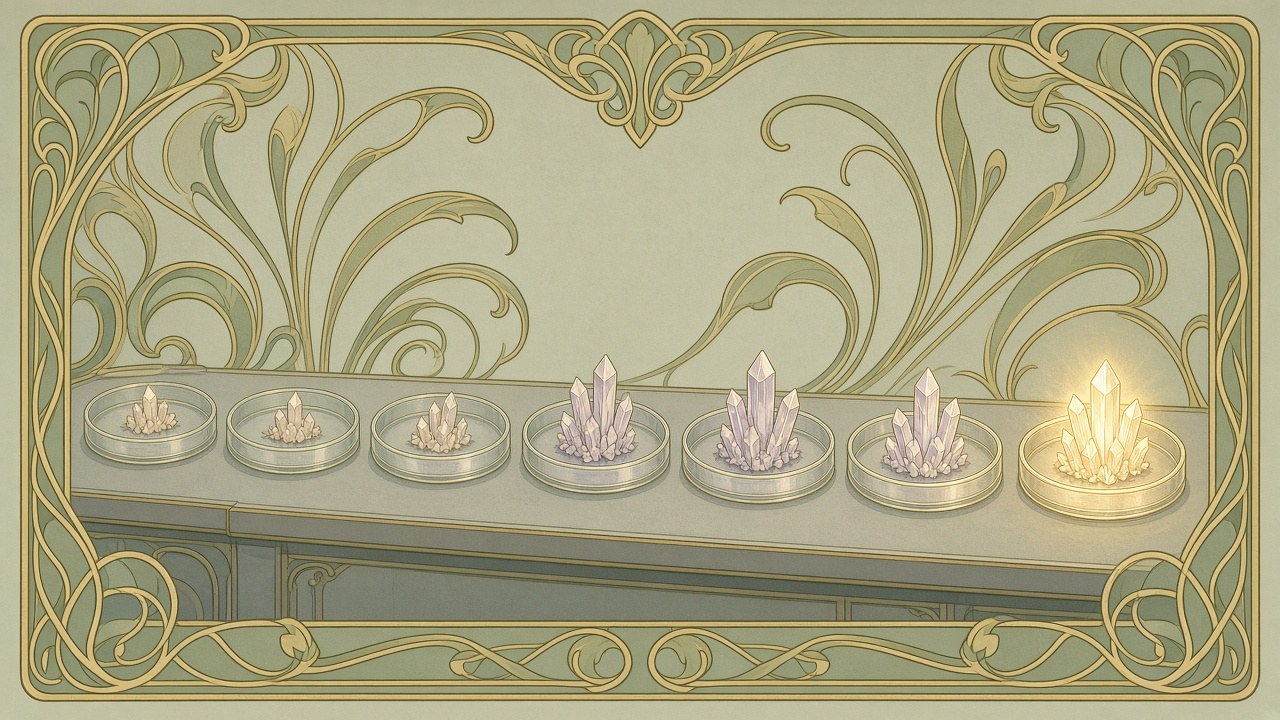
Illustration: crystals growing brighter dish by dish, evoking the thousands of crystallizations that concentrated radium.
Tons of ore for a fraction of a gram
The raw material was waste. Pitchblende from St. Joachimsthal in Bohemia had already been processed for its uranium, and the leftover residue held the radium. The Austrian Academy of Sciences arranged for several tons of it to be sent to Paris.
The Curies worked in an empty shed lent by the school where Pierre taught. According to the NobelPrize.org history, it had a leaky glass roof and was like a hothouse in summer and freezing in winter. The German chemist Wilhelm Ostwald called it “a cross between a stable and a potato shed.” Marie did the chemistry in batches of up to 20 kilograms. “Sometimes I had to spend a whole day stirring a boiling mass with a heavy iron rod nearly as big as myself,” she wrote. Pierre measured the activity after every step.
Her lecture gives the numbers:
- A ton of residue held only “a few decigrams” of radium.
- Each ton yielded 10 to 20 kilograms of crude barium sulfate carrying the radium.
- Converted to chlorides, the mixture contained only about 3 parts of radium per 100,000.
Radium chloride is slightly less soluble than barium chloride, so she separated the two by fractional crystallization. Each time the salt recrystallized, the crystals got a little richer in radium. Getting a very pure salt took “several thousands of crystallizations.”
The proof built up gradually:
- The spectroscopist Demarçay found a new spectral line in the enriched chloride, and it grew stronger as the activity rose.
- Her measured atomic weights climbed as the samples got purer: 138 (barium’s value), then 146, 174, 225, and finally 226.45 in 1907, from 0.4 grams of very pure salt.
- From several tons of starting material, she isolated about a decigram of nearly pure radium chloride and measured an atomic weight of 225. She presented the work in her doctoral thesis on June 25, 1903. The examiners judged it the greatest scientific contribution ever made in a doctoral thesis.
- In 1910, she and André Debierne isolated radium as a metal.
Radium took its place in Mendeleev’s periodic table as the heavier relative of barium among the alkaline earth metals, on the same row as uranium and thorium. Odinity’s history post on Newlands, Mendeleev and the periodic law explains how that table was built to make room for elements no one had found yet.
Glow, heat and a new idea of the atom
Pure radium was astonishing. Curie reported that in solid salts it is about 5 million times more radioactive than an equal weight of uranium. That is enough to make its salts glow on their own. It also gives off heat continuously, about 118 calories per gram per hour. She remembered coming into the shed at night and seeing “from all sides the feebly luminous silhouettes” of their samples.
Where did the energy come from? Rutherford and Soddy proposed that radioactive atoms transform into other atoms as they decay. Radium made that idea testable. Ramsay and Soddy showed that radium produces helium, and Curie called this “a first clearly-established example of atomic transmutation.” That argument only worked because she had shown radium was a true element and not some compound. She also noted that radium “has not an infinite life,” and gave its half-life as about 2,000 years. Today’s evaluated nuclear data, from the IAEA and France’s Laboratoire National Henri Becquerel, put the half-life of radium-226 at about 1,600 years.
Radium’s decay chain is still a working tool. Odinity’s lab on detecting art forgeries uses the decay of radium-226 and its daughter products to tell a centuries-old painting from a modern fake.
Two Nobel Prizes, and a hazard nobody saw
In 1903, Becquerel received half of the Nobel Prize in Physics. The Curies shared the other half for their joint research on radiation. Marie Curie became the first woman to win a Nobel Prize. In 1911, she won the Chemistry prize alone, “in recognition of her services to the advancement of chemistry by the discovery of the elements radium and polonium, by the isolation of radium and the study of the nature and compounds of this remarkable element.” That made her the first person to win two Nobel Prizes.
The Curies had no idea what the radiation was doing to them. Pierre strapped a radium sample to his arm for ten hours and watched the burn-like wound that followed. After 52 days, a permanent grey scar remained. He often carried radium in his waistcoat pocket to show friends, and Marie kept a glowing sample by her bed. Both had cracked, scarred fingers and constant fatigue. According to NobelPrize.org, Marie Curie died in 1934 of aplastic anemia, a blood disease that often results from exposure to large amounts of radiation. Their laboratory notebooks are still so radioactive that readers at France’s national library must sign a form saying they consult them at their own risk.
Radium is dangerous. None of this history describes anything safe to repeat, and radium should never be handled outside a licensed facility.
What’s settled and what’s still told loosely
Settled:
- The logic of the discovery: activity is an atomic property, so extra activity in pitchblende meant a new element.
- The 1898 announcements of polonium (July) and radium (December 26).
- The isolation of radium salts, its atomic weight near 226, its place in the periodic table and its isolation as a metal in 1910.
Told loosely:
- Who discovered radioactivity? The credit is easy to blur. Becquerel found the rays in 1896. Curie named radioactivity and showed it was a property of atoms.
- Exact figures for how much ore she processed vary between tellings. Her own lecture describes factory-scale treatment of “thousands of kilograms.”
As for credit, Curie stated plainly in Stockholm that “the discoveries of radium and of polonium were made by Pierre Curie in collaboration with me.” She added that the chemical work of isolating radium “was carried out specially by me.”