
The Haber-Bosch Process: How Chemists Pulled Bread From the Air
Every breath you take is about 78% nitrogen, yet for most of history farmers couldn’t get enough of it into their fields. Plants can’t use nitrogen gas, only nitrogen locked into compounds. The Haber-Bosch process solved that problem. It combines nitrogen from the air with hydrogen to make ammonia, the raw material for synthetic fertilizer. A century after it went into production, it is estimated to feed roughly half the people on Earth. It also helped Germany keep fighting the First World War, and today it consumes almost 2% of the world’s energy.
A looming nitrogen shortage
In his 1920 Nobel lecture, Fritz Haber described the problem as it looked around 1900. For half a century, the world had been drawing on saltpeter, a nitrogen-rich mineral deposited in the high deserts of Chile. Comparing rising demand with the known deposits, he said, it became clear that “towards the middle of the present century a major emergency would be unavoidable, unless the chemistry found a way out.”
Coal wasn’t the answer either. It held only about 1% fixed nitrogen, and ammonia from coal came only as a by-product of the gas and coke industries. Haber concluded that the only source big enough was “the immense supply of elementary nitrogen available in our atmosphere.” The difficulty was that the nitrogen in air (N2) is famously unreactive. As Hannah Ritchie of Our World in Data explains, crops before Haber-Bosch had to rely on the limited reactive nitrogen already in soils and ecosystems. The one exception was legumes such as peas and beans, which host bacteria that fix nitrogen themselves.
The chemistry: an equilibrium that fights back
On paper, the reaction is simple: one molecule of nitrogen plus three of hydrogen gives two of ammonia.
N2 + 3H2 ⇌ 2NH3
The double arrow is the problem. The reaction is reversible, so ammonia can also break back down into nitrogen and hydrogen. Two features of the reaction set the rules. Both are explained clearly in chemistry educator Jim Clark’s Chemguide account of the process:
- Making ammonia releases heat. By Le Chatelier’s principle, lower temperatures shift the equilibrium toward more ammonia.
- Four gas molecules become two. Higher pressure favors the side with fewer molecules, so it also pushes toward ammonia. It speeds the reaction too, by crowding molecules onto the catalyst surface.
Odinity’s lab report on Le Chatelier’s principle in buffers shows the same kind of equilibrium shift on a small scale.
Here is the catch. At low temperature, the reaction is hopelessly slow. Clark points out that it makes no sense to aim for an equilibrium mixture rich in ammonia if reaching it takes years. Without a catalyst, he writes, “virtually no reaction happens in any sensible time.” Even a catalyst doesn’t change the equilibrium. It only gets the gases there faster. Odinity’s lab report on chemical kinetics covers that rate side of the problem.
Haber found this out the hard way. By 1905, his measurements showed that above red heat, no catalyst would produce “more than a trace” of ammonia at normal pressure. He decided it was “useless to pursue the problem further.” Here the matter rested, as he put it, for three years.

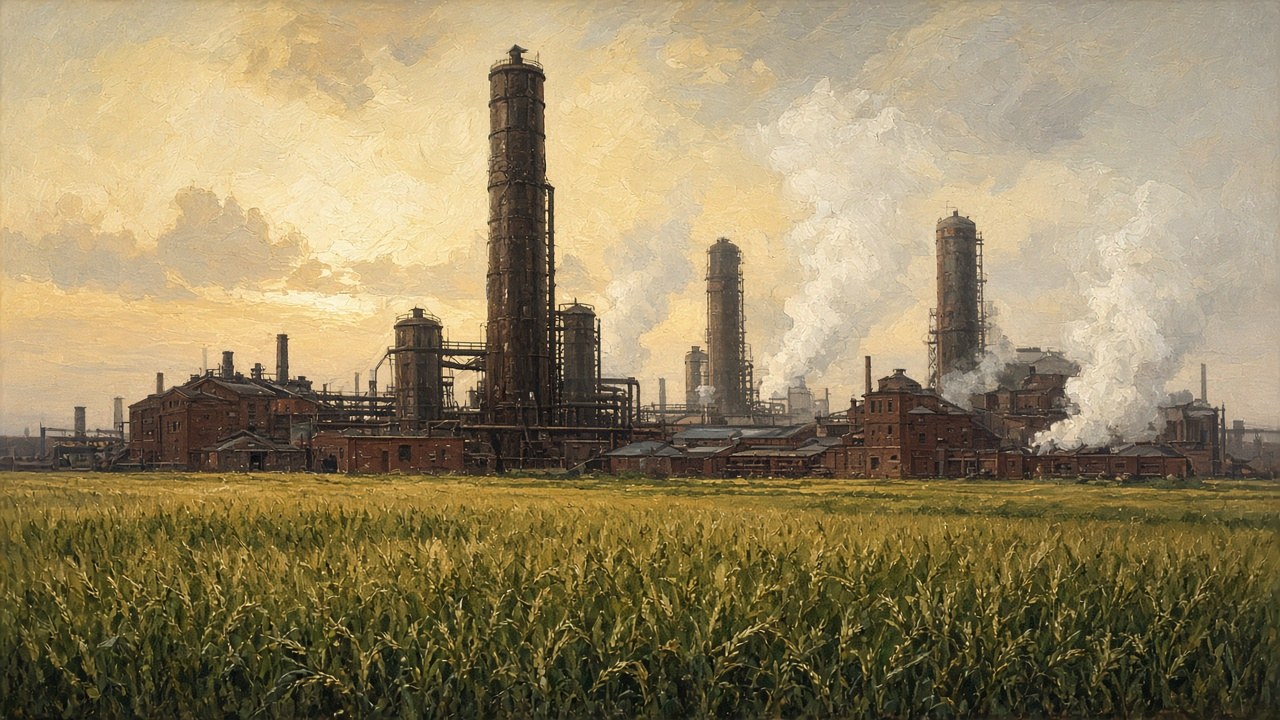
Illustration: wheat growing out of the air, a nod to fertilizer made from atmospheric nitrogen.
How Haber made the Haber Bosch process work
Haber’s way out was to stop fighting the equilibrium and work around it. He went to the highest pressure he could manage. His lab compressor reached 200 atmospheres, and that machine’s limit, he admitted, is what fixed the working pressure. He then searched the periodic table for a catalyst fast enough at 500–600 °C and found two that worked well: osmium and uranium.
The other key idea was circulation. Even at 200 atmospheres, the gas leaving his catalyst held only about 5% ammonia. So Haber, working with Robert Le Rossignol, built a small plant that ran at constant high pressure. It removed the ammonia, sent the unreacted gas back around, and used the heat released by the reaction to warm the incoming gas. That was enough to convince the chemical company BASF to back high-pressure synthesis. According to the Erisman et al. feature in Nature Geoscience, Haber filed his patent on the “synthesis of ammonia from its elements” on October 13, 1908.
Haber was honest about the limits of his understanding. Why a catalyst needs such a high temperature, he said in his lecture, “is a question which we must leave to a more enlightened period of science to answer.”
Bosch’s problem: building it big
BASF acquired the process in 1908 and gave the job of scaling it up to Carl Bosch. His Nobel biography lists the obstacles:
- Plant and apparatus that could survive high pressure and high temperature together.
- A substitute for osmium and uranium. The team found that pure iron with certain additives would do.
- Cheap ways to produce and purify the hydrogen and nitrogen.
Haber noted that BASF also redesigned the oven to overcome the effect hydrogen had on the carbon content of its steel over long runs. The Nobel Prize facts page credits Bosch with an apparatus built from different steels with different resistance to pressure and heat.
The Oppau nitrogen works opened in 1913, followed by the even larger Leuna plant in 1917. Bosch shared the 1931 Nobel Prize in Chemistry “in recognition of their contributions to the invention and development of chemical high pressure methods.” Modern plants still follow Haber’s outline. Clark’s Chemguide describes an iron catalyst with a potassium hydroxide promoter, pressures around 200 atmospheres and temperatures of 400–450 °C. Only about 15% of the gas converts on each pass, but recycling brings the overall conversion to about 98%.
Bread from air, and explosives too
Haber won the 1918 Nobel Prize in Chemistry “for the synthesis of ammonia from its elements.” He ended his lecture with an image of the chemical industry helping the farmer who “changes stones into bread.”
The other side of the story is in his own Nobel biography. The Oppau and Leuna works, it says, “enabled Germany to prolong the First World War” after its supply of nitrates for explosives failed in 1914. Haber also became a consultant to the German War Office and “organised gas attacks and defences against them.” The same man whose chemistry feeds billions also helped launch chemical warfare. Both facts belong in any honest account of him.
His later years were bleak. When Nazi race laws in 1933 forced nearly all his staff to resign, Haber resigned too rather than comply. He went to Cambridge, then moved to Switzerland, and died in Basel in January 1934.
How many people does it feed?
This is the claim that makes Haber-Bosch famous, and it needs careful handling. Our World in Data summarizes the main published estimates:
- Erisman and colleagues estimated that nitrogen fertilizer fed 44% of the world’s population in 2000 and 48% in 2008.
- Vaclav Smil put the figure at about 40% in 2000.
- A separate 2023 estimate found about half in 2019.
These are modeled numbers, not head counts. Ritchie notes that untangling the role of fertilizer from crop breeding, irrigation and mechanization is “challenging.” Most estimates still converge on 40–50% of the world’s population.
The cost is energy. According to a 2020 Royal Society policy briefing, the world makes about 176 million tonnes of ammonia a year. That uses about 1.8% of global energy output (the International Energy Agency puts it at around 2% of the world’s final energy consumption) and releases about 500 million tonnes of carbon dioxide, about 1.8% of global emissions. Most of that doesn’t come from the Haber-Bosch reactor itself. It comes from making the hydrogen, which is usually stripped from natural gas by steam reforming. That step accounts for over 80% of the energy and about 90% of the emissions.
What’s settled and what’s still open
Settled:
- The chemistry: an exothermic, reversible reaction whose equilibrium favors low temperature and high pressure, on an iron catalyst that sets the speed but not the yield.
- The history: Haber’s high-pressure circulation method, Bosch’s scale-up and the plants at Oppau and Leuna.
Still open:
- The exact share of humanity fed. Estimates cluster around half, but they rest on models.
- A cleaner hydrogen supply. The Royal Society briefing calls ammonia one of the “big four” industrial processes, alongside cement, steel and ethylene, that need a decarbonization plan to reach net zero by 2050.
- A gentler route. Haber himself saw this coming. “Nitrogen bacteria teach us,” he said, that nature still uses methods “which we do not as yet know how to imitate.” A century on, that remains true.