
How Does Rust Form? The Slow Electrochemistry of Iron
Leave an iron nail in a tube of water and within a few days it grows an orange crust. Leave an identical nail in a sealed tube of dry air and it stays bright. Leave one in salt water and it rusts fastest of all. That simple classroom experiment holds most of the answer to how does rust form. Iron needs both water and oxygen, and anything that helps electric charge move through the water speeds it up. Rust isn’t iron simply “reacting with air.” Each patch is a tiny battery running on the metal’s surface.
Rust is one kind of corrosion
The OpenStax Chemistry 2e textbook defines corrosion as “the degradation of metals by a naturally occurring electrochemical process.” Rust on iron is the most familiar example. So are tarnish on silver and the blue-green patina on copper. OpenStax cites estimates that the total cost of corrosion in the United States runs to more than half a trillion dollars a year. An older ChemPRIME text on LibreTexts estimates that about one-seventh of all iron production goes to replacing metal lost to corrosion.
What makes rust special among these is that it doesn’t protect the metal underneath. More on that below.
The nail test: what iron needs to rust
The Royal Society of Chemistry’s classroom version of the experiment uses four test tubes, each with an iron nail:
- Tube 1: ordinary water, which contains dissolved air.
- Tube 2: boiled water with a layer of oil on top. Boiling drives out the dissolved air, and the oil keeps more from getting in.
- Tube 3: salt water.
- Tube 4: dry air. Calcium chloride soaks up the moisture, and a bung keeps more from getting in.
After a few days, the nails in tubes 2 and 4 haven’t rusted, and the nail in salt water has rusted the most. The RSC draws the conclusion: water and oxygen are both essential, and “salt can increase the rate of rusting.” It also cautions that rusting is “very simply” a reaction of iron with oxygen, but water is an important part of the process too. The reason water matters so much is electrochemical.
How does rust form? A battery on the metal
Rusting runs like a galvanic cell, the same kind of reaction that powers a battery. Different spots on the same piece of iron take on different roles.
At the anode, iron dissolves. Iron atoms give up electrons and go into the water film as iron(II) ions:
Fe → Fe2+ + 2e−
The RSC explains that this happens where the metal’s thin protective oxide layer is weakest or damaged.
At the cathode, oxygen picks up the electrons. The electrons travel through the metal to another spot, where dissolved oxygen and water accept them and form hydroxide ions:
O2 + 2H2O + 4e− → 4OH−
OpenStax writes the cathode reaction in its acidic form, with H+ ions forming water. The underlying point is the same: oxygen is reduced where it is plentiful, and iron is oxidized somewhere else.
Then rust precipitates. The iron(II) ions drift through the water, meet the hydroxide and more oxygen, and are oxidized further to iron(III). The product is rust, a hydrated iron(III) oxide written Fe2O3·xH2O. The x is there because, as OpenStax notes, the amount of water in rust varies.
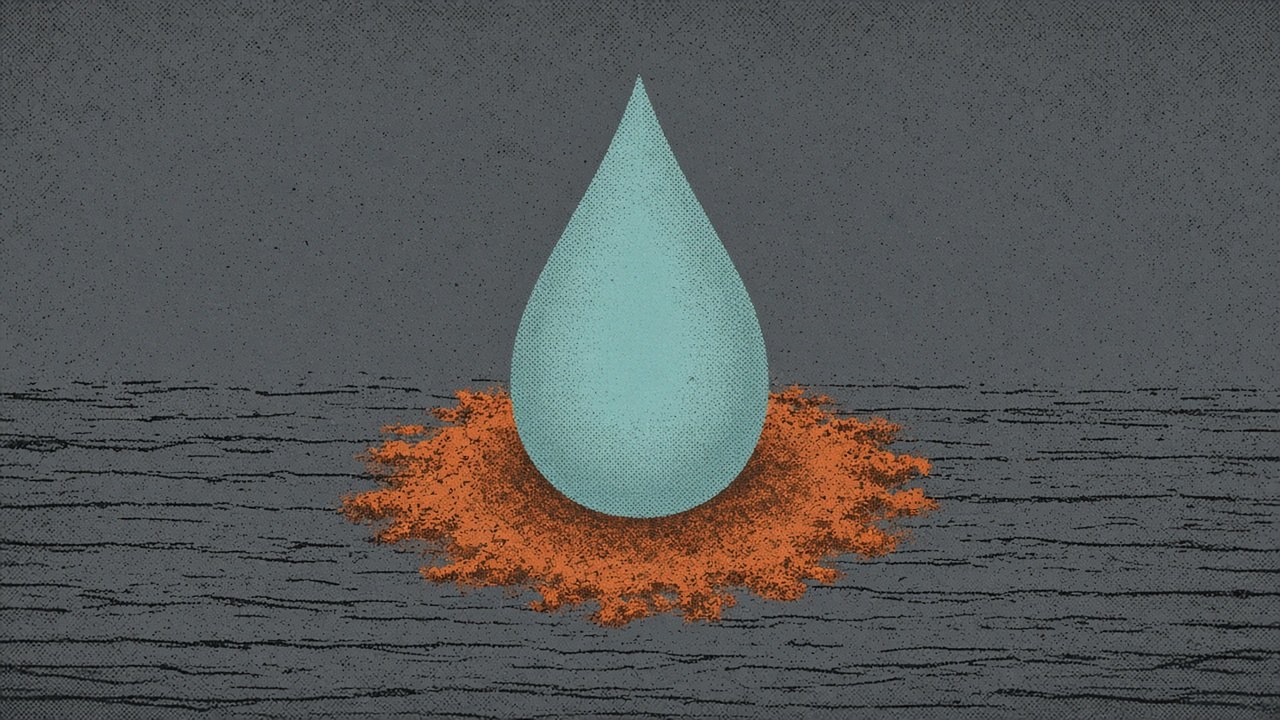
Illustration: rust gathering at the edge of a water drop, where oxygen from the air meets the water.
Why rust appears in one place and eats metal in another
A surprising consequence of the battery picture is that the metal is lost in one place and the rust shows up somewhere else. The ChemPRIME text on LibreTexts gives two examples:
- An old nail in a wooden building. Rust gathers near the head, where oxygen is available. The iron is eaten away deep in the wood near the point, where oxygen is scarce and only the anode reaction can run.
- A drop of water on iron. The metal pits near the center of the drop, while rust deposits near the edge, where the air reaches the water.
Rust also feeds itself. Unlike the patina on copper, OpenStax notes, rust doesn’t form a protective layer. It flakes off and exposes fresh iron to the air. ChemPRIME adds that the presence of rust itself speeds up rusting, along with acids, strain in the metal and contact with less reactive metals.
Why salt makes it so much worse
The battery needs a complete circuit. Electrons flow through the metal, but charge also has to move through the water between anode and cathode, carried by ions. Pure water conducts poorly. Salt water is full of ions.
The ChemPRIME text explains that the reaction can be completed “by ionic conduction if the aqueous solution contains a significant concentration of ions. Thus iron rusts faster in contact with salt water than in fresh.”
Chloride, the ion in road salt and seawater, does a second kind of damage. A 1998 Federal Highway Administration report on corroding bridges describes deicing salts as “extremely corrosive due to the disruptive effects of its chloride ions on protective films on metals.” The report traces the problem to the late 1960s. That’s when concrete bridge decks in the snow belt began delaminating and spalling, some needing maintenance after as little as five years, as states spread more salt to keep roads bare. Steel inside concrete normally sits under a thin protective oxide film. Once enough chloride seeps in, the report explains, that film breaks down and the steel starts to rust. Rust also takes up more room than the steel it replaces, so it cracks the concrete from the inside.
Why aluminum and stainless steel don’t rust away
Plenty of metals corrode. The difference is whether the product protects what’s underneath.
- Aluminum. The RSC’s periodic table entry notes that “whereas iron rusts away when exposed to the elements, aluminium forms a microscopically thin oxide layer, protecting its surface from further corrosion.”
- Copper. Its blue-green patina works the same way. OpenStax uses the Statue of Liberty as its example: the patina covering its originally brown copper skin is a protective layer, a process called passivation.
- Stainless steel. This is iron with a small amount of chromium. OpenStax explains that the chromium tends to collect near the surface, where it corrodes and forms a passivating oxide layer that protects the iron. Odinity’s lab report on determining manganese in steel notes that adding chromium to steel produces stainless steel, which resists corrosion.
Alloys can also corrode in their own ways. Brass, for example, can lose its zinc in acidic or salty water, a form of corrosion covered in Odinity’s guide to copper in brass.
How rust is prevented: barriers and sacrifices
The chemistry points straight to the solutions. Either keep water and oxygen away, or give the battery something else to eat.
Barriers. Paint, grease, oil and plastic coatings keep water and oxygen off the iron. The catch is that the coating has to be complete. ChemPRIME warns that a pinhole in a tin can’s coating rusts very quickly. Tin is less reactive than iron, so it becomes the cathode, and the small patch of exposed iron becomes a concentrated anode.
Sacrificial protection. Connect the iron to a more reactive metal, and that metal corrodes instead. In the RSC’s second classroom experiment, a nail wrapped in magnesium ribbon rusts the least. The nail wrapped in copper rusts the most, because iron gives its electrons to the copper. OpenStax describes the same principle, called cathodic protection, in underground tanks, pipes and water heaters. Blocks of zinc or magnesium are wired to them as “sacrificial anodes” and replaced as they wear away.
Galvanizing combines both approaches. Steel is coated with zinc, which forms its own protective layer. If the coating is scratched, the zinc still corrodes in preference to the iron.
What’s settled and what’s more complicated
Settled:
- Rusting is electrochemical. Iron is oxidized at anodic sites and oxygen is reduced at cathodic sites.
- Both water and oxygen are required.
- Dissolved salts speed it up by carrying charge, and chloride breaks down protective oxide films.
- Coatings, alloying and sacrificial metals all work by blocking or redirecting that cell.
More complicated than the textbook version:
- “Rust” isn’t one compound. Its water content varies, and different oxides and hydroxides form along the way.
- Exactly how chloride breaks down iron’s protective film, atom by atom, is still debated. A 2020 study in npj Materials Degradation used computer simulations to support one proposed four-stage mechanism, and its results suggest that chloride acts as a catalyst that helps pull iron atoms out of the film.
- Real-world rates depend on everything from humidity to the steel’s composition. That’s why corrosion engineers rely on testing, not just equations.