
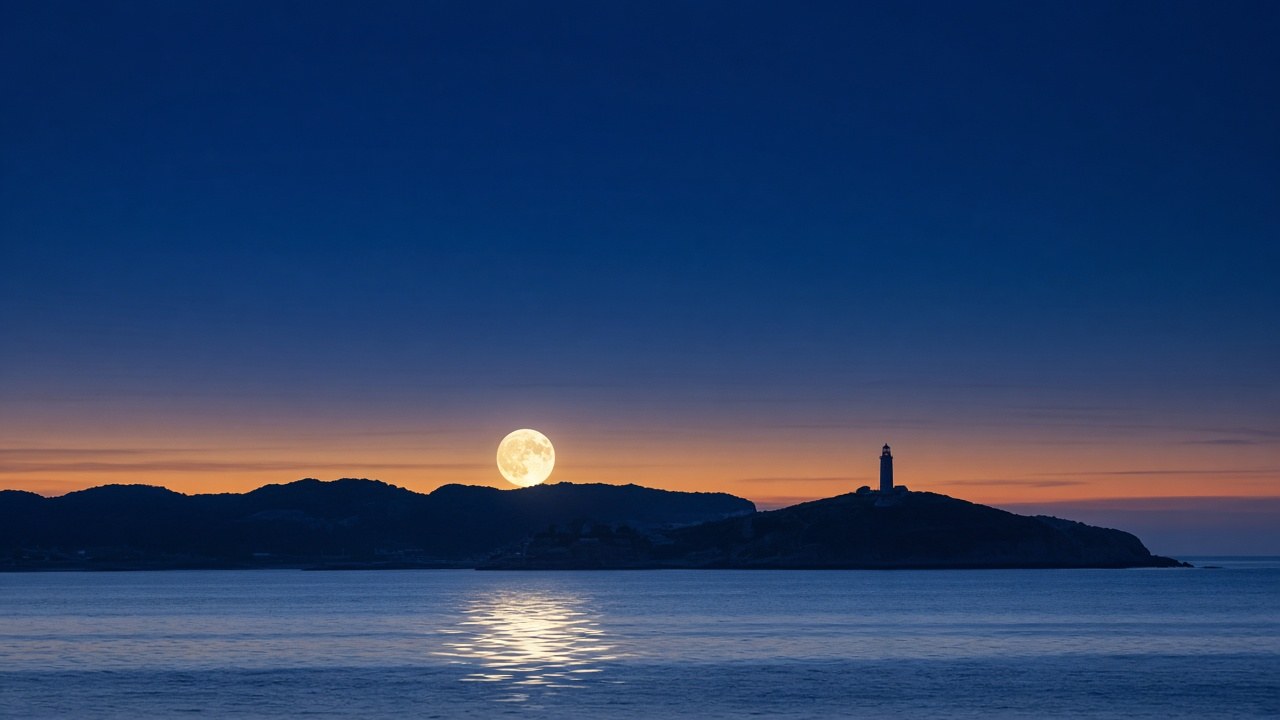
What Is a Supermoon? Tonight’s Full Moon, Explained
Tonight’s full Moon is a supermoon. The Moon becomes exactly full at 14:54 UTC on Nov. 24, 2026, which is 9:54 a.m. EST, so the Moon you see this evening will be only hours past full. Expect plenty of photos captioned “huge.” But what is a supermoon, really, and how much bigger does it look? Less than the hype suggests. The Moon is slightly closer than usual, and the more noticeable change is that it’s a little brighter.
What is a supermoon? Full Moon meets perigee
The Moon’s path around Earth isn’t a perfect circle. NASA explains that during every orbit, which takes about 27 days, the Moon reaches a closest point called perigee and a farthest point called apogee. On average, perigee is about 226,000 miles (363,300 km) away, and apogee is about 251,000 miles (405,500 km).
A supermoon, in NASA’s words, “occurs when a full Moon coincides with the Moon’s closest approach to Earth in its elliptical orbit.” Because the orbit wobbles, and shifts depending on where the Sun and Earth are, the exact distances vary, and some supermoons are closer than others.
Most of the time the two don’t line up. NASA notes that through most of the year, perigee and full Moon don’t overlap. Supermoons happen only three or four times a year, and they always come in a row.
Not an official term
NASA is upfront that “supermoon” “isn’t an official astronomical term.” According to EarthSky, the word was coined in 1979 by the astrologer Richard Nolle. He defined a supermoon as a full or new Moon within 90% of its closest approach to Earth. Before that, astronomers called these perigean full Moons.
Because there’s no official definition, lists vary. NASA describes the usual cutoff as a full Moon within at least 90% of perigee. The reference site Time and Space Science applies that idea as a distance threshold of 361,885 km, which it attributes to the astronomer Fred Espenak. EarthSky, which also uses Espenak’s tables, notes that he became a world expert on eclipse predictions during his time at NASA’s Goddard Space Flight Center. Time and Space Science points out that sites using a round 360,000 km, or requiring the full Moon to fall within a day of perigee, publish shorter lists. “Neither is more correct,” it says.
The 2026 supermoons, checked
Here’s how the main sources line up:
- Nov. 24, 2026: NASA lists it as an upcoming supermoon at 14:54 UTC. EarthSky, using Espenak’s table, gives the distance as 224,170 miles (360,768 km). Time and Space Science calculates 360,793 km at 14:53 UTC, about 23,600 km closer than average.
- Dec. 24, 2026: NASA lists it at 01:28 UTC, which is the evening of Dec. 23 in U.S. time zones. EarthSky gives 221,667 miles (356,740 km) and calls it the closest full supermoon of the year.
- Jan. 3, 2026: EarthSky also counts the year’s first full Moon as a supermoon, at 362,312 km.
- Jan. 22, 2027: another supermoon follows, at 357,644 km by EarthSky’s figures.
The small differences in times and distances come from different calculation methods. The sources that give distances agree that tonight’s full Moon qualifies and that December’s will be closer.

Illustration: a full Moon over a stormy sea. Supermoon tides are only slightly higher than usual, and big surf comes from weather.
Why supermoons come in clusters
Two cycles are at work. The time from one full Moon to the next, the lunar month, averages 29.53059 days, according to EarthSky. The time from one perigee to the next is shorter. So the full Moon drifts slowly relative to perigee, lining up with it for a few months in a row and then falling out of step. EarthSky notes that 14 returns to full Moon almost exactly equal 15 returns to perigee, a span of about one year, one month and 18 days. That’s why the closest supermoon of 2025, on Nov. 5, is followed 14 lunar months later by the closest of 2026, on Dec. 24.
The extremes over several years are wider still. Time and Space Science lists the closest full Moon in its 2025–2029 range as Feb. 10, 2028, at 356,757 km. The most distant is Oct. 22, 2029, at 406,256 km, about 49,500 km farther away.
How much bigger and brighter?
This is where the hype runs ahead of the physics. NASA says a full Moon at its closest can appear “up to 14 percent bigger and 30 percent brighter” than the faintest full Moon of the year, which happens when it’s farthest away. That’s the most extreme comparison, a supermoon against a “micromoon.”
Compared with an average full Moon, EarthSky puts the gain at up to about 8% in size and some 16% in brightness. Its comparison for the supermoon-to-micromoon difference is a U.S. quarter next to a nickel. You’d see that side by side, but not with a single Moon in the sky.
That’s the catch. Time and Space Science notes that the difference “side by side in a photograph” is obvious. Looking up on one night with nothing to compare against, though, “most people cannot tell.” NASA agrees that 14% “doesn’t make a big difference in detectable size,” but says a supermoon “is a bit brighter.” EarthSky argues the brightness boost is the part casual observers may actually notice.
Why a rising Moon looks enormous
If tonight’s Moon looks giant as it rises over the horizon, that’s not the supermoon effect. Time and Space Science calls it the Moon illusion, and says it’s “entirely in your head.” Measure the Moon, or photograph it rising and again high in the sky, and the disk is the same size. Any rising full Moon gets this boost, super or not.
People have been studying the Moon closely for a long time. Robert Hooke described its crater-like pits after studying it through a telescope in October 1664, and his account appears in Odinity’s collection of Hooke, Newton and Voltaire readings.
Supermoons and the tides
A supermoon does have one measurable effect on Earth. NASA notes that because the Moon is at its closest approach, “it can cause higher tides than usual.”
How much higher? EarthSky explains that high tides around full and new Moons are called spring tides. When they coincide with perigee, they’re perigean spring tides, sometimes called king tides. They tend to come a day or so after the full Moon. Citing Espenak, EarthSky says the closest supermoon’s gravity is only 4% greater than the Moon’s at average distance. It puts the usual extra tide at “a couple of inches (or centimeters).” Flooding typically needs a storm on top. Time and Space Science agrees the effect is “real but modest.”
The pull that holds the Moon in its orbit is the same gravity that raises the tides. Odinity’s centripetal force experiment explainer counts Earth’s gravity on the Moon as a classic example of a centripetal force.
What’s settled and what’s a matter of definition
Settled:
- The Moon’s orbit is elliptical, so its distance changes every month.
- Full Moons near perigee are slightly larger and brighter.
- They raise slightly higher tides.
- Tonight’s full Moon and the one on Dec. 24 are both close enough to count by the usual rule.
A matter of definition:
- Exactly which full Moons get the “supermoon” label, since there’s no official cutoff.
- Whether you’ll notice the difference. The size gain is hard to see by eye; the brightness is easier.
So step outside this evening. It’s not a giant Moon, but it is a slightly closer and brighter one, and next month’s will be closer still. NASA keeps its list of upcoming supermoons up to date.