
How Does CRISPR Work? The Bacterial Immune System Turned Gene Editor
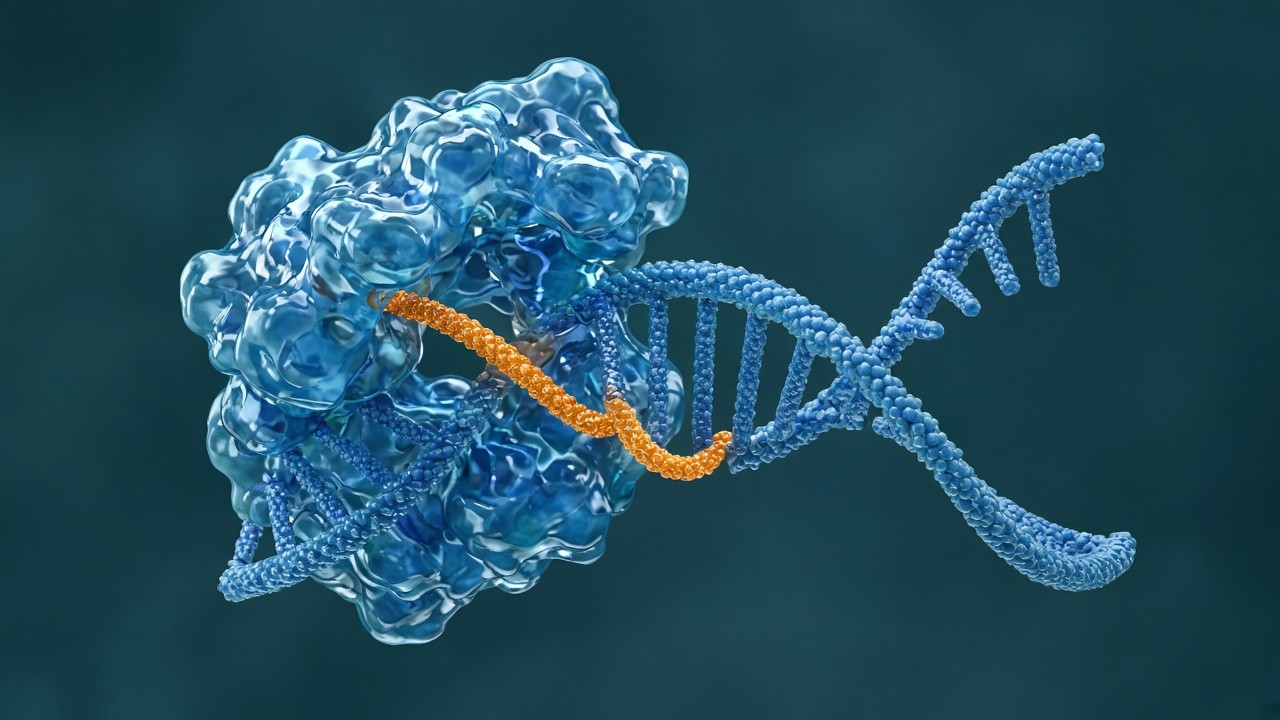
Bacteria have been fighting viruses for billions of years, and some of them keep a record of every attack. They clip a short piece of the invader’s DNA and file it in their own genome, so the next time that virus shows up, they recognize it and cut it apart. Scientists turned that ancient defense into a gene-editing tool cheap and precise enough to change biology labs everywhere. So how does CRISPR work? It comes down to a cutting protein, a short guide molecule that tells it where to cut, and the cell’s own repair crews, which do the actual rewriting.
A strange pattern in bacterial DNA
The story starts with a puzzle nobody could explain. In 1987 Ishino and colleagues at Osaka University were sequencing a gene in E. coli and noticed an odd stretch of DNA next to it. According to the Nobel Committee’s scientific background on the 2020 chemistry prize, it held five repeated sequences, each 29 base pairs long, separated by 32-base-pair “spacers” that didn’t repeat.
Similar patterns kept turning up. In the 1990s the Spanish microbiologist Francisco Mojica found them in Haloferax mediterranei, a salt-loving microbe, and his later work reported a family of these repeats across archaea and bacteria. A 2022 history of the field by Irina Gostimskaya traces the name to a 2002 paper by Jansen and colleagues, who used a name Mojica suggested: CRISPR, short for clustered regularly interspaced short palindromic repeats. The same paper described a set of genes that always sat next to the repeats, the CRISPR-associated or cas genes.
What the repeats were for stayed a mystery until 2005. That year, the Nobel background notes, researchers saw that the spacers matched DNA from bacteriophages (viruses that infect bacteria) and plasmids. Microbes carrying a spacer that matched a particular virus seemed to be protected from it.
Proof that it’s an immune system
The decisive test came in 2007. Rodolphe Barrangou and colleagues worked with the bacterium Streptococcus thermophilus, and their paper in Science reported that after the bacteria survived a phage attack, they had added new spacers matching that phage. Adding or removing spacers changed which phages the bacteria could resist.
That made CRISPR an adaptive immune system: a memory that bacteria build from experience and pass on when they divide. The Nobel Committee’s popular summary calls it an ancient immune system. Later studies of the same bacterium showed how viruses fight back. The bacteria only attack DNA next to a short signal sequence called a PAM (protospacer adjacent motif), which keeps them from attacking their own stored spacers. Phages could escape by mutating their PAMs.
How does CRISPR work as a gene editor?
Turning the bacterial system into a tool took two scientists who met by chance. Emmanuelle Charpentier was studying Streptococcus pyogenes, a bacterium that causes human infections. In March 2011 she published the discovery of a second RNA molecule, tracrRNA, that the bacterium needs for its CRISPR defense. That year she met Jennifer Doudna, an RNA biochemist at Berkeley, at a café in Puerto Rico, and the two decided to work together.
The key paper, by Martin Jinek, Charpentier, Doudna and colleagues, appeared in Science in 2012. It showed how the Cas9 protein from S. pyogenes works in a test tube.
- The guide. Cas9 is steered by two RNA molecules working together: the crRNA, transcribed from a spacer, which carries the address, and the tracrRNA, which holds the complex together. The Nobel summary notes that Cas9 didn’t cut until tracrRNA was added.
- The match. The guide RNA pairs with a matching stretch of DNA. According to the Nobel background, a “seed region” of about 10 nucleotides next to the PAM matters most for recognition.
- The PAM. For S. pyogenes Cas9 the PAM is NGG, where N is any of the four DNA bases. Without it, Cas9 doesn’t cut.
- The cut. Cas9 has two cutting domains. According to the Jinek abstract, the HNH domain cuts the DNA strand that pairs with the guide, and a RuvC-like domain cuts the other one. Together they make a double-strand break, which the Nobel background places three base pairs upstream of the PAM.
Then came the move that made it a tool. The team fused the two RNAs into a single “guide RNA” and showed that it still directed Cas9 to cut. Change the address part of that guide and you can aim the scissors at a different sequence. The Nobel summary describes the team picking five different places in a gene and reprogramming the scissors to cut at each one.
Within months, other labs showed it worked in living mammalian cells. Two papers in Science in 2013, from Le Cong and colleagues and from Prashant Mali and colleagues, reported editing in human and mouse cells. In 2020, Charpentier and Doudna shared the Nobel Prize in Chemistry for developing what the Royal Swedish Academy called “genetic scissors.”
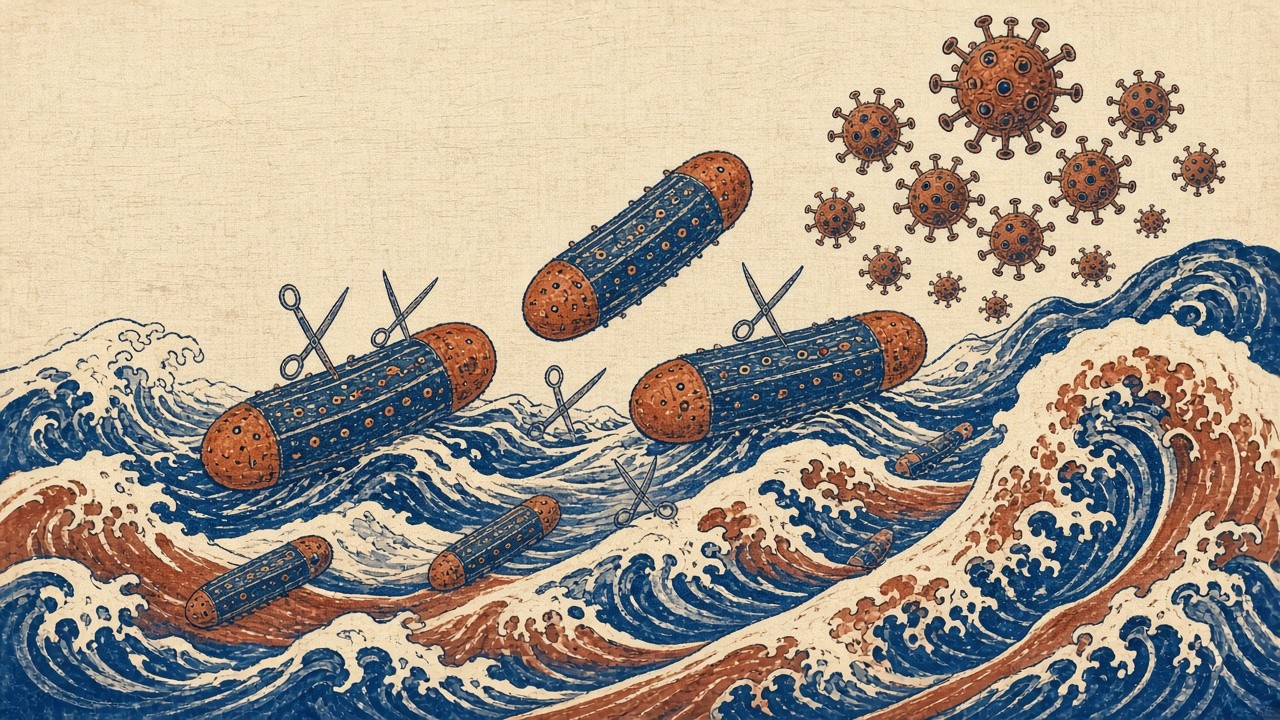
Illustration: bacteria fending off approaching viruses, the ancient fight that CRISPR evolved for.
The cut is only half the edit
Cas9 doesn’t write anything. It just breaks the DNA. The rewriting is done by the cell’s own repair systems, and the Nobel background describes the two main ones.
The first, non-homologous end joining, glues the broken ends straight back together. It’s fast but sloppy, and it usually leaves a small insertion or deletion at the break. Inside a gene, that often scrambles the reading frame so the cell can no longer make a working protein. That makes it handy when researchers want to switch a gene off and see what happens.
The second, homology-directed repair, copies from a template. If scientists supply a piece of DNA that matches both sides of the break and carries the change they want, the cell can use it to rebuild the sequence with the new version inside.
Where CRISPR is being used
In research labs, CRISPR became a basic tool for finding out what genes do. In agriculture, the Nobel summary describes rice edited to absorb less cadmium and arsenic from soil, and crops developed to better withstand drought and resist pests.
In medicine the first approvals have come. In November 2023 the UK’s Medicines and Healthcare products Regulatory Agency (MHRA) authorized Casgevy (exagamglogene autotemcel), calling it a world first, for sickle cell disease and transfusion-dependent beta thalassemia in patients 12 and older. On December 8, 2023, the US Food and Drug Administration approved Casgevy for sickle cell disease in patients 12 and up with recurrent vaso-occlusive crises, calling it the first FDA-approved treatment to use CRISPR/Cas9. On January 16, 2024, the FDA also approved it for transfusion-dependent beta thalassemia.
Casgevy doesn’t edit genes inside the body. According to the FDA, doctors collect a patient’s own blood stem cells and edit them in a lab so they make more fetal hemoglobin. The cells are then given back in a stem-cell transplant after high-dose chemotherapy clears the bone marrow. In the trial the FDA summarized, 44 patients were treated. Of the 31 followed long enough to evaluate, 29 (93.5%) went at least 12 months without severe pain crises. The most common side effects the FDA listed were low platelet and white blood cell counts, mouth sores, nausea, musculoskeletal pain, abdominal pain, vomiting, febrile neutropenia (fever with a low white blood cell count), headache and itching, and every treated patient is being followed in a long-term study. This is a summary of what regulators reported, not medical advice. Anyone with questions about a treatment should talk to a qualified clinician.
Other uses are still being studied. The Nobel summary describes clinical trials for inherited eye diseases and animal experiments that deliver Cas9 using modified viruses. MedlinePlus, from the US National Library of Medicine, lists research into conditions such as cystic fibrosis and hemophilia. None of these is an approved therapy.
What CRISPR still can’t do well
The tool has real limits. The National Human Genome Research Institute notes that genome-editing tools sometimes cut in the wrong spot, and that scientists aren’t yet sure how such off-target errors might affect patients. Getting the editor into the right cells in a living body is another open problem.
The biggest debate is about editing that’s inherited. NHGRI separates somatic editing, which affects only the person treated, from germline editing of eggs, sperm or embryos, which would pass changes to future generations. MedlinePlus notes that, because of ethics and safety concerns, germline and embryo genome editing are currently illegal in the United States and many other countries. In November 2018 the Chinese scientist He Jiankui announced the birth of twin girls whose embryos he had edited with CRISPR. Gostimskaya’s history records the international scandal that followed and his three-year prison sentence.
The basic mechanism of CRISPR-Cas9 is well established and has been confirmed in labs worldwide. What’s still being worked out is how to make editing safer and more precise, how to deliver it inside the body, and where society draws the line.
Curious how genetic tools look in a teaching lab? Odinity’s pGLO lab on bacterial transformation moves a gene into E. coli, and the lac operon lab in two E. coli strains shows how bacteria switch genes on and off. For what happens when one gene is broken, see the eyeless gene mutation study in fruit flies.