
The Thermite Reaction: How Aluminum and Rust Make Molten Iron
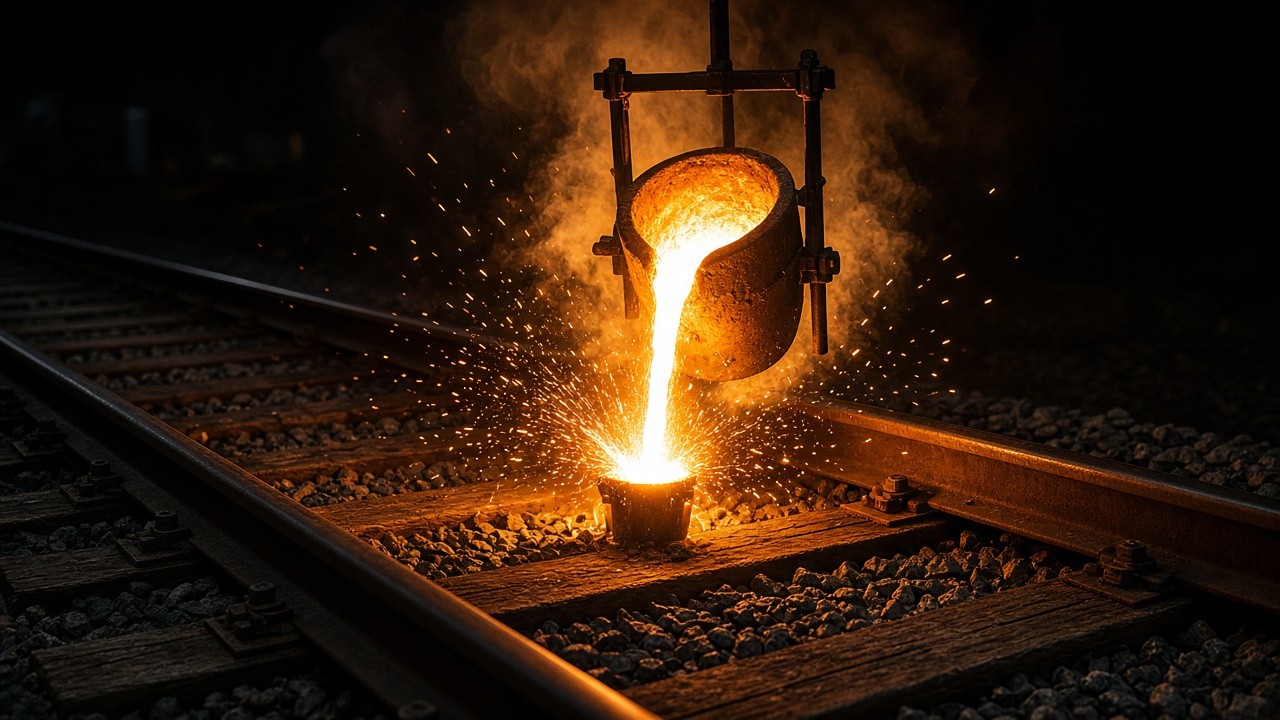
Every so often, rail workers do something that looks like a magic trick. They clamp a small crucible over the gap between two rails, light it, and a few moments later white-hot liquid iron pours down and fuses the rails into one piece. No electricity, no furnace. The heat comes from a chemical reaction between aluminum and iron oxide, which is essentially rust. That’s the thermite reaction, and it’s one of the most violently exothermic reactions in ordinary chemistry. It also has a story that runs from a German chemist’s search for pure metals to wartime firebombs and modern railways.
What the thermite reaction actually is
At its heart, thermite is a swap. Iron oxide holds oxygen. Aluminum wants oxygen even more. When the reaction gets going, as Joe Schwarcz of McGill University’s Office for Science and Society puts it, oxygen transfers from the iron oxide to the aluminum, leaving aluminum oxide and metallic iron.
Chemists call this a redox reaction. Aluminum is oxidized (it gains oxygen) while iron is reduced (it loses oxygen and goes back to being a metal). It’s the same chemistry as rusting, run backward, with aluminum doing the work.
What makes it famous is the heat. Schwarcz notes that the hottest, light-blue part of a candle flame reaches about 1,400 degrees Celsius, and the thermite reaction reaches around 2,500 degrees. Evonik, the company that grew out of the inventor’s family firm, describes the mixture generating about 3,000 degrees. Either way it’s hot enough that the iron comes out as a liquid.
Why so much heat?
The answer is in how strongly each metal holds on to oxygen, and you can see it in standard thermochemistry tables. The US National Institute of Standards and Technology (NIST) lists the standard enthalpy of formation of aluminum oxide (corundum) as about −1,675.7 kilojoules per mole. For iron(III) oxide in its hematite form, the figure is about −825.5 kilojoules per mole.
Those numbers measure how much energy is released when each oxide forms from its elements. Aluminum oxide’s is roughly twice as large. So pulling oxygen away from iron costs energy, but handing it to aluminum releases far more. By Hess’s law the difference, roughly 850 kilojoules for each mole of iron oxide that reacts, comes out as heat.
Here’s the odd part. A mixture that releases this much energy doesn’t simply go off by itself. The inventor’s own patent describes the very energetic reaction occurring once the mixture is heated “up to the point of fusion.” In energy terms, the reaction has a high activation barrier: a lot of energy must go in before any comes out. Once one spot is hot enough, the heat it releases is enough to keep the reaction moving through the rest of the material.
Hans Goldschmidt’s search for pure metal
The reaction was turned into a process by Hans Goldschmidt (1861–1923), a chemist from a family chemical business in Essen, Germany. According to McGill’s account, in 1893 he was looking for a way to make pure metals from their ores. The classic way to get iron is to heat its ore with carbon, which takes the oxygen away as carbon dioxide. But leftover carbon tends to contaminate the iron. Goldschmidt wanted a carbon-free route and found it in aluminum.
Evonik’s history describes the work the same way: Goldschmidt began studying aluminothermic reactions scientifically in 1893 to make carbon-free metals such as chromium and manganese. The Goldschmidt company dates the invention of its Thermit process to 1895, with German imperial patent no. 96317.
His US patent, US 578,868, granted in 1897, explains the problem he solved. Heating a whole batch of powdered aluminum and metal compound at once set off a reaction so energetic that material was thrown out of the crucible and wasted. His improvement was to make the reaction “set in, not throughout the whole mass at a time, but only at one point,” and let it spread from there. The patent says the method let him produce refractory metals such as chromium and manganese “in large quantities and on a commercial scale.”
Illustration: an imagined 1890s chemistry lab of the kind where aluminothermic reactions were first studied.
From tram tracks to modern rail
Goldschmidt noticed something else: the reaction made small quantities of first-class molten steel, which could join two pieces of metal end to end. According to McGill and the Goldschmidt company, the first commercial use came in 1899, welding tram tracks in Essen, the same year Goldschmidt received a patent (DRP 116400) for aluminothermic butt welding.
It solved a real problem. Evonik’s history describes how track used to be laid in short sections, at most four meters long, joined with bolted plates called fishplates. Trains rattled over every joint with the familiar “clack-clack,” and the joints were a safety hazard. By the start of the First World War, Thermit welding had become the worldwide standard for streetcar track, though the big railway companies held back until the late 1920s. Evonik says the process is still used today, and the Goldschmidt company calls it a standard procedure for welding railway and tram rails.
A darker history
Heat that welds steel can also destroy. McGill’s account recounts that Zeppelins dropped thermite-based incendiary bombs on England in 1915. By the Second World War, thermite was used to ignite incendiary bombs with magnesium-alloy casings. Schwarcz writes that the Allies dropped some 30 million four-pound thermite bombs on Germany and another 10 million on Japan. Thermite grenades were used to disable artillery by welding the breech shut.
The hazards. In the company reports to the European Chemicals Agency that PubChem aggregates, aluminum is classified H261 (in contact with water releases flammable gas, 90.8%), H228 (flammable solid, 60.6%) and H250 (catches fire spontaneously if exposed to air, 34.2%). Those figures come from 4,079 company reports; the percentages are among the 3,741 that give hazard codes. For iron(III) oxide, 402 of 457 reports (88%) say it doesn’t meet the GHS hazard criteria, and the 55 that give hazard codes list H315 (causes skin irritation) and H318 (causes serious eye damage). The reaction itself is far more dangerous than either ingredient: it produces molten iron at thousands of degrees, throws sparks and can set fire to anything nearby. This is a demonstration for trained professionals and industrial welding crews, not an experiment for home or an unsupervised lab.
What’s settled and what’s still debated
The basic chemistry is not in doubt. The oxygen swap, the energy released and the reason it’s released all follow from well-established thermochemical data. So does the history of Goldschmidt’s process and its use in rail welding.
What varies is the detail. Published temperature figures differ from source to source, from about 2,500 to 3,000 degrees Celsius in the two accounts used here. The real figure depends on the exact mixture, how much heat escapes, and whether the products boil or melt. Treat any single number as approximate.
Thermite also shows up in conspiracy theories. Schwarcz mentions claims that thermite brought down the World Trade Center towers and lists them alongside claims that the moon landing was faked. Nothing in the chemistry described here supports those theories.
Want to see how chemists measure reaction heat in a safer setting? Odinity’s calorimetry lab on the enthalpy of hydration measures the heat of a much gentler reaction. The bomb calorimetry lab on biodiesel measures the energy content of a fuel. And for what heat does to metal once it’s made, see the annealing lab on heat treatment.