
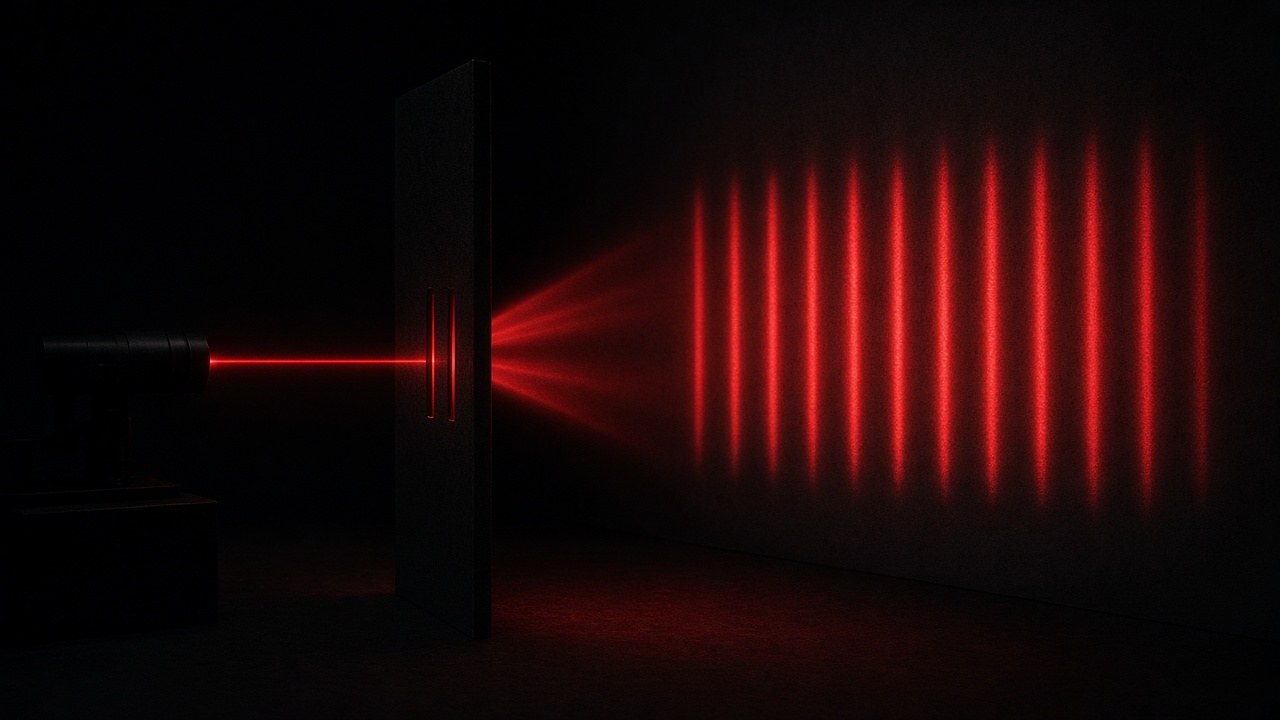
The Double Slit Experiment: How Light Showed It Is a Wave and Then Some
Fire electrons one at a time at a barrier with two narrow openings, and record where each one lands. Every electron arrives as a single dot, like a tiny bullet. Keep going, and the dots slowly build up a pattern of bright and dark stripes that only waves should make. That’s the double slit experiment. It began more than 200 years ago as a demonstration that light is a wave, and it became what Richard Feynman called a phenomenon with “the heart of quantum mechanics” in it.
Thomas Young and the waves of light
Feynman summed up the long argument over light in his lectures: “Newton thought that light was made up of particles, but then it was discovered that it behaves like a wave.”
A key part of that discovery came from Thomas Young. According to Physics World, Young carried out his original double-slit experiment with light “some time in the first decade of the 1800s.” He showed that light from two slits interfered to produce a characteristic pattern of fringes on a screen. The date is fuzzier than textbooks suggest. The experiment is widely dated to 1801, but Physics World notes that Young didn’t publish an account of it until his Lectures on Natural Philosophy in 1807.
Young was confident from the start. In his 1803 Bakerian Lecture to the Royal Society, he described finding “so simple and so demonstrative a proof of the general law of the interference of two portions of light” that he thought it right to lay “a short statement of the facts” before the Society.
How interference makes stripes
Feynman’s lectures explain the effect with water waves in a shallow trough. A wave hits a wall with two holes, and a new circular wave spreads out from each hole. Where the two waves overlap, they combine.
- Constructive interference: where the waves arrive “in phase,” their peaks add up to a big wave. This happens wherever the distance to one hole is a whole number of wavelengths longer or shorter than the distance to the other.
- Destructive interference: where the waves arrive “out of phase,” one wave’s peak meets the other’s trough, and they largely cancel. This happens wherever the two distances differ by an odd number of half-wavelengths.
The result is a row of strong and weak spots, the fringes. The key point is that the pattern with both holes open is not the sum of the patterns from each hole alone. Feynman contrasts this with imaginary indestructible bullets fired through the same two holes. Bullets arrive in lumps, and their two-hole pattern is just the one-hole patterns added together, with “no interference.”
Because the stripes depend on wavelength, the spacing of the fringes carries information about the wave that made them. The same principle lets physicists and crystallographers read structure from diffraction patterns. Odinity’s lab on diffraction patterns from polystyrene beads and breath figures shows how. There, a helium-neon laser’s light, scattered by tiny beads, produces diffraction patterns. The report explains such patterns, in its X-ray background, as waves that “interfere with each other constructively and destructively.”
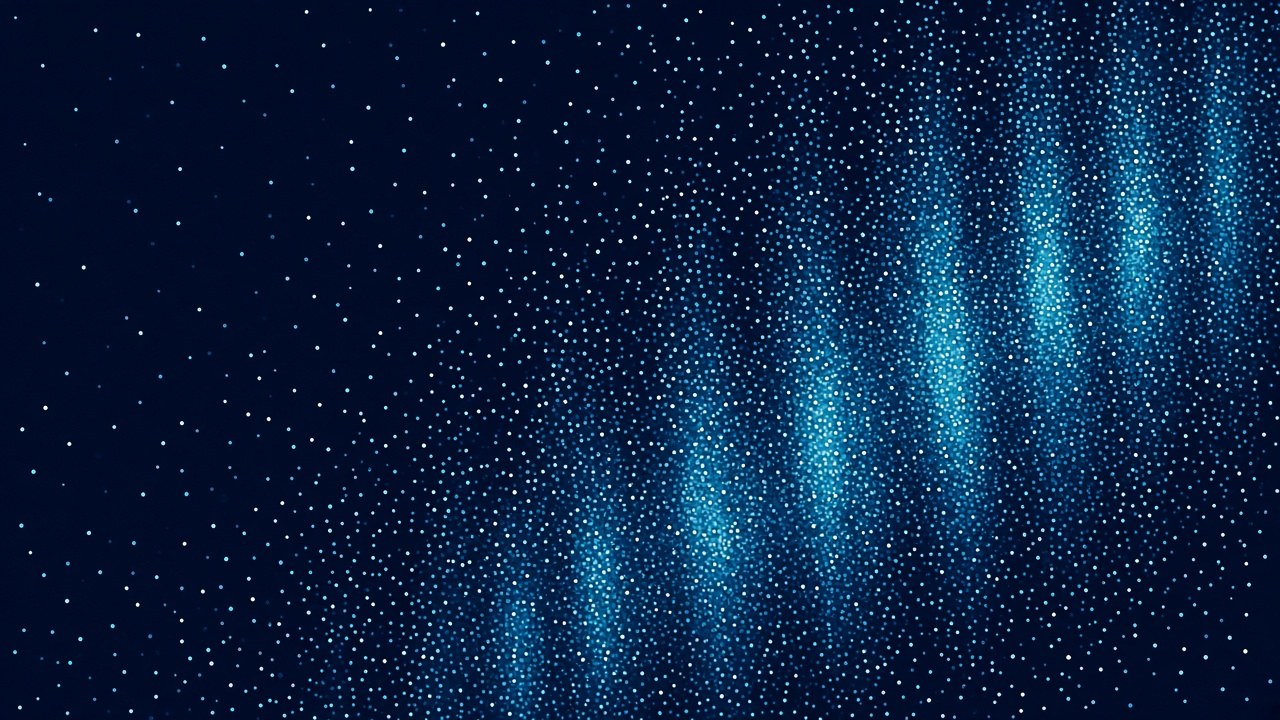
Illustration: single dots that gather into stripes, the way single electrons build up an interference pattern.
Then the double slit experiment met quantum physics
Things got strange in the 20th century. Physics World traces the steps:
- 1909: G. I. Taylor showed that even the feeblest light, equivalent to “a candle burning at a distance slightly exceeding a mile,” still produced interference fringes. That led to Dirac’s famous statement that “each photon then interferes only with itself.”
- 1927: Clinton Davisson and Lester Germer saw electron beams diffract from a nickel crystal, the first demonstration that particles can behave like waves.
- 1961: Claus Jönsson of the University of Tübingen performed the first actual double-slit experiment with electrons, demonstrating interference with up to five slits. It was published in German and stayed little known. When an English translation appeared in 1974, the editors of the American Journal of Physics called it a “great experiment” but noted there are “few professional rewards” for such work.
- The 1970s: Pier Giorgio Merli, GianFranco Missiroli and Giulio Pozzi in Bologna ran double-slit experiments with single electrons. A letter in Physics World argues this was the first such experiment, in 1974.
- 1989: Akira Tonomura and colleagues at Hitachi filmed the pattern building up from single electrons.
Hitachi’s own account describes what the team saw. Electrons were emitted one by one and passed on either side of a filament thinner than a thousandth of a millimeter, which acts like a double slit. At first, bright dots appeared “here and there at random positions,” and each dot was a single electron detected as a particle. Only about 10 electrons were emitted per second, so there was never more than one in the microscope at a time. After 20 minutes, clear interference fringes had formed, made up entirely of individual dots.
Feynman put the conclusion simply: “The electrons arrive in lumps, like particles, and the probability of arrival of these lumps is distributed like the distribution of intensity of a wave.” Tonomura’s team noted in their paper that such an experiment “has been regarded as a pure thought experiment that can never be realized.” Since then, Physics World adds, particle interference has been shown with neutrons, atoms and molecules as large as carbon-60 and carbon-70.
What happens when you watch
If each electron arrives as a lump, surely it goes through one slit or the other? Feynman tests the idea with a thought experiment. Shine light near the slits, so each passing electron gives off a flash that shows which hole it used.
In his account, every electron is seen at one hole or the other, never both. But once you can tell which way the electrons went, the stripes vanish, and the pattern becomes the plain sum of two single-slit patterns. Make the light gentle enough that you can no longer tell which hole was used, and the interference returns. Feynman’s general rule: if an experiment can determine which alternative actually happened, “the interference is lost.”
Feynman ties this to Heisenberg’s uncertainty principle. In his words, “It is impossible to design an apparatus to determine which hole the electron passes through, that will not at the same time disturb the electrons enough to destroy the interference pattern.”
What’s settled and what’s still a mystery
Settled by experiment:
- Light makes interference fringes, as Young showed.
- Electrons, neutrons, atoms and even large molecules do too.
- Single particles arrive one at a time as dots and still build the pattern.
- Quantum mechanics predicts these patterns, with probability amplitudes that add like waves.
Still debated:
- What’s really going on. Feynman wrote that “no one has found any machinery behind the law.” He also said that even experts “do not understand it the way they would like to.” Physicists have proposed several interpretations of what the mathematics means. These are interpretations, not settled results.
- Who did it first. Physics World notes that the single-electron experiment, voted the most beautiful in physics by its readers in 2002, “does not have a name associated with it.” Letters the magazine published in 2003 show that credit was disputed between the Bologna and Hitachi groups.
Feynman told his students not to try to set up the electron version, because the apparatus would have to be made “on an impossibly small scale.” As it turned out, the experiment was possible after all, and it works the way he described.