
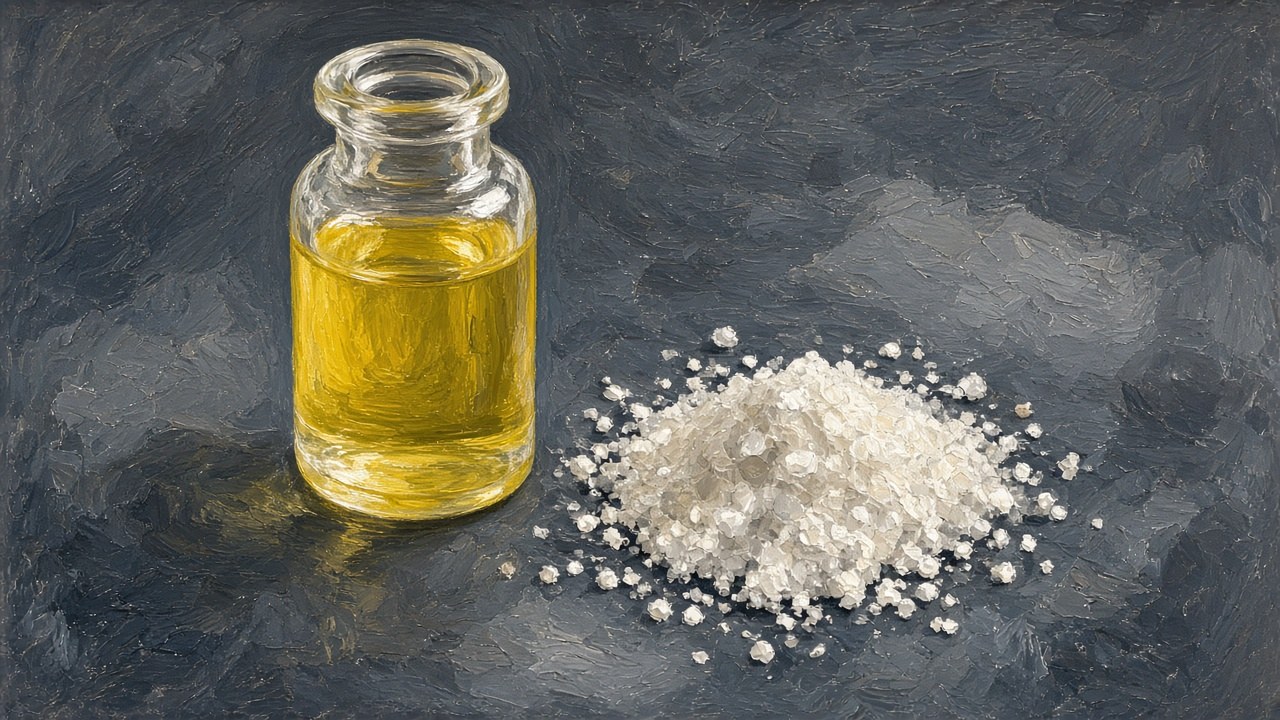
Triphenylmethanol: Three Rings, One Carbon and a Very Stable Cation
Take one carbon atom, bolt three benzene rings onto it, and add a single OH group. The result, triphenylmethanol, is an unremarkable-looking white powder. Drop it into concentrated sulfuric acid, though, and it dissolves to give a bright yellow solution. That colour change helped chemists realise, more than a century ago, that a positively charged carbon could be stable enough to sit in a flask. The same crowded molecule also sits at the root of the first organic free radical and of a protecting group still used to build DNA.
What triphenylmethanol is
Triphenylmethanol, also called triphenylcarbinol or trityl alcohol, has the formula C19H16O and a molar mass of about 260.3 g/mol, according to PubChem. Structurally it is methanol with all three hydrogens on carbon replaced by phenyl rings: a central carbon bonded to three C6H5 groups and one hydroxyl. That makes it a tertiary alcohol, and a very bulky one. The three rings crowd around the central carbon, and that crowding shapes almost everything interesting about the compound.
The physical facts are fairly plain:
- Appearance: PubChem lists it as a white to cream crystalline powder.
- Melting point: about 160–163 °C. The NIST Chemistry WebBook compiles literature values between 433.65 and 435.6 K, roughly 160.5 to 162.5 °C. One much lower 1931 value is an outlier.
- Boiling point: NIST lists 633 K (about 360 °C), taken from a 1990 Aldrich chemical catalogue, with no measurement method listed.
- Water solubility: essentially none. A University of Minnesota exam key describes it as insoluble in water.
That well-known melting point is handy in teaching labs: a student who makes the compound can check the purity of their crystals against a well-known value. In one Odinity report on making triphenylmethanol from benzophenone and bromobenzene, the purified product melted at 160–163.2 °C against a 162 °C standard.
Why it is a classic Grignard product
Triphenylmethanol is one of the standard products of the Grignard reaction in undergraduate organic chemistry. In outline, phenylmagnesium bromide (made from bromobenzene and magnesium) adds to the carbonyl carbon of benzophenone, or twice over to the ester methyl benzoate. A final acid step then gives the alcohol. The lesson is carbon–carbon bond formation. As the student in Odinity’s Grignard synthesis of benzoic acid and triphenylmethanol report put it, the lab “is centered around the addition of carbons to a compound.” The product is a solid with a sharp melting point and a clear O–H stretch in the infrared, so success is easy to confirm.
The other lesson is about water. Grignard reagents react readily with water, so as Odinity’s Grignard reaction to prepare triphenylmethanol report explains, glassware is dried and the reaction is run in anhydrous diethyl ether.
A note on that solvent: PubChem’s hazard data classify diethyl ether as an extremely flammable liquid and vapour (GHS hazard statement H224). It boils at about 34.6 °C and has a closed-cup flash point of about −45 °C. Its vapour is roughly 2.6 times denser than air and, according to the CAMEO Chemicals entry in PubChem, “may travel considerable distance to a source of ignition and flash back.” This is why ether work is done in a fume hood away from flames and sparks. The same Odinity report notes that the hazards of handling large volumes of ether count against Grignard reactions at industrial scale.
The trityl cation: a carbocation you can see
Most carbocations are fleeting intermediates. The triphenylmethyl, or trityl, cation is the exception that got the field started. In his 1994 Nobel lecture, George Olah recounted that in 1901 James Norris and Friedrich Kehrmann independently found that “colorless triphenylmethyl alcohol gave deep yellow solutions in concentrated sulfuric acid.” Adolf von Baeyer recognised the salt-like character of what had formed in 1902. He also linked the appearance of colour to salt formation, a phenomenon he called halochromy.
What happens is straightforward in outline. Strong acid protonates the OH group, which leaves as water, and what remains is Ph3C+. The University of Minnesota key describes the reverse as well. Dilute the yellow solution with water and the equilibrium shifts back: the colour disappears and neutral triphenylmethanol precipitates.
Why is this cation so tolerable? Resonance. Lecture notes from the University of Basrah explain that the positive charge on the central carbon is spread over many resonance structures, because the π systems of the three phenyl rings can share it. In each ring, the same benzyl-type delocalisation that Michigan State’s online organic text describes for the related radical puts the charge on the ortho and para carbons, not the meta ones. Spreading a charge over many atoms lowers its energy.
There is a catch. The molecule cannot lie flat, because hydrogens on neighbouring rings bump into each other. The rings twist into a three-bladed propeller. The Basrah notes point out that this makes the π overlap imperfect. Michigan State’s text gives a figure for the radical: the rings turn by about 35°, but p-orbital overlap stays above 80%, so delocalisation is not seriously diminished.
Illustration of a propeller-like arrangement around a central point, evoking the twisted rings of the trityl ion (artist’s impression).
The trityl group as a protecting group
The stability of the trityl cation has a practical payoff. Chemists often need to temporarily mask an OH group while they work on another part of a molecule. Converting it to a trityl ether (R–O–CPh3) is one standard way.
A University of Houston teaching handout summarises the trityl group’s profile:
- It goes on with trityl chloride in pyridine.
- It is stable to base.
- It comes off with mild acid such as formic or acetic acid.
- Its steric bulk “allows for good selectivity in protecting primary over secondary alcohols.”
The easy acid removal ties back to the cation chemistry above: in acid, the bond to oxygen can let go because the trityl cation it leaves behind is so well stabilised.
A variant with two methoxy groups on the rings, dimethoxytrityl (DMT), is removed by weak acid. Roberts and Caserio’s textbook, hosted on LibreTexts, notes that DMT is widely used to protect the 5′-hydroxy group of nucleosides, particularly in oligonucleotide synthesis. A 2016 paper in Tetrahedron Letters by Shahsavari and colleagues turns the chemistry around. It generates tritylium trifluoroacetate directly from trityl alcohols and trifluoroacetic anhydride, then uses it to tritylate secondary alcohols without expensive silver salts.
Gomberg’s radical, briefly
The trityl story has a third chapter. In 1900, Moses Gomberg at the University of Michigan was trying to make hexaphenylethane, two trityl units joined together. According to the American Chemical Society, which designated the work a National Historic Chemical Landmark, he treated triphenylmethyl chloride with zinc under carbon dioxide and got a yellow solution. The solid left behind oxidised rapidly in air and reacted readily with iodine.
Gomberg concluded that he had made triphenylmethyl, Ph3C•, a carbon with only three bonds and an unpaired electron. He reported it in the Journal of the American Chemical Society as “An Instance of Trivalent Carbon.” The ACS notes the claim stayed in dispute for nearly a decade. Michigan State’s text adds a twist: the dimer in equilibrium with the radical turned out, more than fifty years later, not to be hexaphenylethane at all. It is a para-coupled compound, because the central carbons are too crowded to bond to each other. Gomberg had identified the peroxide formed in air by reducing it to a known compound: triphenylmethanol.
What is settled and what is still subtle
The basics are textbook-settled:
- the structure and formula
- a melting point near 160–162 °C
- its formation from Grignard reagents
- its ionisation in strong acid to a coloured, resonance-stabilised cation
- the trityl group’s role as an acid-removable protecting group
- Gomberg’s radical as the first persistent organic free radical
The finer points are where care is needed. “Delocalised over the rings” is a good picture, but the propeller twist means the rings do not share the charge perfectly, and resonance drawings exaggerate how flat the ion is. Even the trityl dimer, which chemists drew wrongly for more than half a century, shows how this small molecule kept surprising the people who studied it.