
Acetic Acid pH: How to Calculate It and When the Shortcut Fails
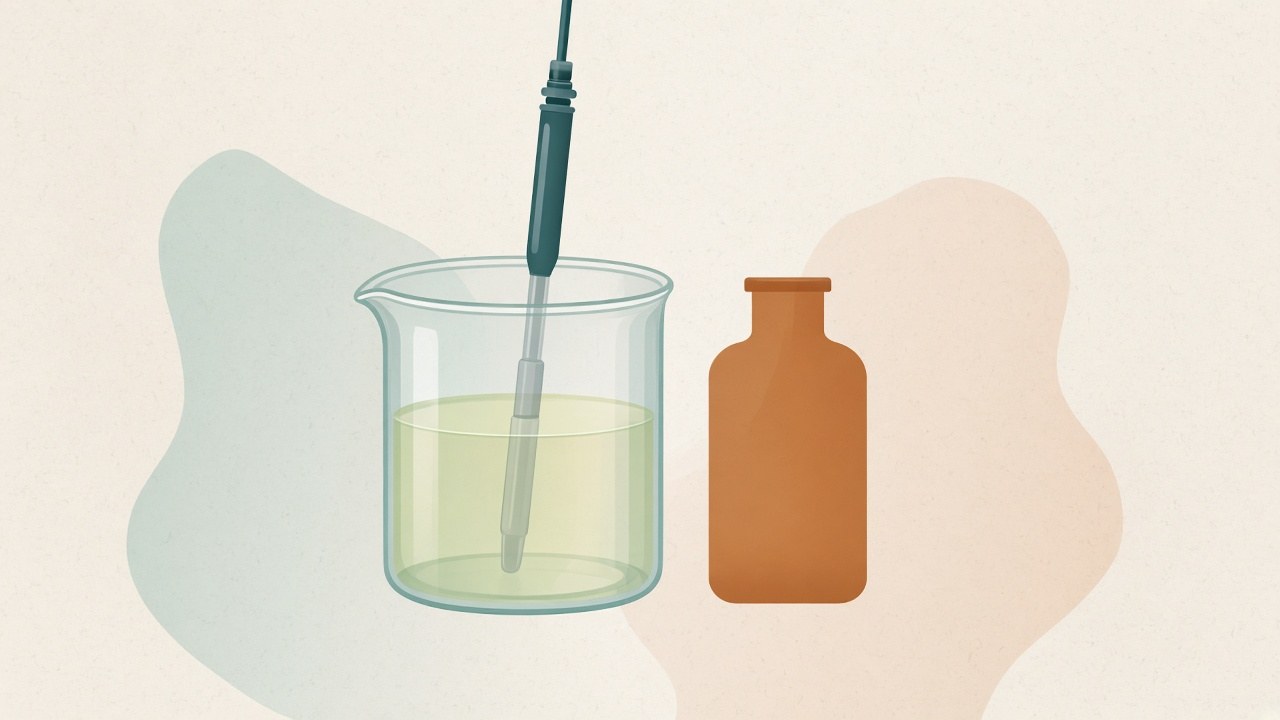
Pour a little vinegar into a beaker, dip in a pH meter, and the reading lands well below 7, but nowhere near the pH of a strong acid at the same strength. The reason is that acetic acid gives up only a small share of its protons. Working out acetic acid pH comes down to one equilibrium constant, a bit of algebra, and knowing when the usual shortcut stops working.
Why acetic acid is a weak acid
In water, acetic acid (CH3COOH) hands a proton to water and becomes acetate:
CH3COOH + H2O ⇌ H3O+ + CH3COO−
The reaction reaches a balance long before all the acid has reacted. The acid dissociation constant, Ka, describes that balance:
Ka = [H3O+][CH3COO−] / [CH3COOH]
Chemists usually quote the negative logarithm, pKa. The PubChem record for acetic acid lists a pKa of 4.76 at 25 °C, taken from the Hazardous Substances Data Bank. That works out to Ka ≈ 1.74 × 10⁻⁵. Textbooks often round it to 1.8 × 10⁻⁵. A small Ka means most of the acid stays as intact molecules. That predictability makes it a lab workhorse, from titrations to Odinity’s adsorption of aqueous acetic acid experiment on charcoal.
How to calculate acetic acid pH: a worked example
Take 0.10 mol/L acetic acid at 25 °C. Call the amount that dissociates x, so [H3O+] = [CH3COO−] = x and the remaining acid is 0.10 − x. (LibreTexts’ Chem1 text notes that water’s own contribution is negligible “in all but the most dilute solutions.”)
1.74 × 10−5 = x2 / (0.10 − x)
The shortcut. If x is tiny next to 0.10, drop it from the bottom of the fraction. Then x2 ≈ Ka × C, and x ≈ √(1.74 × 10⁻⁶) ≈ 1.32 × 10⁻³ mol/L. The pH is −log(1.32 × 10⁻³) ≈ 2.88.
The check. Is 1.32 × 10⁻³ really small next to 0.10? It’s about 1.3% of it. The Chem1 text calls the usual test the “five percent rule”: if the first estimate of x is more than 5% of the number it was subtracted from, the shortcut isn’t justified. At 1.3% we pass easily. Solving the full quadratic gives the same pH to two decimal places, 2.88.
That 1.3% is also the percent ionization, about one molecule in 75. A LibreTexts exercise gets the same 1.3% for 0.100 M acetic acid.
When the square-root approximation fails
The shortcut [H3O+] ≈ √(KaC) works when most of the acid stays undissociated. The Chem1 text says this usually means concentrations above about 10−3 M. Another LibreTexts page uses “more than 100 times Ka.”
Here is what happens as you dilute, using pKa 4.76 (my own calculations, rounded):
- 0.10 M: shortcut pH 2.88, quadratic 2.88, about 1.3% ionized
- 0.010 M: shortcut 3.38, quadratic 3.39, about 4% ionized; just inside the 5% rule
- 0.0010 M: shortcut 3.88, quadratic 3.91, about 12% ionized; the rule now says use the quadratic
- 0.00010 M: shortcut 4.38, quadratic 4.47, about 34% ionized
The pH gaps look small, but pH is logarithmic. At 0.00010 M the shortcut overstates [H3O+] by roughly 23%. The quadratic solution, x = [−Ka + √(Ka2 + 4KaC)] / 2, takes one spreadsheet cell.
What dilution does to acetic acid
Each tenfold dilution raises the pH by only about half a unit, not the full unit a strong acid would show, because the fraction ionized climbs. The Averill text on LibreTexts puts it plainly: a weak acid’s percent ionization “actually increases as its analytical concentration decreases.” The Chem1 text calls this the Ostwald dilution law and treats it as an entropy effect rather than a Le Chatelier one, since dilution lowers [HA] as well as the ions.
There is also a floor. Diluting an acid raises the pH, as one LibreTexts page says, “but you can not raise it above 7, the value of neutral water.”
Illustration of a row of vials evoking a dilution series (artist’s impression).
Vinegar: a familiar acetic acid solution
The US Food and Drug Administration has no formal standard of identity for vinegar, but its Compliance Policy Guide Sec. 525.825 says each listed variety “should contain 4 grams of acetic acid per 100 mL,” measured at 20 °C. When vinegar is diluted with water, the label should state the acid strength, and “in no case should it be less than 4 percent.”
With PubChem’s molar mass of 60.05 g/mol, 4 g per 100 mL is roughly 0.67 mol/L, and the shortcut gives a calculated pH near 2.5. That is a textbook estimate, not a prediction for any bottle. FDA’s CPG Sec. 562.100 notes that distilled vinegar “contains a number of volatile materials not present in dilute acetic acid,” and activity effects (below) also matter at this strength. Odinity’s acetic acid content of vinegar report shows how a lab measures the acid itself, by indicator and by pH-meter titration.
Acetate buffers and the Henderson-Hasselbalch equation
Add sodium acetate and you have a buffer. Rearranging the Ka expression gives the Henderson-Hasselbalch equation, as in LibreTexts’ buffer chapter:
pH = pKa + log([CH3COO−] / [CH3COOH])
When acid and acetate are equal, the log term is zero and pH = pKa, about 4.76. Every tenfold change in the ratio moves the pH by one unit. That is why the pH halfway to a weak-acid titration’s equivalence point estimates pKa. In Odinity’s unknown acid titration report, students read pH 4.3 at half the endpoint volume and compared it with a handout value of 4.79, a reminder that real readings drift from tables.
The same chapter notes buffers “usually have a pH that is within ±1 pH units of the pKa,” and more concentrated buffers have greater capacity. You can see this in Odinity’s Le Chatelier’s principle and buffers lab, where acetic acid–acetate wells barely moved when strong acid or base was added, while unbuffered wells changed sharply.
Measured vs calculated pH
Every calculation above uses concentrations, but the IUPAC 2002 recommendations on measurement of pH define it through the hydrogen-ion activity, pH = −lg aH. That single-ion activity is “immeasurable by any thermodynamically valid method,” so pH scales rest on a convention and standard buffers.
Activity is concentration times an activity coefficient, which, as Harvey’s Analytical Chemistry 2.1 explains, approaches 1 only as ionic strength approaches zero. A 2020 article by Michael Hippler and George Metcalfe in Bunsen-Magazin found that, for a phosphate buffer, plain Henderson-Hasselbalch gave a pH “consistently 0.4 too high” compared with a pH meter. The authors argue that activities should be used once ionic strength exceeds 0.005 M.
Acetate shows a smaller version of the same thing. The IUPAC report lists a 0.1 mol/dm³ acetic acid plus 0.1 mol/dm³ sodium acetate solution as a secondary pH standard. Its 25 °C values (4.65 and 4.72 in two table entries) both sit below the 4.76 that the simple equation predicts for equal amounts.
The meter has limits too. IUPAC lists glass-electrode slopes below the theoretical value, drift and memory effects, strong temperature dependence, and shifting liquid-junction potentials. For most work it describes two-point calibration with two standard buffers bracketing the sample, with a target uncertainty of 0.02–0.03 pH units at 25 °C.
What’s settled and what’s a rule of thumb
Settled:
- Acetic acid is a weak, monoprotic acid with a pKa of about 4.76 at 25 °C.
- Its pH follows from the Ka equilibrium.
- Its percent ionization rises as it is diluted.
- pH is formally defined by hydrogen-ion activity, not concentration.
Rules of thumb:
- the 5% test for dropping x
- the “concentration above 10−3 M” and “100 times Ka” guides
- the ±1 pH unit buffer range
- treating concentration as activity
When calculated and measured pH differ by a tenth or two, non-ideal solutions and meter limits are the usual suspects, not the arithmetic.
Safety note: concentrated (glacial) acetic acid is far more hazardous than vinegar. Of the 5,076 company reports to the European Chemicals Agency that PubChem aggregates (from 68 notifications), acetic acid is classified H226, flammable liquid and vapor (99.7%); H314, causes severe skin burns and eye damage (>99.9%); and H318, causes serious eye damage (14.7%).